Celluloid Saturday at Widescreen Weekend 2017

Widescreen Weekend – Celluloid Saturday
Saturday October 14th, 2017
National Media Museum, Bradford
The annual Widescreen Weekend festival reaches its 21st birthday this year – for 21 years the festival has expanded and evolved, shifted and reformed, however its focus has always stayed the same; to celebrate the past, present and future of widescreen film and cinema technology.
At the festival we showcase the best in cinema experiences by presenting a variety of formats – glorious 70mm screenings, new 4k restorations, 35mm archive prints and original 3 strip Cinerama (with our Pictureville cinema being 1 of only 3 venues in the world that can show this format).
Sharing our passion with our audiences is what the festival is all about and we always hope to remind people why going to the movies is so magical.
However recently, we’ve taken on a new challenge.
The sourcing and projecting of celluloid films has become increasingly difficult, and therefore it has become more important to champion celluloid film and allow screenings to become more accessible.
Thankfully, we are not alone in this, and directors such as Christopher Nolan (who shot his latest film Dunkirk on a mix of 65mm and IMAX cameras) and Quentin Tarantino (whose film The Hateful Eight was the widest release in 70mm film since the 90’s) are presenting film exhibiters with new content and slowly reviving celluloid film.
Our contribution? May we present Celluloid Saturday.
This year, as part of Widescreen Weekend’s 2017 programme we are dedicating our Saturday screenings and events to celluloid and guaranteeing that all films are presented on photochemical film.
We have also collaborated with freelance programmers and film societies who share our passion for championing celluloid film. Rebecca Nicole Williams (aka The Celluloid Sorceress) presents a 30th Anniversary screening of The Untouchables on 70mm, and Cigarette Burns Cinema (London’s leading independent programmer, catering to fans of leftfield and classic horror) brings us Suspiria on 35mm.
So step into the revival of celluloid, and indulge in a day of fantastic, photochemical screenings –
www.scienceandmediamuseum.org.uk/whats-on/celluloid-saturday
Celluloid Saturday Day Pass (£35/£30 conc.) on sale now
A Ghost Story

2017 – USA
Director: David Lowery
Starring: Casey Affleck, Rooney Mara, Will Oldham
Words: Josh Senior
A Ghost Story is one of those gems in a calendar year, an independent release that gets the promotion it deserves. It really does, David Lowery’s latest film is one of the most important to be released in 2017, and that’s an understatement.
Lowery has had an accelerated if odd trajectory to reach his current acclaim as a director, first really coming to attention with his 2013 proto-western Ain’t Them Bodies Saints which also featured Affleck and Mara. Then he followed this up by directing the live-action Pete’s Dragon for Disney, which (speaking as the parent of a young child) really stands out in the plethora of children’s movies released in the last three years. From indie darling, to a big studio safe pair of hands, Lowery is now working in unfamiliar waters once again, tasked with delivering a third film that differs from his previous efforts. He does so with A Ghost Story, a daintily beautiful snapshot of life, love and reality.
In its basic essence, the film follows a young couple C and M (Affleck & Mara), who are living somewhere in a cosy Texas suburb. When tragedy strikes and Affleck’s character suddenly dies, he remains trapped in-between life and death as a ghost, literally a white sheet with holes for eyes, and must watch as his wife deals with her grief and then attempts to move on with her life, leaving him behind. He then lingers on in the house he used to call home and has to live alongside the future tenants as months, years and even decades roll by with no halt for the merciless roll of time.
Lowery is attempting to tackle the biggest of themes with this work in taking a bite out of mortality and the reason for existence, which at once sounds incredibly pretentious. However, his handling of the subject matter is done in such an oddly satisfying manner that this never comes across as anything other than impressive. The film is put together in a rather unconventional way with long takes of seemingly banal situations, shot in a boxy 1.33:1 aspect ratio, with rounded corners softening the frame, or random moments of quiet, and it engrosses you completely. Two standout scenes being a long take of the characters (pre-death) as they lie in bed and share a sleep hazed embrace, which feels so real it’s a testament to their talents as actors, you almost feel like you shouldn’t be watching, as it’s such a pure moment. The second is a 5-minute take of Rooney Mara sitting on the floor and crying while she eats a pie (post-death) as the ghost lingers in the background. You can’t take your eyes off it, not for one second.
Daniel Hart also crafts a luscious mood-board of sound which flits in and out almost seamlessly to add a real aura around the narrative events. Lowery introduces his characters as struggling musicians, and so the music comes from diegetic origins and then transcends into the surreal, as we move from life to death and back round again, losing track of where the narrative really began and where we are.
There is a common theme in Lowery’s films of two people trying to get back to each other and their journeys in doing so. In Ain’t Them Bodies Saints Bob Muldoon escapes prison after not seeing his wife, Ruth, for several years in a desperate bid to be re-united with her, and faces a battle of epic proportions in doing so. The question in that story is whether Ruth is still in the same place as Bob emotionally when they do eventually meet. Pete’s Dragon, similarly deals with a young boy trying to escape back into the woods where he has lived with his pet dragon for years after the death of his parents, the duality of this film is the moral question of living outside of society and because it’s a Disney film it does manage to find a satisfactory answer to this question, inevitably.
A Ghost Story is almost the spiritual third entry into this trilogy of films, charting a man’s journey to return to the thing he loves. All three question the viewer, whether returning to where the characters start is the best thing for them in the long run.
To put it simply, this film is, and will be considered one of the best films of the year when we look back in six months or so. To experience it in a cinema is a real delight and if you haven’t already it’s the perfect chance to immerse yourself in the works of a director who is going from strength to strength.
Up next Lowery will bring us The Old Man and The Gun, a western starring Robert Redford and he is also slated as the director for Disney’s live-action reboot of Peter Pan. It will be interesting to see how he transplants his overarching theme onto both of these, and I for one cannot wait.
The Thing and Big Trouble In Little China

1982 & 1986
Director: John Carpenter
Starring: Kurt Russell
Words: Oliver Innocent
A veritable titan of horror, John Carpenter is perhaps the most revered of the filmmakers to emerge during that golden period of genre-defining horror films in the 1970s.
Carpenter’s films are amongst the most fondly-remembered of the era, due in large to his love of classical Hollywood storytelling. Indeed, while contemporaries like Tobe Hooper (The Texas Chainsaw Massacre) sought to assault the viewer with sickening imagery and deliberately confrontational filmmaking techniques, all Carpenter wanted to do was scare you. Where The Texas Chain Saw Massacre mounted an all-out assault on the senses, Carpenter’s Halloween was pure entertainment, its aim simply to shout “boo!” and make you jump.
The release of The Thing in 1982 marked something of a change in direction.
Still obviously influenced by classical Hollywood cinema, it nevertheless sees Carpenter moving away from the funhouse scares of Halloween towards a more refined, unnerving brand of terror. This shift in direction is most evident when comparing the monsters in both films. In Halloween the threat is tangible and unquestionable, a man in a white mask. The question of what the threat is in The Thing is a lot less clear. Sure, it’s an alien from outer space, but the fact that it can assimilate and perfectly imitate any of the characters means that you are always guessing who the titular Thing actually is. The real terror is not the Thing itself, but the constant unsettling niggling in the back of your mind that anyone could be the Thing, that none of these characters can be trusted. Even Kurt Russell’s cool, resourceful MacReady succumbs to the overwhelming paranoia, and by the end we are not sure whether even he is still human.
The Thing also impresses with its creepy, unnerving atmosphere.
Carpenter establishes this from the outset as he introduces us to a microcosm cut off from the rest of the world, surrounded by the bleak, blank Antarctic whiteness where any attempt at escape would almost certainly spell death. This is cemented in the sequence exploring the deserted Norwegian camp as Carpenter ratchets up the tension with the twisted bodies suggesting the true horrors to come. When those horrors do come, they do not disappoint. The practical creature effects work courtesy of effects legend Rob Bottin is simply outstanding, putting most modern CGI to shame. Round this off with an excellent ensemble cast and maestro Ennio Morricone’s eerie, pulsing electronic score, and you have what is arguably Carpenter’s masterwork.
This makes it all the more disappointing that the film bombed so badly at the box office and was attacked so viciously by critics.
The fact that it was released two weeks after Spielberg’s huge box office hit E.T. may be the reason it performed so poorly, its downbeat tone and monstrous alien completely at odds with audiences’ love of Spielberg’s friendly extraterrestrial. As if this wasn’t enough, it was also released the same day as Ridley Scott’s Blade Runner, another sci-fi classic.
Thankfully, in recent years The Thing has gone on to attain cult status, having undergone a complete critical re-assessment. Now widely seen as a sci-fi horror classic, it has spawned video and board games, action figures, and even a prequel film.
In stark contrast to The Thing’s grim, insular intensity is another of Carpenter’s box office failures, 1986’s blockbuster attempt, Big Trouble in Little China.
The director’s shot at the big time, Big Trouble is Carpenter’s one and only stab at an ‘80s genre-blender in the vein of mega hit comedy/horror/fantasy crossovers like Ghostbusters and Gremlins. For the most part the film succeeds in its intent to deliver pure popcorn entertainment. It is ironic then, that it was never the hit it deserved to be upon its initial release. It could be that the film can never decide exactly what it wants to be, having started out as a Western set in the 19th Century but then modernised when Carpenter, who had always wanted to make a kung fu movie, came onboard. Perhaps there was just too much going on, the film’s strange cocktail of comedy, action, horror, fantasy, romance, kung fu, Chinese mysticism and buddy movie proving too much to palate.
However, like The Thing, it has also gone on to acquire a cult following.
It wouldn’t be exaggerating to say that much of the fandom surrounding it can be attributed to the inimitable Kurt Russell’s standout performance as the exaggeratedly all-American Jack Burton. One of many Carpenter/Russell collaborations, a working relationship similar to that of Scorsese and De Niro, Big Trouble, it could be argued, sees them at their most comfortable together, Carpenter allowing his star to let loose and really flex his comedy chops. This makes for one of Russell’s greatest performances as he does his best John Wayne impression (having already perfected Clint Eastwood as the brooding Snake Plissken in Carpenter’s Escape from New York) while spouting hilarious one-liners (“It’s all in the reflexes!”). It also sees him playing against type, much of the film’s comedy coming from him being such an incompetent fool who bulldozers his way through life with complete ignorance. He has not got a clue what is going on, knocks himself out by shooting up at a ceiling, and walks into a fight with lipstick all over his face, yet he still manages to destroy evil through pure reflex.
No wonder he’s become one of Russell’s best-loved characters.
Big Trouble’s status as a beloved cult classic can also ironically be put down to what may have turned audiences off initially; namely its hotchpotch of seemingly mismatched genres. The film’s refusal to adhere to a single genre or style makes for a decidedly hyperactive viewing experience, leaving little time for boredom as it flits between scenes of martial arts, slapstick comedy, Hitchcockian suspense and fantasy monster madness.
Brimming with imagination, its tongue firmly planted in its cheek, Big Trouble is quite possibly Carpenter’s most unique, thoroughly enjoyable offering, a film truly deserved of its cult reappraisal.
To celebrate the 35th anniversary of The Thing, and the cult collaboration of John Carpenter and Kurt Russell, we will be holding a double-bill back-to-back screening of The Thing and Big Trouble In Little China at Sheffield’s Abbeydale Picture House, more details can be found here – bit.ly/2tMjjVo
Shin Godzilla

2017 – Japan
Directed by – Hideaki Anno and Shinji Higuchi
Starring – Hiroki Hasegawa, Satomi Ishihara, Jun Kunimara, Ren Osuga
Words: Nathan Scatcherd
Shin Godzilla is the first Godzilla movie from Toho Studios in twelve years. The studio’s last instalment, Final Wars, was an exuberantly ridiculous battle royale featuring the Big G scrapping with almost every other Kaiju monster from the franchise, in celebration of the most feverishly over the top elements of the series.
However, as Godzilla’s image has morphed in cycles over the decades – from terrifying incarnation of nuclear destruction to more benevolent, or at least morally unknowable, ally of humanity and back again – so this newest entry in the franchise returns our gigantic radioactive lizard to his scary, antagonistic roots.
The film is an ambitious attempt to show the devastation wrought by Godzilla from the ground level; specifically, from the point of view of the Japanese government, as they desperately try to destroy – and then merely contain – the King of the Monsters, struggling to maintain the wellbeing of Japan and its citizens with increasingly grasping attempts at stopping the rampage.
The sombre tone and the focus on governmental response to Godzilla harkens back to the original 1954 classic as well as The Return of Godzilla from 1984.
It also refers to the franchise’s allegorical roots; what begins as a slightly farcical satire on the ineptitude of government officials quickly becomes a much more focused analogue of the 2011 Tohoku tsunami disaster, and the subsequent meltdown of the Fukushima Daiichi nuclear plant.
The imagery of destruction here offers franchise-honoured parallels between Godzilla and real-world disaster, the camera sweeping over the ruined cityscape, mirroring news coverage of the 2011 tragedy.
However, the film’s laudable seriousness and probity do occasionally get in the way of its own pacing, and crucially, it becomes slightly dry and disengaging as a monster movie (which is of course its main identity at heart).
Godzilla is barely in his own film, as we are shown scene after scene of the Japanese Prime Minister and his aides discussing the difficult decisions to be made regarding evacuation and possible nuclear attack; scientists attempting to come up with a way of immobilising Godzilla rather than killing him; meetings held in drab offices… all this ends up offering are variations on the same theme that has been prevalent throughout the series and is, by now, self-evident: Godzilla is a force of nature, unkillable, unstoppable.
Shin Godzilla awkwardly positions itself as both sequel and reboot, set in a world where this is apparently Godzilla’s first appearance, although we as an audience of course know the ‘rules’ of Godzilla by now, and so have to wait for the initially clueless human characters to catch up with us.
When Godzilla himself is onscreen, there is still a primal, visceral thrill to be had in watching this implacable dragon shifting his massive weight around a city, toppling buildings and generally being a terrifying prospect to consider. His various new evolutionary stages, and the couple of new or updated offensive capabilities he displays in his path of destruction, offer a fresh slant on the big guy (at least visually), although some of the CGI is alternately endearingly goofy, and just plain goofy.
It’s a shame that Godzilla is surrounded with fairly stock, uninteresting human characters the film forces us to spend much more time with (this is also a common complaint about Gareth Edwards’ 2014 Godzilla movie, and one I personally share; since when did it become fashionable to hold out so much on the one thing people really want, or at least expect, to see in these films?).
Overall, Shin Godzilla is an admirable attempt to call back to the franchise’s roots while taking the character of Godzilla himself into new territory, although it continually undercuts itself by overestimating how engaging its governmental POV approach is, spending too long in various offices as people we never really grow to care about wring their hands and worry about the same issues that have been covered more successfully in previous films.
The theme of ‘Godzilla as destructive metaphor’ was perfected in Ishiro Honda’s original film. At this point, Shin Godzilla just feels strangely redundant.
Baby Driver
2017 – UK/ USA
Director: Edgar Wright
Starring: Ansel Elgort, Lily James, Kevin Spacey, Jamie Foxx, John Hamm, John Bernthal
Words: Josh Senior
The trouble of knocking several really good films out so early on in your film-making career, is that it only increases the anticipation for every film that follows. It’s a nice problem to have, granted, but it’s one that Edgar Wright suffers from currently. Two of his first three films were Shaun of the Dead and Hot Fuzz, two of the best British films of the 00’s. Tough acts to follow on all accounts, but Wright managed this well with his transatlantic follow up Scott Pilgrim vs. The World, another excellent piece of film-making from this now established directorial talent. 2010’s The World’s End never quite managed to reach those early heights for a number of reasons, and so with the arrival of Baby Driver, are we now watching a director on the wane whose powers are slowly starting to fade?
It’s a difficult question to answer, especially if we use Baby Driver as the piece to measure Wright’s career-to-date against. It might not be his best, but it could have been so much better. The film is based on an idea that found its nexus in a music video that he directed back in 2002, for the band Mint Royale, which starred Noel Fielding. A getaway driver pulls up for a heist and times the length the robbery will take to a song, and then sits and sings along while his colleagues commit the crime. The decision to expand this idea is an odd one, and the premise is stretched quite thin during Baby Driver.
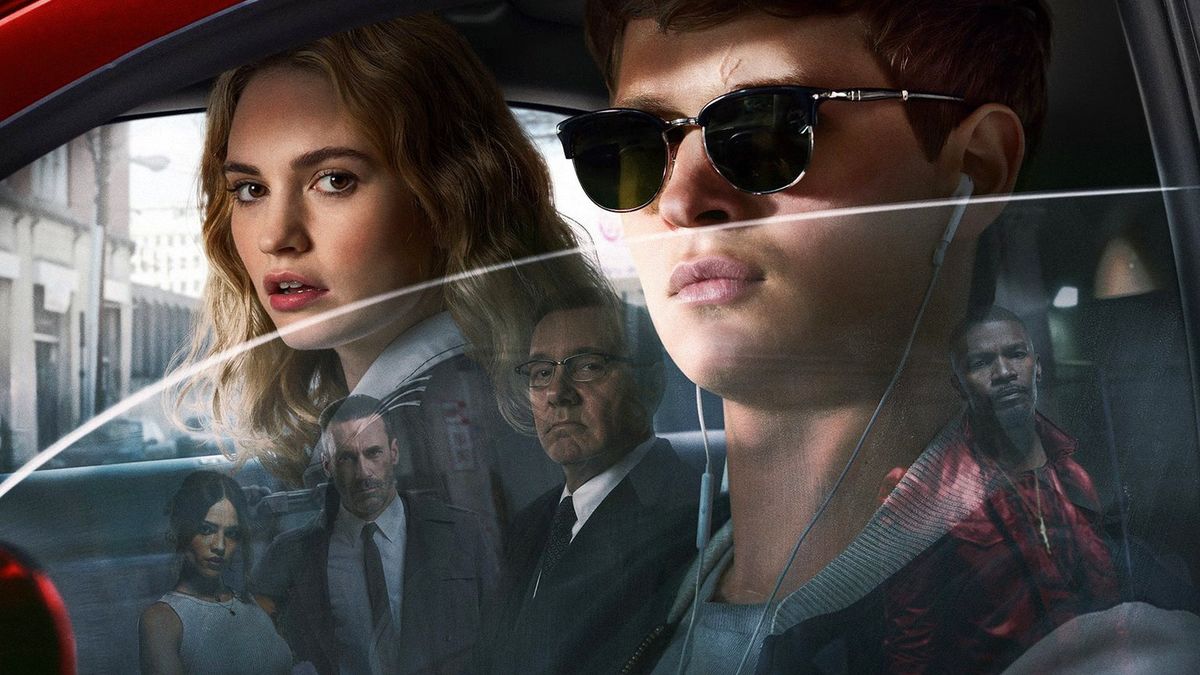
Baby played by Ansel Elgort, literally soundtracks his life to a series of carefully selected songs which help to block out his tinnitus (the cause of which we discover later on). It’s suggested that the beat of the music helps him keep in time (and block out background noise) during the series of difficult escapes he is tasked with driving through. His life is laid out for him by mob-boss Doc (Spacey) who sets up the heists and recruits a various array of thugs and villains to steal money from various banks. Baby is coasting along, quite happy with himself, until he meets Debora (James) in a diner and suddenly his ambitions in life gain a certain clarity. As Baby attempts to uncouple his life from his criminal career the two begin to collide and he realises that walking away from being the Baby Driver may not have been as easy as he thought.
This film has a soundtrack that features a staggering 35 tracks, and it really begins to niggle after 30 minutes or so. Although its enjoyable to see car chases choreographed to tracks by The Damned and Queen, there is a song laced over every scene, and after a while it begins to grate slightly. It’s a clever and unique idea in principal that fails a little bit in execution. It’s also the principal around which the film is built, so your enjoyment of this is paramount to your feelings on the film as whole.
If you take the slightly jaded view, as I do, the closer analysis of the film’s other narrative components shows quite a hollow piece overall. It’s a tad cliche; the young man who has made bad choices, who wants to ride off into the sunset with a girl on his arm and a bag of money. There is also too much emphasis put onto the villains, made up of Doc’s team of thugs. In particular John Hamm who plays what is supposed to be an unhinged lunatic, but comes across as trying too hard. Jamie Foxx is enjoyable in his role but he doesn’t do anything particularly interesting or divergent from his usual shtick. The world of Baby Driver is made up of black and white characters who are either good or evil with very little middle ground. They try to address this towards the end but by then it’s a bit too late.
Now we’re not saying that the film isn’t enjoyable though, because it is. The three heist sequences, that the narrative is propped up by are the best bits of the film. As I believe they are intended to be. The technical achievement of painstakingly choreographing them to the timings of each song is really impressive. There’s also a lot of good comic exchange between Baby and his colleagues, and during the third act some great comedy gore that harks back to the closing sequence in Hot Fuzz. I went in looking for the artistry and ingenuity that Wright excels in and just found myself wanting more. It almost felt like it had been thought about too extensively and that he hadn’t trusted enough in his own intuition.
John Bernthal’s character says very early on to Baby that “in the world of crime you need to get your hands dirty, and one day you will see red”, it’s the moment that is supposed to mark Baby’s journey in the film. That he might not be as cool as he thinks, and that his talents might not be enough on their own to carry him through. This creates an obvious case of serendipity between lead character and director that is really hard to shake off. It’s this illusion of confidence throughout that leaves you feeling a bit empty… but just about entertained. Till next time then…
Must See Movies: August

At Reel Steel we want to make sure you’re getting the most of your cinematic enthusiasm, so each month we put together our short list of some of the best new releases, from popcorn munching explosion fests to the often weird and wonderful.
Take a look at the trailers below and see what you think to this month’s recommendations!
A Ghost Story
released Friday August 11th, 2017
Following a tragic accident, this haunting tale is an exploration of our state in the afterlife, and how a relationship can produce an eternal connection.
Starring Casey Affleck (winner of the 2017 Best Actor Oscar for Manchester By The Sea) and Rooney Mara (Carol), this story shows that no matter how difficult, life must go on for the living.
Atomic Blonde
released Friday August 11th, 2017
Based on the graphic novel series “The Coldest City”, Atomic Blonde follows MI6’s most lethal assassin as she deploys any of the skills at her disposal to stay alive and navigate her way through Berlin, while revolution and double-crossing are found at every turn.
From David Leitch (director of John Wick, and the upcoming Deadpool sequel), and starring Oscar winner Charlize Theron, this deadly game of spies is a breakneck action-thriller.
Detroit
released Friday August 25th, 2017
In July 1967, a police raid erupted into a street riot that took hold of the city of Detroit for five days.
From Kathryn Bigelow, the Oscar winning director of The Hurt Locker, Detroit tells the story of one of the darkest moments of civil unrest that still resonates with racial divisions in contemporary American society.
– SPECIAL EVENT –

The Thing and Big Trouble In Little China
bank holiday double-bill screening
Saturday August 26th
We return with another cult cinema screening at Sheffield’s Abbeydale Picture House, where we previously brought you Bruce Lee’s Enter The Dragon and horror classic Evil Dead 2.
We’re celebrating the movie partnership of legendary horror film director John Carpenter and Hollywood favourite Kurt Russell who together produced several films through the 1980’s and 90’s, with a back-to-back screening of a pair of films holding a cult status only matched by their levels of danger from another world – The Thing, and Big Trouble In Little China.
More info and tickets available here – http://bit.ly/2tMjjVo

The Full Monty
20th Anniversary screening with Q&A
Tuesday August 29th
Celebrating the 20th anniversary of The Full Monty, The Burton Street Foundation will be holding a special screening at the location in Sheffield where much of the film was shot, also featuring a Q&A with the film’s writer Simon Beaufoy.
Details here – http://bit.ly/2vhDNop
War For The Planet Of The Apes

2017 – USA
Director: Matt Reeves
Starring: Andy Serkis, Woody Harrelson, Steve Zahn, Amiah Miller
Words: Christian Abbott
‘The Planet Of The Apes franchise’ has been one of considerable ups and downs. The original back in 1968 was a fascinating deconstruction of society and morality. The hoaky setup was subset by the resolve of the script – you could look past the men in costume and be invested in this alternate world.
Following its success, sequels were inevitable if unnecessary (but when has that stopped anyone), and so a series was born. A series, that despite its weaknesses has stood the test of time, born anew and with newfound purpose – to retell the origins of this Planet Of Apes for our more contemporary sensibilities.
On paper this should have been a disaster, starting with Rise in 2011, it was both a prequel and a remake – a combination of dubious intent. Yet, the reviews were rather glowing, audiences awed at the spectacle and the technological achievement of the picture was inspiring. Not only this, but the narrative update was satisfying and respectful. It was a home-run that restored faith in Hollywood and genre-fiction film-making.
Then came Dawn in 2014 which brilliantly exceeded almost every aspect of the latter. It was a film with grit and believability in its own world – a prestige picture in modern film-making. With a build up like this, the War couldn’t come sooner. More so than any other franchise film this summer was anticipation higher. The foundation was set for a spectacle, a film that both reached the heights of its own trilogy and connected elegantly to the beloved original.
Yet, that hasn’t been the case.
On the surface the film works – it gets from A to Z and the story is told adequately. But, that’s just it, the film is fine. Not great – a serviceable conclusion. Within the trilogy, the script is by far the weakest, more of a prison break movie than a war film, and a questionable one at that. This is unfortunately one of those films that can be enjoyed, but given five minutes of thought breaks down on its narrative, with plot-holes that just continue to compound on one another.
There is far too much convenience here, too many quick setups. It was as though director Matt Reeves and his respective writers went into this film with a checklist of points that needed to be addressed. Far too often points are explained clumsily or not at all, simply telling us that this is how it happened and we need to accept it.
The bridge between Dawn and the original was monumental in a narrative sense and War has made the mistake of trying to close the gap completely. Strangely enough this appears limited to the fact it is a trilogy, perhaps with more films the story could have been told more naturally, but alas here we are.
This all isn’t to say the film was a complete failure; in fact it is still an entertaining addition. Yet it isn’t anything more than that, and knowing the heights this franchise can achieve, it is a shame.
Dunkirk
2017
Director: Christopher Nolan
Starring: Fionn Whitehead, Tom Hardy, Aneurin Barnard, Mark Rylance, Kenneth Branagh, Cillian Murphy, Harry Styles, Tom Glynn-Carney, Barry Keoghan, Jack Lowden
Words: Joe H.
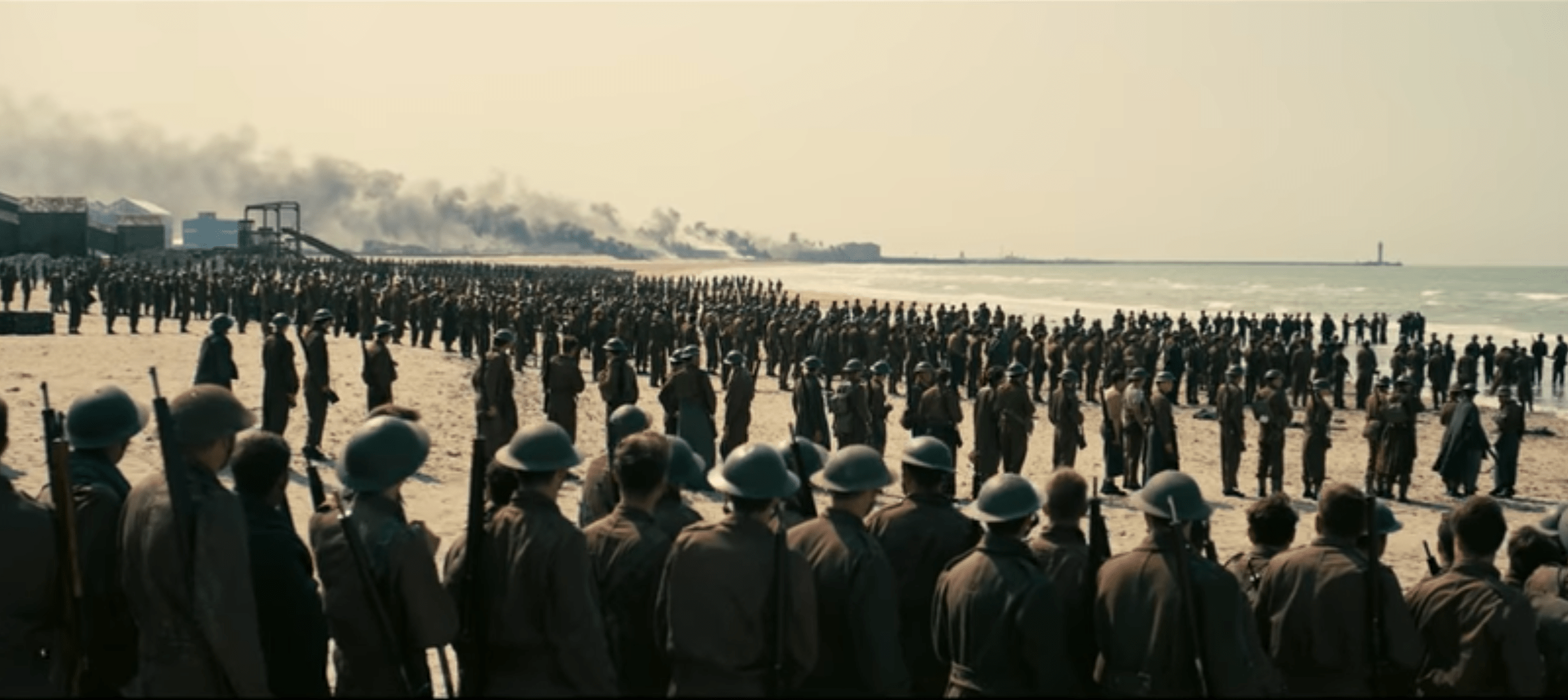
The events of the evacuation of Allied troops in 1940 from the beaches of Dunkirk as enemy forces approached are told here through three intertwining stories – from land, sea and air, as ground forces while under air cover are slowly evacuated using every naval and civilian vessel available.
The perspective of events as we follow the experiences of a handful of soldiers and civilians show that each person fights their own personal battle within a wider conflict – with each story set over the course of a week, a day, and an hour, events almost feel as though they take place in real-time as the evacuation unfolds and individual stories intersect.
Conflict by its nature is unforgiving, a moment where you feel time to breathe will be suddenly cut short by tragedy, and it’s these smaller moments which have just as big an impact on screen – the expression on the face of a soldier when they see an enemy fighter plane approaching, the acceptance and decisions made in the face of impossible odds, the suspense carried forward in this unrelenting story of survival, in however small a part each person plays in it, shows the experiences of the few amongst the many.
The performances all portray a persons sense of purpose and drive against the background of unimaginable events, with no one person being more important than another.
An intrinsic piece of this film is the evocative musical score from Hans Zimmer, being a longtime collaborator with Christopher Nolan having produced the soundtrack on several of the director’s feature films (Inception, The Dark Knight Trilogy, Interstellar), here he has created an extraordinary score – acting like the approaching enemy force or the rising tide on the beach itself, it builds and sustains tension as an essential and near-constant element to the story, with large parts of the film being relatively dialogue-free when action and survival sequences unfold.
The collaboration here between Nolan and Zimmer has produced something which can be seen as a true example of how vital a part the musical score can play in a film, and actually elevate the experience of the story itself – as this film wouldn’t be what it is without this soundtrack.
Christopher Nolan is a director who has always impressed, but the scale and ambition of this film is something to behold – it’s cinematic in every sense of the word, a refreshing blockbuster with breathtaking cinematography that places the audience in the midst of the action.
The effort to see this film on the biggest screen possible will be massively rewarded, as this film is an experience best felt immersed in a wall of sight and sound.
Dunkirk isn’t a war film as such, but rather a suspense movie and survival story – it will without question be considered one of the best films of the year, and deservedly so.
It Comes At Night
2017
Director: Trey Edward Shultz
Starring: Joel Edgerton, Kelvin Harrison Jr., Christopher Abbott, Riley Keough, Carmen Ejogo, Griffin Robert Faulkner
Words: Nathan Scatcherd
Judging by the trailers, one could be forgiven for feeling like they’d seen It Comes at Night before.
A mysterious, highly contagious virus has taken hold of the world. A family (Edgerton, Ejogo and Harrison Jr.) have holed themselves up in an old country house, relying only on each other, understandably mistrustful of strangers. ‘Contagion panic’ movies; zombie movies (these two are often the same, granted); video games like The Last of Us; it seems like the viral apocalypse surrounds us, with various degrees of flash and spectacle, blood and guts.
But It Comes at Night is not the film it perhaps appears to be in its marketing. There are no shuffling brain-eaters here, and no obviously telegraphed jump scares. It is perfectly paced, and at points almost unbearably intense; the kind of exercise in building tension and an atmosphere of thick, choking dread that is, with any justice, sure to become one of the staple ‘how to’ examples shown in film school horror modules. And make no mistake, this is a horror movie. Detractors of more slow-burning modern chillers such as It Follows and The Witch will likely find similar problems with this film, but for those of us who know better, It Comes at Night is a bleak, deliberate, deeply affecting example of horror at its most insidious and unnerving.
Once our aforementioned family come into contact with another seeking refuge (Abbott, Keough and Faulkner), the self-sufficient life they have made for themselves comes under strain, as the film focuses not on the virus or the circumstances surrounding it, but on the thin, jagged line between mistrust and friendship; the human bonds of compassion, and family, and how sometimes these things can drive a person with good intentions to nonetheless do terrible things.
To say much about the story would be to ruin it. I will confess however that, once the film had ended, I realised I’d been digging my nails into my arm from the sheer tension.
It Comes at Night… and stays with you long after.
Doc/Fest Diary 2017: Part Two
Christian Abbot makes his annual pilgrimage to the world’s finest film festival which just so happens to take place in our great City of Sheffield. Taking in as many documentaries as his mind can handle, Christian provides us with his diary from the weekend. Below are films he managed to see at this year’s festival and his thoughts on each. Read Part One here…
Armed with Faith
Working as part of a bomb squad is never an easy task, working as part of one in one of the most dangerous parts of the world is a nightmare. Khyber Pakhtunkhwa province of Pakistan is the setting of this most tense of documentaries. The film serves to ask a simple question, why would anyone want to work in such a dangerous field? Via the interviews with the men whom work as part of this profession, a variety of answers is given, but what comes through them all is a sense of duty in their work, a sense of pride knowing that it is a job that simply and unfortunately needs to be done. Often it is little more than the men’s faith that gets them into work in the morning and importantly back home to their families at night. The consequences of this work are felt through this film, particularly in the fate of one of the men profiled. It is an essential watch to understand the unthinkable.
Chasing Coral
Companion film to director Jeff Orlowski’s 2012 film Chasing Ice, he has shifted his focus away from glaciers and to the reefs of the world – both are sharing a similar fate. Shot over the course of 3 years and aided by volunteers from around the world in 30 different countries, we see the devastating effects of climate change first hand. It is an inconvenient truth that these reefs are dying and with them ecosystems of millions of forms of life. Within the next 30 years we could see a world without these beautiful works of nature unless we make a change now. Orlowski’s documentation will serve as either a reminder of how close we came to losing them or a time capsule to an extinct form of life. The film only showcases the inevitability of our actions but in inadvertently begs us the question, why are we allowing this to happen?
Give Me Future
An obvious homage to The Rolling Stones’ Gimme Shelter, something the director acknowledged himself during the Q&A following the film and which the band in focus, Major Lazer, directly references within the film. The film fortunately stands on its own two feet despite this. Director Austin Peters follows the band as they make the first American tour of Cuba in over 30 years. The results of the tour are unexpected, audiences of a clearly different background are because of this but the main message of the film is a surprising one of unification and moving on. While there are setbacks due to government interferences and limitations from money and equipment, the final performance of the film is better than anyone involved could have hoped for. The final third of the film is almost entirely a music video for the band, a satisfying payoff after a turbulent two thirds of worry that the gig would not even go ahead. This is one of the more entertaining documentaries of the festival in that it prides itself of showcasing music and love. It also shows a change in times that should be celebrated, and of course, any fans of the band will more than love this one. For anyone who doesn’t, it’s still a good ride.
Brimstone & Glory
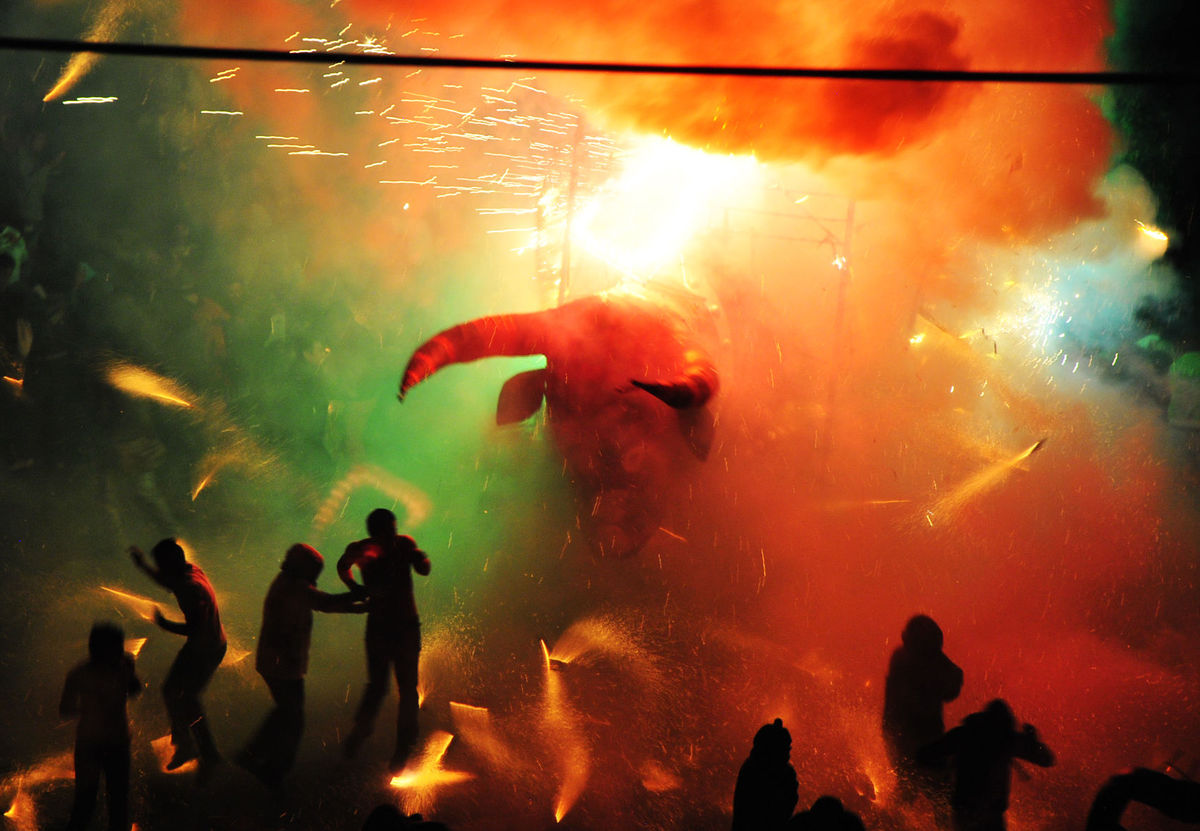
Easily the most visually stunning film of the festival and that is no surprise considering the topic of the film: explosives, fireworks, gunpowder. The cinematography is nothing short of breath-taking as we witness some of the most dangerous pyrotechnic stunts imaginable. Director Viktor Jakovleski takes us inside the workings of the most important religious festival of the year in Tultepec, Mexico. All that we know of health and safety, child protection and general common sense is thrown out the window as we witness men climbing three story high scaffolding held together by duct tape, children making explosives and people jumping head first into fire. The final third of the film is one massive showcase of the festival, its beauty and consequences. People dying and permanently injured. You find yourself wondering why anyone would put themselves in such extreme danger, but as one interviewee states, “you do it for the scar, to say you were part of it, to remember those you’ve lost”.
Carnage – Swallowing the Past
A personal favourite of the festival, one admittedly seen before due to a person interest and investment into the film. Carnage is a mockumentary, a projection of a future after the planet all became vegan within the next 50 years. It looks back at our known past and beyond into their future, asking why anyone would eat meat? This is a very different spin on the expectations anyone would have on the vegan community. This isn’t about bombarding people with the horrors of the meat and dairy industry but rather, it takes a step back and accepts the stereotypes of vegans and thrives in them. While it cannot be called the most, well-made film of the festival, nor the most visually arresting, it is arguably the most entertaining. It serves the purpose all documentaries should strive toward, which is to make you look at the world differently and see things from another’s perspective.
First and foremost this film wants to make you laugh, but it never forgets the message – stop eating meat. Admittedly, this is not the most objective review, but even if you have the biggest disdain for your non-meat eating cousins, then this film is especially made for you.
 REEL STEEL
You must be logged in to post a comment.