Deadpool
2016/ USA, Canada
Director: Tim Miller
Starring: Ryan Reynolds, Ed Skrein, Karan Soni
Words: R. Topham
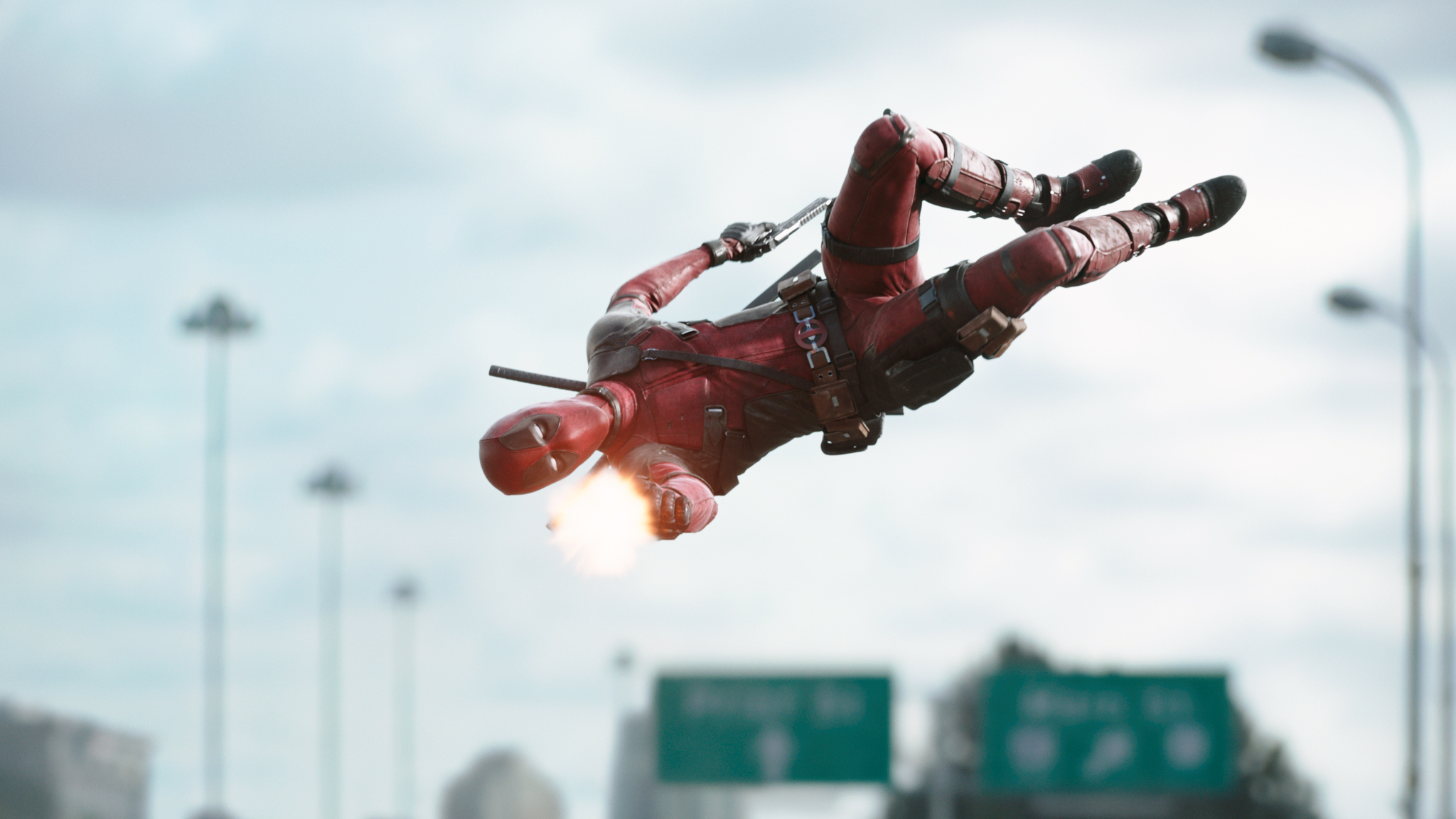
Deadpool breaks so many rules it’s basically rewritten the book, creating a whole new genre of comedy/action/superhero/spoof movie in the process. Taking over and improving on the craic we saw in Ant-Man, it is a completely unique, game-changing experience that is about as much fun you can possibly have at the cinema.
Deserving of the hype, it is incredibly funny. Tongue-in-cheek from the very beginning, even the opening credits unapologetically mock the Marvelverse, introducing the characters like “some moody teen” and “produced by some asshats”, for example. The jokes and ripostes are puerile in essence; a constant stream of crude innuendos about sex and dicks only missing a “yo momma” here or a “that’s what she said” there. But the script is written in such a way that, as a right-thinking member of society, your immediate reaction is not to recoil in embarrassment or contempt but to giggle, because – hallelujah – it’s a comedy that actually delivers what it promises.
This is almost entirely owed to Ryan Reynolds, who adds another tally to his ever-growing list of neurotic, slightly insane but jocular characters, finally proving himself to be both a strong leading man and a commendable action man (while tastefully poking fun at his stint as Green Lantern, which I doubt he’ll ever be forgiven for). On the back of Deadpool, Reynolds’ path to become the Robert Downey Jnr of the X-Men franchise is all but confirmed, as it becomes increasingly difficult to pin-point examples of genuine acting against Reynolds personal comical input.
Deadpool ticks some of the boxes so many comic book adaptations failed to trace because it isn’t insufferably long, it doesn’t rely on cataclysmic CGI attacks on entire cities, and is a refreshing alternative to the ‘bad person wants to end the world so we/I must stop them’ storylines coming out of Hollywood recently. It’s the perfect concoction of all the ingredients for a satisfying superhero film, all the while retaining an overtly smug attitude.
Triple 9
2015/ USA
Director: John Hillcoat
Starring: Casey Affleck, Kate Winslet, Chiwetel Ejiofor, Anthony Mackie, Aaron Paul
Words: J. Wood
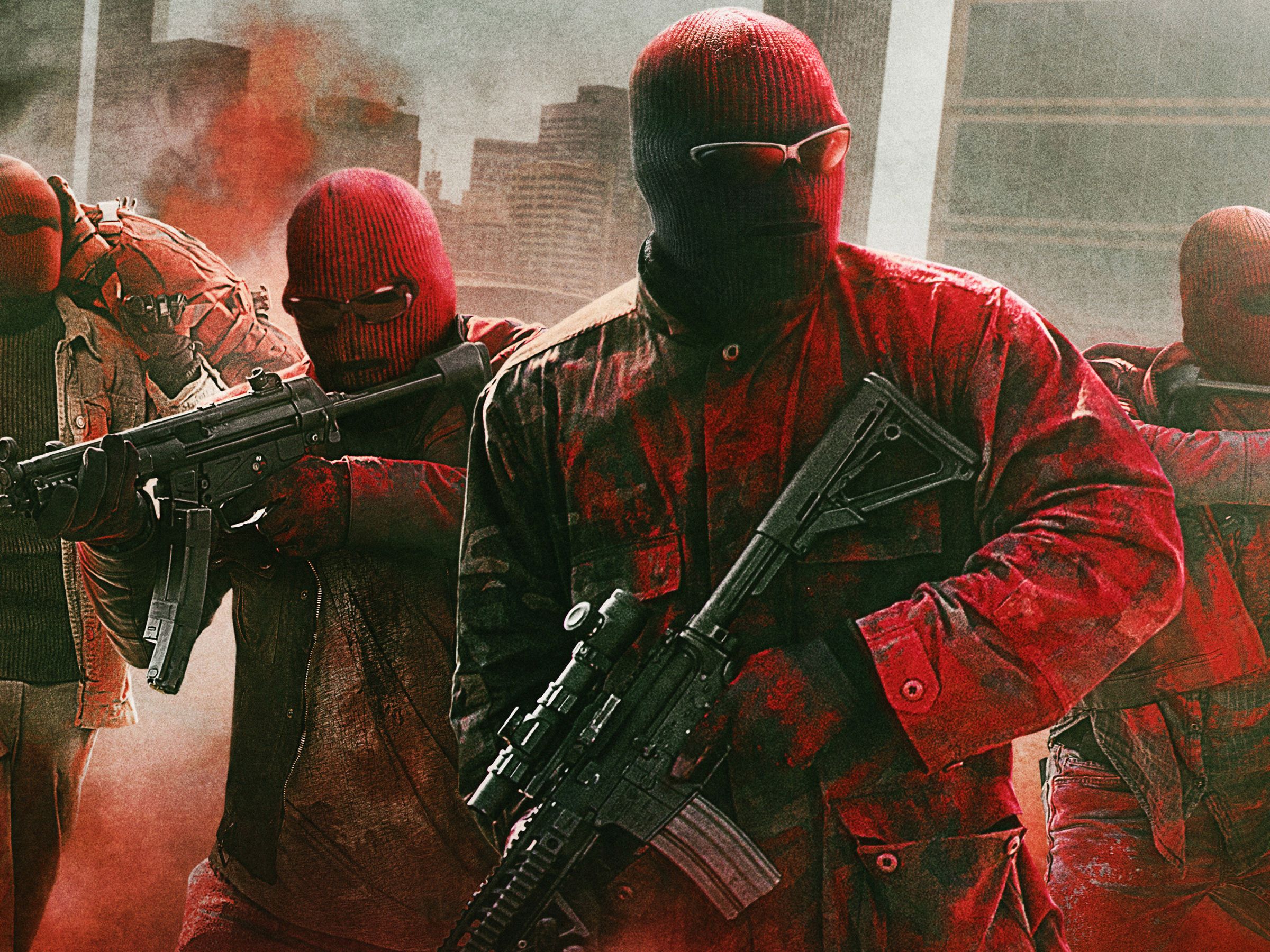
Triple 9 sees director John Hillcoat trying so hard to be Michael Mann that it is actually quite embarrassing to watch on screen. Hillcoat has made three very good films, all Western or at least Western influenced, he is clearly comfortable in the genre so why he has tried to take on a modern crime thriller is beyond my comprehension. Triple 9 was one of the films that I was most looking forward to for 2016, on the basis of a director who has barely put a foot wrong and a brilliant cast list. This is likely to be one of the most disappointing films of the year, because pretty much everything that could have gone wrong has.
A lot of the problems stem from writer Matt Cook’s script, which relies too much on everything being intertwined and connected rather than make a credible drama. To briefly summarise Chiwetel Ejiofor’s character is a former special forces man now working armed robberies for the Russian mob in Georgia. His ex-partner is the sister of the Russian’s front. Chiwetel’s gang is made up of cops and ex cops, one of whom is partnered with Casey Affleck’s character, whose uncle (Woody Harrelson) is the lead investigator on one of the gang’s raids. The film relies far too much on the audience buying into the coincidences that lead to a situation like this, and to be quite honest I simply did not.
Another issue with the script is the horrific bleakness and in some instances outright nastiness that it calls for. Whilst I was watching it I thought quite a lot of Sicario, Denis Villeneuve’s Conrad inspired cartel thriller of last year, that has a similar aesthetic and ideal as this film does. For a while I was wondering why I let the violence and horrors of Sicario go, whilst this one just made me really rather uncomfortable, and then the two answers struck me, credibility and reality. The thing that sold me on Sicario was the cartel angle, and though the events in that piece of fiction may not depict actual cartel committed atrocities, there was enough that rang true about them to hit me, whereas here Atlanta is portrayed as a forgotten urban wasteland rather than a modern, vibrant city, and the story feels so contrived and outlandish that it is creating these moments of sheer dark heartedness to fit into that. I am usually one with a strong stomach for this sort of thing, but towards the end one action left me speechless at the grimness of it all, in a film that for my money had not earned the right through its filmmaking to subject its audience to that.
That brings me on to the next major bone of contention with Triple 9, the execution of the whole thing on a technical level. Hillcoat’s direction is plainly suited to long, lingering shots of vast, expansive landscapes. He is not an ultra-modern filmmaker who is comfortable with action sequences in which the camera feels like it is within the very heart of the action. Some of the heist scenes and chases of the film were so poorly filmed and edited together that they are almost illegible. Compare these to the crisp scenes that a Roger Deakins or a Greig Fraser would bring to such kinetic sequences and you are left sadly disappointed, whilst attempts to emulate Heat fall way below par. Add to that an overly intrusive score and a lighting set-up so dim and dark that it appears to have fallen foul of the electricity bill, and you are left with a technical mess of a film.
Then there are the performances which are a mixed bag if ever there was one. On a good note kudos to Casey Affleck for carrying a difficult film admirably, as everything around him collapsed. There are very few actors who I can see on screen and not realise who they are because they inhabit their roles so well and yet still stay below the radar and he is one of them. Elsewhere Chiwetel Ejiofor gives it his best, he is clearly a fine actor who clearly saw something more than the character that made the final cut. He does his best to make the most of the character’s emotional torment but I can’t say he managed it, whilst the menace he has clearly shown in the past is missing here. There are ridiculously bad phoned in performances from Harrelson (playing the same character he always does) and Mackie, while Aaron Paul is still to really convince in any non-Breaking Bad role. At least Kate Winslet, the only woman who really got the chance to make any sort of impact in this painfully macho film in which women are tokens or plot devices, makes an effort to make her character interesting but an unconvincing accent and a more subdued performance than her astonishing look suggest hit the brakes on that. In a film characterized by mistakes though the biggest one is the signing off on Michael K. Williams having a single scene cameo as a transsexual prostitute, an awful decision if there ever was one.
Triple 9 suffers from too grandiose an ambition and too limited an execution. I can tell that there was an idea to play along the Heat mantra of the cop and the criminal being two sides of a coin, whereas here the characters are both sides of the coin themselves. Also there was clearly an inclination to give the characters personal lives that either never came to fruition or, like a lot it seems, hit the cutting room floor. There are simply too many time constraints and an abundance of threads, which means that too many ideas remain under developed. Add to this one of the most underwhelming ‘reveals’ of recent times and a final act so hurried that it somehow forgets to give what I would consider sufficient closure to three of the aforementioned threads, and you have a movie that simply does not achieve anything close to the goals it set out with.
Bone Tomahawk

2015/ USA, UK
Director: S. Craig Zahler
Starring: Kurt Russell, Richard Jenkins, Patrick Wilson, Matthew Fox, Lili Simmons, David Arquette, Evan Jonigkeit
Words: N. Scatcherd
Bone Tomahawk is a strange film; a ‘cannibal horror Western’ (and as genre mash-ups go, that combination certainly grabs the attention) that feels like a cross between The Searchers and Cannibal Holocaust. It is at once a patient, deliberately paced ‘rescue mission’ Western aswell as being unsettling and – at least in its final twenty minutes – breathtakingly brutal B-movie fare about man-eating troglodytes. Those with the patience for indulgent dialogue, the endurance for hardcore splatter and a fondness for Kurt Russell’s majestic mutton chop facial hair will find that Bone Tomahawk is a compelling oddity well worth tracking down. Everyone else will probably find the whole thing too slow, too nasty or just too weird to get onboard with.
Our story is simple enough. Following his panicked desecration of a tribal burial ground (fleeing in terror from the murder of his partner in crime), outlaw Purvis (Arquette) comes to the ironically named town of Bright Hope for shelter. After tangling briefly with Sheriff Hunt (Kurt Russell) and his well-meaning but generally inept backup deputy, Chicory (Richard Jenkins), he’s taken to one of the cells for questioning. But when he falls ill the town’s doctor, Samantha O’Dwyer (Lilli Simmons) is called to tend to him, leaving her husband Arthur (Patrick Wilson) at home to nurse a recently sustained broken leg by himself.
Anyway, tribesmen* sneak into the town seeking vengeance for their defiled territory, kidnapping Purvis and Samantha as well as a young jail guard (Evan Jonigkeit). Hunt, Chicory, smarmy gunslinger John Brooder (Matthew Fox) and Arthur O’Dwyer set out on a desperate rescue mission, and it’s their journey that takes up the majority of the film’s runtime. The trek is complicated by O’Dwyer’s injury – a broken leg being a far more serious thing in the age of the American frontier than it thankfully is in the 21st century – and the film derives much of its tension from the question of whether or not his stoic determination to rescue his wife is enough to actually get the job done, when one nasty fall could mean amputation, perhaps even death. He’s almost superhumanly motivated to get Samantha home safe, but he also can’t help slowing down the group out to achieve that very goal.
Director S. Craig Zahler comes from a literary background, writing novels and screenplays before venturing into directing, and this appreciation of the written and spoken word is evident in Bone Tomahawk’s verbose dialogue. It revels in period speech and the occasional meandering monologue, and in the hands of lesser actors it would probably get tiring. Happily, the cast are all on great form, with an almost unrecognisable Richard Jenkins standing out in particular as the slightly bemused, perhaps not too bright but still eminently likeable Chicory. His musings about flea circuses and the perils of reading in the bath would easily irritate if delivered by a less charismatic actor, but he brings warmth and dim-witted charm which stop things from feeling interminably doom-filled.
This is mostly a Very Serious and Very Grim movie after all, and some of the violence really is tough to watch. Zahler seems to delight in catching the viewer off guard; the film generally takes its time with protracted scenes of our protagonists slowly traversing vast stretches of desert, and then suddenly there’ll be a shocking jolt of violence. Whereas other films might bolster such shifts into physical action with a heart-pumping musical score or lots of fast cutting, Bone Tomahawk doesn’t rely on such naked manipulation. One sequence, wherein Sheriff Hunt grapples with one of the troglodytes up close and personal, is genuinely tense precisely because the violence plays out fairly slowly and without musical accompaniment. It’s a desperate brawl, not some slick action movie fight scene, and the film establishes a kind of casual brutality which negates the usual comfort of knowing the protagonist(s) will win every fight and come out on top. Another scene – which I won’t spoil – has the dubious honour of featuring one of the most genuinely grotesque and jaw-dropping movie deaths I’ve ever watched, and again, its intensity is heightened by the lack of music and the way the camera doesn’t flinch from showing every thoroughly nasty detail.
Ultimately, Bone Tomahawk is an enjoyably strange creation which seems to relish toying with audience expectation. It succeeds in injecting a streak of cannibal horror weirdness into the type of traditional Western genre tropes you’ve seen one hundred times before, and its idiosyncrasies make it an intriguingly fresh-feeling experience which will no doubt stand up on repeat viewings… provided you’ve got the stomach.
*The film is fully aware of the potential for some dodgy racial politics in playing on the old ‘cowboys vs Injuns’ stereotype, and so goes out of its way to assure the audience that these “troglodytes”, as they are referred to, are not intended to be representative of Native Americans as a whole. Rather they are a group of mud-caked cave-dwellers who communicate in strange, subhuman roars and eat their enemies. Essentially they perform the same role as zombies popularly do – they’re human beings, sure, but far enough removed from humanity to be portrayed as comfortably killable ‘Others’.
Must See Movies: March

Words: J. Wood
We here at Reel Steel care about cinema, and as a result we care that you, our readership are going to see the very best that cinema has to offer. Whilst we know that you will all be aware that the latest comic book extravaganza or Seth Rogen comedy is due for release, there may be some non-franchise films well worth a look that slip the net.
Our writer Joe Wood has happily compiled a list of three movies a month up until May that he highly recommends you seeing. He will report back at the end of each month to confirm whether his selections were appropriate, or whether he might have to watch Sex & The City 1 & 2 as atonement for his misguidance.
Here goes:
Hail, Caesar!
(released 04/03/16)
A new Coen Brothers film is always something that deserves attention and by the looks of the trailers this is no exception. A typical Coen Brothers farce set in the backlots of 1950s Hollywood, as fixer Eddie Mannix has to juggle all manner of catastrophes, not least of which is the kidnap of his star. Starring Josh Brolin and George Clooney, an actor at his finest working with the Coens, as well as fellow previous collaborators Frances McDormand, Tilda Swinton and Scarlett Johansson, alongside Ralph Fiennes, seemingly reprising his astonishing turn in The Grand Budapest Hotel. All the ingredients are there for this to become the comedy of the year.
Anomalisa
(released 11/03/16)
This has won rave reviews in America, where it has already opened, and earned a nomination for Best Animated Feature at the Oscars, a haul some consider meagre. Written and directed by Charlie Kaufman, the genius behind Being John Malkovich, Adaptation, Eternal Sunshine of the Spotless Mind and Synecdoche, New York, I would advise readers to go in expecting the unusual, yet the profoundly moving also. In particular, the involvement of Duke Johnson, who directed the Claymation ‘Community’ episode has put at ease my fears over the animation gimmick, and I genuinely think this could be very special indeed.
High Rise
(released 18/03/16)
For such a brilliant author, the fact that in 2016 Empire of The Sun and David Cronenberg’s Crash are the only J.G. Ballard adaptations is scandalous. Thankfully Ben Wheatley, the chameleonic filmmaker behind Kill List and A Field in England rides in with this adaptation of one of my favourite Ballard works, about an enclosed, upscale community falling apart. Tom Hiddleston leads this, with support from Jeremy Irons and Sienna Miller in what seems to me as a fan of the book to be very astute casting. Wheatley is one of the few filmmakers I would consider to have the darkness needed to effectively bring Ballard’s dystopian visions to the screen, so this is a match made in heaven.
The Assassin

2015/ Taiwan, China, Hong Kong, France
Director: Hsiao-Hsien Hou
Starring: Qi Shu, Chen Chang, Satoshi Tsumabuki
Words: B. Halford
In the 9th century, the states of what would become China are in a state of conflict, with violence being commonplace. In the province of Hubei, Nie Yinniang (Shu) is a proficient assassin who kills noblemen with her stealth and agility. One day she is called away to Weibo by her mentor Jiaxin (Feng-Yi Sheu) to kill governor Tian Ji’an (Gang); Yinniang’s cousin and once-betrothed.
With awards season upon us, the world turns to the various ceremonies to look at the varied films getting recognition. Amongst them is something of an oddball, The Assassin; a film that has managed to capture the coveted Best Director prize at the Cannes film festival for Hou Hsiao-Hsien, but was also conspicuously absent from any award categories at the upcoming Oscars. Whilst we can never truly be certain as to why committees of various awards do and do not nominate films, The Assassin’s disparity in recognition is somewhat telling of a film that will inevitably fall into the “love it or hate it” camp.
To wider audiences, The Assassin has been sold as a wuxia action film in the vein of Crouching Tiger, Hidden Dragon and whilst this isn’t inaccurate in terms of genre, The Assassin is ultimately a far more sedate affair than it has been advertised as.
What constitutes most of The Assassin is a focus on the time and place rather than on the action. This definitely has its positive side as the film takes its time with the visuals that are absolutely gorgeous and amongst the best I’ve seen for a long time. Painterly and making the absolute most of the environment. The issue that comes with that however is that it detracts somewhat from what is going on in the foreground, especially as the languid pace can tax the attention span.
The film compensates for this by a rather modest and straight-forward plot. Whilst the tendency is to see wuxia films as indulgent epics, The Assassin clocks in at around 100 minutes, meaning that the slow pacing doesn’t come into much conflict with a very convoluted or complex story.
As the film’s lead, Qi Shu doesn’t exactly put in a poor performance but is never particularly memorable. She’s sold much more on her abilities as an assassin than as much of a noteworthy character despite the backstory. Her enigmatic aspect is certainly in keeping with a memorable lineage stretching back through Mad Max and The Man With No Name, but lacks something of the charisma or sympathy of such roguish figures.
Where the character of Yinniang does come alive however, is in the film’s sparse action sequences. Again, something of a break from western expectations, these fights are relatively more realistic and quiet, lacking in bombast but definitely abundant in character, style and a great example on how to use choreographed movement to visually tell a story.
You can’t really argue that The Assassin isn’t a visually striking film. The whole thing is extraordinary to look at and is worth the time and money but there is a feeling that you’re watching a series of slides about the beauty of Chinese nature with the occasional fight scene thrown in. Gorgeous but a little pretentious and dull.
Youth

2015/ Italy, UK, France, Switzerland
Director: Paolo Sorrentino
Starring: Michael Caine, Harvey Keitel, Rachel Weisz
Words: R. Topham
Imagine if Wes Anderson made an As Good As It Gets style drama, and you’ll picture something similar to Youth. It is up there with the most emotionally reflective films about the depths of the life you’ll ever see. It taps into feelings you weren’t even aware existed. Michael Caine and Harvey Keitel deliver their best performances in years, and director Paolo Sorrentino manages to make apathy an effortlessly enviable art.
Caine’s retired composer and conductor Fred Ballinger is on a routine vacation at a luxury Swiss spa with Keitel’s director and screenwriter Mick Boyle, his best friend for decades – they’re the kind of friends who “only tell each other the good things”. They’re at that stage in life when four drops of piss is substantial and staying in shape is merely a waste of time, but when Ballinger receives a visit from the Queen’s emissary requesting he conduct his legendary ‘Simple Songs’ one last time, a life of indifference becomes a life riddled with complex and unexpected emotion.
Not only does Youth utilise music as its platform for expressing untouched and indescribable emotions, but it’s also packed full of Tumblr-ific quotes and musings delving into the philosophies of time, morality, passion, love, hate, forgiveness and regret. It is, of course, most poignant in its position on age; Boyle uses binoculars to exemplify that what you see looks and feels close when you’re young because that’s the future, but far away when you’re old because then you’re looking at the past, for example. Idiosyncrasies in human nature is a constantly recurring theme, best shown as constitutive of the agitation of time lapsing when Ballinger and Jimmy Tree (Paul Dano) are in a clock shop and the former orchestrates all the ticks and cuckoo’s into a sweet melody. Jane Fonda also makes an exceptional cameo that obliterates the peace and exacerbates the deflated brooding in traumatic fashion.
As Boyle says, sometimes you have to follow where the wind blows in order to survive in this jungle, and if the wind is blowing in a direction of more compassionate films like this then consider me a follower.
Our Brand Is Crisis

2015 – USA
Director – David Gordon Green
Starring – Sandra Bullock , Billy Bob Thornton, Joaquim de Almeida
Words: J. Wood
David Gordon Green’s political satire sees Sandra Bullock star as ‘Calamity’ Jane Bodine, a formerly great political strategist haunted by her past deeds for her job. Parachuted in by the American government to help an ailing Bolivian presidential candidate she finds herself up against her old adversary Pat Candy (Billy Bob Thornton), seeing whether she can rediscover her former glories.
Our Brand Is Crisis is a film that has a crisis of confidence, and a crisis of identity. All the way throughout watching it I was struck both by how much I was gently entertained by the film yet at the same time how schizophrenic the film seemed to be in its tone. I do believe that it was meant to be a dark comedy, yet the comedy doesn’t quite have the darkness and in an effort to attain that air the film turns into more of a drama.
The film benefits brilliantly from the ever likeable presence of Sandra Bullock, an Oscar winning actress and genuine megastar who doesn’t often get the dues she so clearly deserves thanks to her sometimes dubious choice of material. While this is not the best film or role she has appeared in by quite some distance it is almost tailor made for her screen presence. At her very best Bullock for me is the female equivalent of George Clooney, immensely likeable and charming yet effortlessly able to convey disillusionment and despair. Here she makes the all too subtle bitterness of Jane come to the fore and add some real substance to the film, substance that the film quite possibly does not deserve. Given the character spends the first twenty minute of the film moping and suffering from Altitude Sickness Bullock still manages to pull off the unenviable task of making her a likeable central figure who the audience can side with, which makes the incredibly well written comedic moments all the more effective.
The script does feel weirdly over and under developed at certain points in the film, but the comedy takes the best moments hands down. Those who watched Top Gear in Bolivia a few years ago will know about the Death Road, a clifftop, narrow, primitive track. Seeing two campaign buses racing across this treacherous road in an effort to get to a rally first is a brilliant moment, but is not alone, with the interplay between the campaign background players always sharp and worth watching. The dramatic moments of the film are just not particularly well gelled in with this; Adam McKay and Charles Randolph took a serious subject in The Big Short and managed to craft a clever balance between the comedy and the drama, something that just never quite happens here. There are also a couple of scenes that come across very painfully as Americans coming into a Third World Country and solving all its problems, which left me feeling rather uneasy.
The writing of the supporting characters strangely veers from brilliant to very poor. Take the Presidential Candidate Castillo; played by Joaquim de Almeida there is a great interpretation of a political character here. This is a politician who has absolutely no business to be challenging for this presidency, he has absolutely no connection with his electorate and almost no idea how to arrest this slide. The easy way to show this would be to make him a clueless buffoon but Straughan writes him as an intelligent man just ill equipped to take on the challenge, and it is only when Bullock’s Bodine takes the reins that he turns it around. The portrayal of him by de Almeida is staggeringly good, capturing all the nuances of the character perfectly and, in his appearance in a chat show, a great moment of emotive acting. Conversely Billy Bob Thornton is strangely subdued as Pat Candy, Bullock’s main adversary. He is constantly referred to in the dialogue as some kind of Machiavellian figure of chaos and malice, and having seen his performance in Fargo Thornton seems perfect to convey this. Unfortunately, the way the character is written differs from how he is spoken about, he is a quipping constantly and just feels like an impotent force in the film, when he really needs to be a potent presence.
What really did surprise me was the direction of David Gordon Green, a director who has had one of the strangest careers in modern cinema, veering from thought provoking indie cinema to director for hire for Seth Rogen & Co., before moving back to less thought provoking indie cinema. This is strangely kinetic and alive filmmaking from Green, who directs the film in a fast moving way I would never have thought possible. He does a great job of capturing the feel of an exotic location, not a given by any means, and although much of this comes from his cinematographer and the brilliant score of David Wingo, it is still in my opinion Green’s best film for a long time.
There are numerous flaws in the film that have a notable effect on the film, but importantly they never affected or diminished my enjoyment of the film. It is an interesting subject, and a portrayal of it that is vastly improved from Clooney and Grant Heslov’s The Ides of March. Worth watching for Sandra Bullock alone, who is always a joy to behold, Our Brand Is Crisis may not have reached the heights the film’s lofty Oscar ambitions intended, but I would definitely give it a recommendation.
The Big Short

2015 – USA
Director – Adam McKay
Adapted from the book – ‘The Big Short’ by Michael Lewis
Starring: Christian Bale, Steve Carell, Ryan Gosling, Brad Pitt
Words: J. Wood
The financial crash of 2008 has provided material for a number of interesting films over the past few years and this is another, telling the story of the select group of people who bet against the housing market, seeing the disaster that nobody else did, and still profited from it. Christian Bale, Steve Carell, Ryan Gosling and Brad Pitt star in this most interesting film.
The man who has made a directorial career out of harnessing Will Ferrell’s overgrown man-child act for the big screen would not be one of the first names I would have expected to have written and directed a smart, funny yet remarkably scathing black comedy about the world of finance and get two Oscar nominations for it but hey, we live in a world where a Jay Roach film is Oscar nominated.
The Big Short is the very best of both worlds. Think about the two major films that have emerged from the most recent Global meltdown, Margin Call and The Wolf of Wall Street, this manages to get fully to grips with the technical side in the way that the painfully underrated Margin Call did whilst at the same time hitting the mass entertainment notes that Scorsese’s bloated film manages so effectively. This is a film that relies on four ‘oddball’ characters to lead the action, only two of whom ever interact. The film is really three stories told as one incredibly well-edited film. Indeed, it took me over an hour to realize that there was to be no intersection. Look at the characters; Mike Burry is a weird, glass-eyed, socially awkward hedge fund manager, Mark Baum a perpetually angry, embittered and traumatized investor, Jared Vennett the Jordan Belfort type and Ben Rickert the enclosed has been who got sick of it all. None of these are characters you would base a movie around, yet McKay somehow does it with all four.
The four leads are all very strong, but none more so than Carrell. He is the perspective of the director and screenwriters’ opinions on the subject. He hates the life of Wall Street trading, everybody knows it, most of all his wife (Marisa Tomei), yet he is unable to function without it. Carrell adds another string to his rapidly expanding bow with a performance that at first appears to be a one note shouty, sweary effort before becoming mellowed somewhat by his embitterment at the situation. There are two great scenes, one in which he interrogates a stripper about her mortgage, and one in which he finally realizes quite the economic situation that he is exploiting. Both of these scenes give nuance to a straightforward character, and Carell once again proves his worth as a dramatic actor by giving these scenes the necessary reactions. Similarly pitched to this role is that of Ben Rickert, but of the leading quartet Brad Pitt is given the least exposure, and so can only make so much. Christian Bale is uncharacteristically oddball and it surprisingly suits him. I had always thought Bale too intense an actor to take on any real comedy and even though this is kind of like halfway house comedy, he does impress and hint at being able to tackle such roles in the future. Of the four leads it is Ryan Gosling, made up to look eerily like Leonardo DiCaprio’s version of Jordan Belfort that makes the least impression, but then he has the least interesting role to be honest.
Elsewhere throughout the film there are interesting secondary roles, played by impeccably cast actors and actresses, be it for a single scene or throughout the movie. The film may be permanently tinged with the blackly comic edge of Randolph and McKay’s writings. Moving briefly into territory that was inhabited by Michael Shannon and Andrew Garfield in last year’s 99 Homes, there is a brilliant dramatic sequence as two callous realtors expose to the audience the levels of the sham that is being perpetuated by all those in charge of the economy. It is a really eye-opening moment, the moment that you realize that the opportunism and greed did not stop, as publicized, by the bankers but seeped and perpetrated even the most basic pond life like individuals. The final few minutes very cleverly takes you back to what seem to be insignificant moments from earlier on in the picture and provide a harrowing view of the real effects of people’s greed and stupidity. This is not dissimilar to the weirdly incongruous info-graphic that appeared over the end credits of McKay’s The Other Guys.
As a filmmaker Adam McKay really impresses here by not just relying on a script and a stellar cast but employing some hitherto unseen nous in putting together a very well thought out narrative. Take for example his extensive use of stock footage to emphasise his point; in less steady hands this is a very ill thought out process that just looks clumsily cut and pasted in but here it helps to steady the cuts and better link between the narratives playing out simultaneously, a feat for which editor Hank Corwin deserves some credit. The film does have some flaws though, not least the distracting camerawork that seems to be trying to make the film look like a documentary for no really good reason and with no apparent pattern. There were some scenes where this really looked quite amateurish.
Even for a film which basically spends its two hour plus length saying ‘I told you so, and so did these men’ (the funniest line incidentally being Mike Burry, when asked as to how he pinpointed the mortgage crisis, simply stating that he read the information, something not even lawyers did), the mugging fourth wall breaking and celebrity cameos explaining the financial terms being used by the film (I still did not fully understand all the financial gobbledygook behind it, even after a champagne supping Margot Robbie in a bubble bath told me) felt a little too smug for its own good. That said I appreciate a film this well put together and acted having the gall to stand up and be counted by telling the truth. I appreciate a writer and director brave enough to come out and anger the businessmen, some of whom are likely involved in film financing, by calling them out as the immoral liars and cheats that they are, rather than be ambivalent (Margin Call, 99 Homes) or glamourizing (The Wolf of Wall Street). That he made an entertaining film in the process is the cherry on the cake.
The Revenant

2015 – USA
Director: Alejandro González Iñárritu
Starring: Leonardo DiCaprio, Tom Hardy, Will Poulter
Words: C. Abbott
Now it is important to preface, and impossible to talk about this film, without mentioning the supposed drama during its production. During the uncharacteristically long shoot of nine months, there was constant friction on set between director Alejandro González Iñárritu and various cast and crew members, causing some to leave or be fired. It was brought into question the regard for safety Iñárritu had, yet regardless of what ones opinion is of this, it has been shown time and again throughout the history of cinema that productions brought to the limits are often the most fascinating. Iñárritu clearly wanted to create the harsh vision of this brutal tale, and through that his sets were not an easy place to work on. Yet as he stated himself, “If we ended up in greenscreen with coffee and everybody having a good time, everybody will be happy, but most likely the film would be a piece of shit.”
Following a group of fur trappers during the 1820s, we see Hugh Glass, an expert of these untameable lands left for dead following a savage bear attack. We journey with this man on a staggering quest of vengeance and determination as he overcomes the impossible: death. From the very opening you are taken aback by the astounding visuals. Emmanuel Lubezki once again proving how he has cinematography down to a science, from his work on Children of Men to Tree of Life, he frames narratives in a voyeuristic and naturalistic style that compliments The Revenant perfectly. The decision was made to shoot almost entirely in natural lighting and harnessing the awe of the twilight hours in the day. Shot meticulously over the course of 80 days, it will be a long time before cinema sees something quite like this again. Often poetic, we are thrown from set piece to set piece with magnificent interludes of calming serenity. Lubezki and Iñárritu have captured the vivid landscapes of North America in a time of vicious brutality and relentless domination.
It seems Iñárritu has become something of a cinematic perfectionist, his previous film Birdman or (The Unexpected Virtue of Ignorance) used seamless editing to achieve a stage-like, theatrical effect. This was something pioneered by Hitchcock with the 1948 film Rope. Now his latest film focus is on the natural lighting and chronological order of shooting, Kubrick achieved this with 1975’s Barry Lyndon. Iñárritu has built on these cinematic milestones and perfected them with such a degree of accuracy and sheer talent for his craft that it is almost impossible to see him as anything other than a brilliant visionary. The results of his latest vision are something to behold and cherish in a time when big budget films such as this are increasingly a hollow, studio backlot affair. Not only this, but a performance by Leonardo DiCaprio that may finally win him his Oscar, Tom Hardy on his consistently mumbling top form, an understated performance from Domhnall Gleeson and the entire cast giving it their all, there is little to criticise here. This is a film that must be seen, and one made to last the test of time.
Room

2015
Director: Lenny Abrahamson
Starring: Brie Larson, Jacob Tremblay, Sean Bridgers
Words: B. Halford
For all of his life, Jack (Tremblay) has lived with his mother (Larson) in “Room”, a shed where they are held by a kidnapper named “Old Nick” (Sean Bridgers). With Jack’s entire worldview based around Room, he refuses to believe there’s a world outside; but when he succeeds in escaping, he enters a new place that he and his mother have little idea how to cope with.
Based on the novel by Emma Donaghue (who also wrote the film’s screenplay), Room is an emotionally-charged drama with some interesting ideas to showcase. Stories of abduction and unlawful imprisonment are sadly nothing new and are also common fodder for cinema, but Room is able to hold its own thanks to its particular sense of priorities.
Conventionally, films that have dealt with abduction have been from the stance of either the victim trying to escape or an investigation into the crime itself. The former is only the case in the beginning of the film and the latter is virtually non-existent. Instead we get a view of what life is like for those who have experienced abduction in the aftermath from the media attention to the psychological trauma; something that needs skill to pull off.
As such, a great deal of credit has to go to the film’s two leads, Brie Larson and Jacob Tremblay. As an actress, Larson is given a rather mammoth task of playing a character whose situation would probably be fraught with conflicting emotions and whilst the full range of emotions isn’t perhaps used to its greatest potential, it’s still an impressive performance. What is perhaps more impressive is young Jacob Tremblay whose strong presence and grasp on emotions belies his youth making something of a young actor to watch for in the future. In the supporting cast, Joan Allen is a rock steady role as Larson’s mother whilst both William H. Macy and Tom McCamus both give memorable supporting performances as Larson’s two father figures.
With awards season upon us, it’s not a mystery as to why this film has been given such buzz. It does tick several boxes that the board members of these awards like but its praise is far from undeserved. It’s a particularly strong batch of films heading up the Oscars this year and Room could be in with a good chance of getting some recognition. More modest in its presentation than say The Revenant or Mad Max: Fury Road (I’m still trying to get my head around the idea that I live in a world where the conservative and genre-film phobic Academy have recognised a Mad Max movie), that just allows the powerful nature of the film’s subject, writing and performances shine through all the more.
 REEL STEEL
You must be logged in to post a comment.