Must See Movies 2017 (so far)

As we reach the mid-point of our cinematic journey through 2017, we take our annual look back at the first six months of the year, to review what we think are the best six films we have seen so far. The Academy Awards always make it such a tough decision with the depth in quality they bring but happily they haven’t stolen the show completely this year. So, in no particular order, here we go…
La La Land
Damien Chazelle’s follow up to the dark and brooding Whiplash kicks our list off. Much hyped and anticipated due to its director and leading stars; Ryan Gosling and Emma Stone. La La Land offers up a light and breezier look at the pursuit of one’s dreams, as opposed to playing drums for hours until your hands start to bleed. La La Land is a perfect dose of entertainment that tells its story using the Hollywood musical as its device, but doesn’t cross over to the bland or schmaltzy tropes of the musical genre as a whole. The songs and set pieces all have a place in this film, and are not simply thrown in to bulk the run-time out. Even more impressive is the fact that Gosling and Stone performed live, and spent months in preparation for their roles. What we get is a stunningly beautiful and heartwarming tale that manages to tell a deeply rich and powerful story. At once a treat for the eyes that lingers on as a treat for the mind afterwards.
Get Out
Jordan Peele’s debut directorial effort was released to critical acclaim earlier this year, arriving at an odd time for a horror release and pulled together on a shoe-string budget. Get Out is a breath of fresh air for contemporary horror that offers a daunting and foreboding rise in tension as it slowly creeps towards a bloody third act. Chris (Daniel Kaluya) takes a trip into the country with his new girlfriend to meet her parents, and discovers along the way that his ethnicity may be the driving force behind the trip. What he uncovers upon arrival is a devastatingly hideous network of people, and that he may not be safe after all as the film goes on to deal with the themes of race, hypnosis, possession and lobotomy. What Peele does is turn the ‘cabin in the woods’ idea on its head by bringing his character into the home of affluent white people and juxtaposes that with an insane plot and a wicked sense of humour. Get Out is incredibly sharp in its composition and will surely act as a calling card for both Peele and Kaluya, we await their next project with much anticipation.
Manchester By The Sea
“Probably one of the saddest movies you will ever see”, is pretty much the perfect one line review you could hope to write for this film. Casey Affleck helms the devastating Manchester By The Sea, which finally nabbed him that much deserved Oscar Award win for Best Actor earlier this year. His performance, as well as Michelle Williams’s, drags this hulking tale of loss and depression along and overwhelms you with emotion at every turn. Kenneth Lonergan has provided us with a modern masterpiece of film-making that really draws its strength from his prowess as a writer. Unlike other films that ran for awards this year, Manchester By The Sea uses its script as its bedrock. You’ll find little in the way of set-pieces or artistic cinematography, but what you do have is a socio-realist tale that grabs you and takes hold from the opening minutes. And even in the moments where it reaches its darkest moments, all it inspires you to do as a viewer is appreciate what you have and cherish the people you care for. Its main message is really one of hope, if you can get past the floods of tears you will definitely be brought to when viewing this film.
Logan
Hugh Jackman’s performance as Wolverine throughout the X-Men franchise has really now served to book end the comic book movie genre and its dominance of cinema across the last two decades. Arriving on our screens in X-Men in the distant year of 2000, Logan has grown on screen as his audience has grown with him. If comic book films were largely aimed at a younger audience to begin with, they are now moving into much more adult themes when we consider the success of Deadpool in particular. Wolverine even managed to summarise how studios failed to react properly to the emergence of Marvel in the ridiculous X-Men Origins: Wolverine. Logan is Jackman’s final appearance as the clawed anti-hero and he goes out in a furious and unflinching battle of survival. Leaning heavily on the source material of Old Man Logan and using it’s R-Rating to maximum effect, this is the film we all wanted to see when we were ten tears old and watched the X-Men cartoons on Fox Kids. That film couldn’t be made back then when comic book movies were about weirdos in spandex, and were only stories ‘nerds’ would watch. We had to grow up first to finally experience what a film about this character should truly be. It’ll be interesting to see where comic book movies go without Wolverine, but they won’t be the same.
Moonlight
You’d like to hope that Moonlight is remembered for the genius piece of film-making that it is, as opposed to being the subject of all the Academy Awards controversy it attracted. Barry Jenkins’ Best Picture winner is a knockout punch of a tale that focuses on ideals of sexuality and familial bonds. We follow the life of Chiron, a young black homosexual man, through three chapters in his life each focusing on a different phase of his youth and adolescence; starting out around the age of ten in Little, then into his high-school years in Chiron, finally rounding things up in his early twenties in the final chapter entitled Black. Chiron suffers throughout as he not only has to deal with his Mother’s drug abuse, but also with his sexual preferences which see him isolated and bullied for being homosexual. As the film progresses we see how he deals with both of these issues and how they shape his life as he gets older.
Moonlight is a visual delight, shot in majestic fashion, and is fully deserving of its Awards recognition.
Free Fire
Ben Wheatley’s latest cult nasty is probably his most comprehensive and professional film to date. Featuring an all-star roster of a cast which includes; Brie Larson, Cillian Murphy, Sharlto Copley and Armie Hammer. The film revolves around a gun deal gone wrong as two gangs descend into chaos from what was supposed to be a peaceful, if yet tense, transaction. Free Fire uses its single location to mass effect, as a shoot out of epic proportions ensues between the crowd of criminals. Bullets and blood are the only currency that changes hands however, and the film quickly shifts into the bloody and gore filled realms we expect from a Wheatley film (it’s no Kill List though) and ends with a hilarious admission that all of this death may have been a big waste of time.
So that’s a wrap for our Must See Movies yearly review until December, below are some films that we feel deserve honourable mentions, it’s been a really good year for films so far and it was hard to narrow the list down to just six!
click on the film title to see our review:
Guardians Of The Galaxy Vol. 2
Alien: Covenant

2017 – USA/UK
Director: Ridley Scott
Starring: Katherine Waterston, Michael Fassbender, Danny McBride, Billy Crudup, Demián Bichir, Carmen Ejogo, Amy Seimetz, Guy Pearce
Words: Nathan Scatcherd
Alien Covenant is an alternately entertaining and irritating entry in the franchise; it hits all the beats you would expect of an Alien movie, often feeling like a lot of conscious course-correction after the messy and unsatisfying Prometheus (it’s difficult to discuss Covenant without constantly referring to the film that came before it, and so obviously guided its inception), while still feeling slightly insubstantial as its own entity.
Director Ridley Scott seems to be trying to reclaim authorial control over the Xenomorph as it first appeared in his original 1979 film, delving into the origins of the creature and expanding on the wider universe he nodded at in Prometheus.
However, the biggest strengths of this film lie in its exploration of Michael Fassbender’s malevolent, god complex-driven android David (who we last saw as a mere disembodied head at the end of Prometheus, but by the time of Covenant – which takes place ten years after the events of the previous film – he has been living as a kind of hermit biologist, experimenting with the Xenomorph DNA in his all-consuming quest to create, at any cost). The film’s opening scene, a flashback in which David meets his ‘father’, Peter Weyland (Guy Pearce returning without the awful old man make-up) is one of its most quietly effective, although its high-minded references to Wagner and Michelangelo will roll the eyes of those who already thought Scott was trying to show off with the half-baked discussions of philosophy and anthropology in Prometheus.
In fact, Fassbender is playing a dual role here, also appearing as ‘good android’ Walter, one of David’s later-model ‘brothers’, built with fewer human personality traits and without the innate desire to create. When both characters were on screen, I found myself marvelling at the subtle differences in performance that Fassbender brings to their interactions. It’s perhaps telling that in a film featuring an iconic sci-fi horror creature and multiple action sequences, the scene that I was most invested in is one in which David teaches Walter how to play a flute, all the while exuding both admiration and contempt for this younger, less human model of himself.
By now, David’s complex obsessiveness has perhaps become more interesting than the Xenomorph everybody paid to see.
Speaking of which, there is a sense that, in trying to appease those who were disappointed by the lack of Alien in Prometheus, Ridley Scott has gone too far the other way here, showing off the Alien in various stages way too much and diluting its power. The CGI is surprisingly terrible, with the early stage of the Alien (the small, white-skinned ‘Neomorph’) looking particularly like something out of a PS3 game, skittering around without ever appearing as though it operates on the same plane of reality as the flesh and blood cast. It’s almost offputtingly comical at points, jumping around and making high pitched screeches which sound distractingly like those of some kind of distressed ape. The ‘classic’ Xenomorph as it appears later on is similarly underserved, simply looking too obviously computer generated and never feeling fully present in any given scene. The creature which once so effectively stalked the underlit corridors of the Nostromo has here been relegated to the boss fight at the end of a video game.
The film looks gorgeous otherwise, with cinematographer Dariusz Wolski drawing a dead, cold ominous beauty out of the New Zealand landscape to create the planet our intrepid explorers end up on. There are many shots here which feel almost engineered to end up in the inevitable coffee table art book, and the film paces itself nicely in setting up an atmosphere of quiet dread until our hungry extra-terrestrial friend shows up. The score by Jed Kurzel is also worth noting, not only for how it ratchets up the tension itself, but for how it employs unobtrusive callbacks to the original Alien score by Jerry Goldsmith. It’s a strong example of referring to a classic without merely copying it.
The expansion of the franchise’s mythos and the tying up of loose ends from Prometheus are welcome – and Covenant is certainly the more coherent and enjoyable film of the two – but, while Prometheus felt like a lot of set-up with no payoff, Covenant feels like a lot of apology and reliance on goodwill without much actual substance.
While it has moments which individually work very well, the overall sense is that Scott has essentially made a ‘best of’ reel from his original ‘79 film here, only with sub-par CGI and less effective scares.
Well, Alien has been out for thirty eight years now… I think I’d rather just watch that again.
Cult Corner: The Trip

1967 – USA
Director: Roger Corman
Starring: Peter Fonda, Bruce Dern, Dennis Hopper, Susan Strasberg, Salli Sachse
Words: Nathan Scatcherd
The Trip is a fascinating little oddity; written by Jack Nicholson (!) and directed by B-movie trash king Roger Corman, it is a quintessentially Sixties psychedelic experience, examining the relationship between the ideals of the buttoned up, middle class ‘straight’ life and the acid-dropping, sexually free hippie counterculture.
Paul (Fonda) is a TV advert director going through a divorce with his wife (Strasberg). On top of the obvious pain of divorce, Paul appears to be suffering a sense of existential longing, perhaps something of an identity crisis. He hooks up with some of his hippie friends and decides to take LSD for the first time, as a way of delving into his psyche and perhaps learning something profound about himself along the way.
From the moment Paul drops the tab, the film becomes the titular ‘trip’; an extended hallucinatory sequence examining Paul’s psychological hang-ups and, with perhaps surprising even-handedness, the pros and cons of acid (and, to an extent, drug use in general). The film opens with an almost laughably solemn PSA-style message about the dangers of LSD, setting up expectations of an overblown ‘drug panic’ movie of Reefer Madness proportions. However, The Trip is actually fairly nuanced and clear-headed in its willingness to portray both the good and bad aspects of hallucinogens and, indeed, the culture surrounding their use at that time. Hippies are not looked down on as burned out morons, nor are they venerated as heroic free spirits eking out an existence in a world corrupted by The Man. They are simply people who enjoy an ‘alternative lifestyle’, to borrow a stupid but useful phrase, and The Trip is refreshingly inclusive and realistic in its portrayal of the counterculture as being made up of more than just stereotypical unwashed, long haired yoofs in headbands. Dennis Hopper and Bruce Dern play very different drug aficionados; Hopper’s Max is a perhaps more run of the mill flower child, whereas Dern’s sage-like John is as outwardly middle class as Paul. And yet, these characters are all friends – they exist in the same social circles, doing the same drugs, and it’s never treated as a big deal. In a lot of counter-culture films of this era in particular, there are almost comically antagonistic divisions between ‘freaks’ and ‘straights’, and that this film casually dismisses such boundaries makes it feel strangely progressive.
Inevitably, it had trouble with the BBFC (actually an entertaining story in itself, which you can read about in detail here – http://www.bbfc.co.uk/case-studies/trip), especially as it was one of the first films to show LSD use specifically from the point of view of the person taking the trip. The swirling, kaleidoscopic visuals (aided by some deft editing and, in some scenes, cleverly employed body paint and lighting) are visual, tangible elements marking the film out as a ‘drug movie’, but it has a psychological depth beyond its desire to simply look as trippy as possible.
Paul’s exploration of his mind throws up some terrifically weird and atmospheric sequences, all full of symbolism of course. A standout scene features Paul subconsciously admonishing himself for being part of the advertising industry; his guilt at the material, illusory nature of his work and general lack of satisfaction in his life represented by Hopper’s Max in a judge’s robes, taking him to task for the choices he’s made in his life leading up to this moment of mental self-confrontation. And maybe this is purely down to a certain very personal, subjective viewpoint I couldn’t help bringing with me, but the film’s final few lines of dialogue struck me as being at once blackly funny and genuinely poignant.
The Trip is a natural fit for a double bill with Easy Rider, which would reunite Nicholson and Fonda two years later and offer its own heady, druggy look at the bleak morning after the flower power dream. The Trip in particular feels like a strange, obscure time capsule when watched today; appropriately lysergic and yet appealingly coherent, and faintly prophetic in its contemporary appraisal of the cultural turning point between the peace and love high of LSD and hippie culture, and the harsh comedown of the Nixon presidency to follow.
Guardians Of The Galaxy Vol. 2
2017 – USA
Director: James Gunn
Starring: Chris Pratt, Zoe Saldana, Dave Bautista, Bradley Cooper, Michael Rooker, Kurt Russell, Vin Diesel, Karen Gillan, Pom Klementieff
Words: Nathan Scatcherd
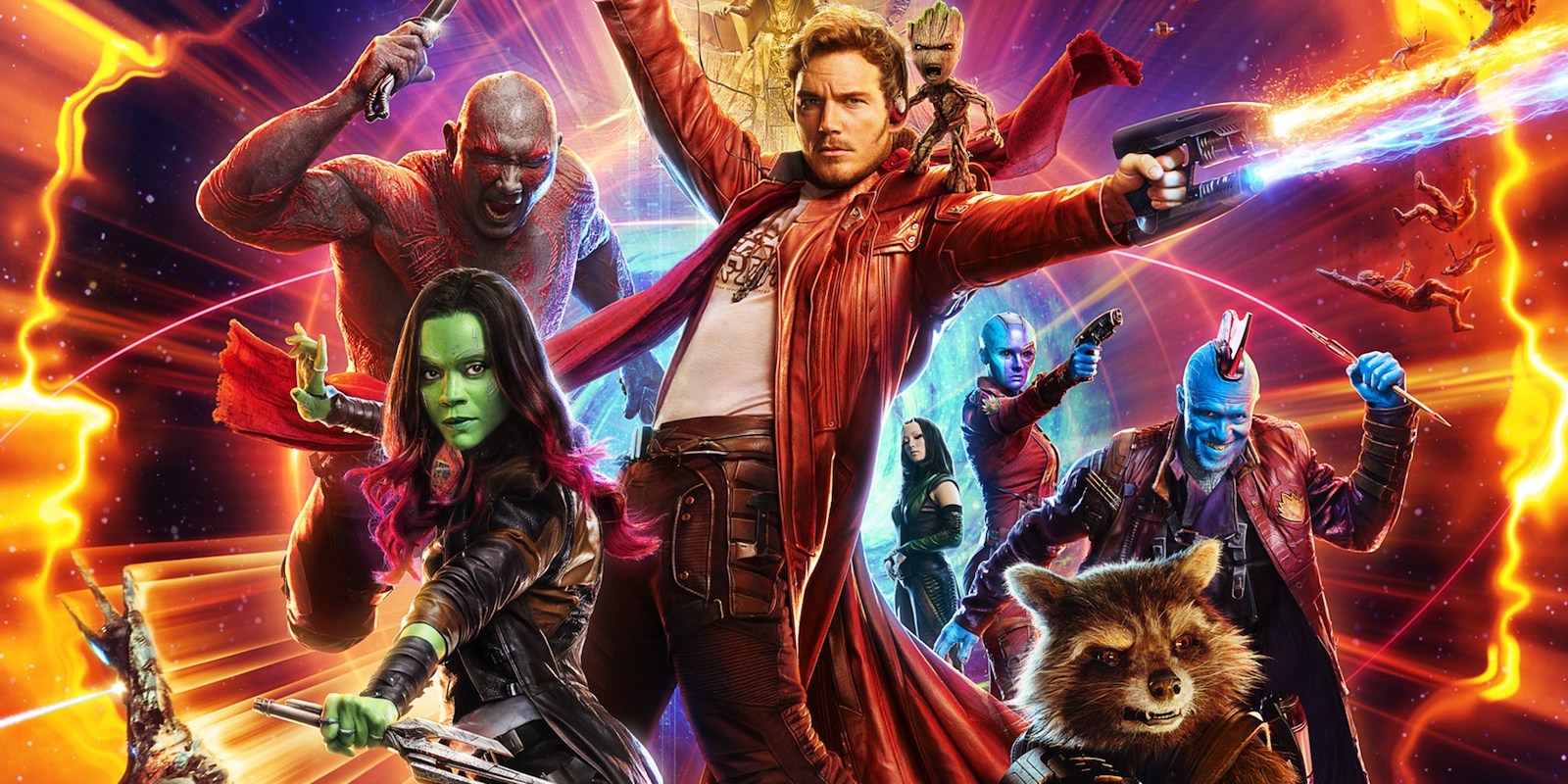
Originally conceived as Marvel’s intergalactic ‘B team’, 2014’s Guardians of the Galaxy proved to be one of the most popular films the studio has put out so far in its – by now – almost reassuringly predictable conveyor belt run of solid, flashy superhero movies. With the Marvel cinematic universe’s… well… universe nicely mapped out now, GoTG 2 dispenses with the Infinity Stones, allows itself to get a little weirder and carves out more of an identity for its band of roguish heroes than simply ‘The Avengers in space’.
The majority of the plot is, as with most of these movies, fairly inconsequential; basically the important thing to know is that Kurt Russell is playing Ego; essentially a living planet, and – duh duh DUH – Star Lord (Pratt)’s father. Yondu (Rooker) pops up again, as does Nebula (Gillan) and, happily, both are given slightly more to do this time around. Rooker in particular gets a couple of big moments, and is characteristically effective; gruff yet honourable, with a heart of gold and a snazzy new Mohawk head-fin. New character Mantis (Klementieff), an empath who can experience the emotions of those she touches, is likeable but feels extraneous; she essentially has one function in the film, which she fulfils right towards the end of the movie, the rest of the time playing off Drax (Dave Bautista), as the two guileless, very literally minded characters develop a strangely endearing friendship.
GoTG 2 mostly coasts on the charisma of its cast, although it has a more solidly emotional centre than the mawkish first film. It’s still prone to moments of sickly sentimentality (some of the dialogue is real Hallmark greetings cards bullshit), but the estranged father/son relationship between Star Lord and Ego is quite effective. Pratt and Russell play it with just the right balance of warmth and mistrust – as well as a lot of charm, obviously – although there is an unavoidable sense that their potentially very interesting relationship is rushed through so we can keep up with the rest of the characters and tick off the story beats leading to an inevitable ‘boss fight’ at the film’s climax.
In fact, the film as a whole suffers from some wonky pacing. The first half of the film revels in the ‘casual hangout vibe’ that GoTG has become known for, and so when the second half kicks off a series of action sequences, returning characters and emotional confrontations – wherein our characters whisper and shout monologues at each other about Who They Are And How They Came To Be – it can feel vaguely exhausting (there is a lot of this latter point by the way… almost everybody gets to take a minute out to explain their motivations and personalities to the camera as much as to other characters).
Still, as far as irreverent, bubblegum space operas go, GoTG 2 is decent rainy-day fun, expanding on its predecessor nicely by showing a weirder* and more emotionally engaging side of the MCU’s intergalactic setting. It may feel strangely lackadaisical when it should be running in high gear (and vice versa), but it shows a smart step in the right direction; further into the strange and unwieldy corners of the Marvel universe, away from the more traditional action beats more than satisfied in other, Earth-bound Marvel movies. The more this franchise allows itself to lean into the genuinely cosmic as opposed to more standard, codified story beats and characters simply wrapped in sci-fi dressing, the more distinct and worthwhile it will become.
*The mere concept of Ego (a character first appearing in Thor in 1966) is more interesting and ‘out there’ than anything in the first movie, which prided itself to irritation on being ‘totally weird and rad, yo!’, and yet played pretty much as, to use my snarky phrase from the beginning of this review, ‘The Avengers in space’.
Alien

1979
Director: Ridley Scott
Starring: Sigourney Weaver, Ian Holm, John Hurt, Tom Skerritt, Veronica Cartwright, Yaphet Kotto, Harry Dean Stanton, Bolaji Badejo
Words: Nathan Scatcherd
Living as we do in the year 2017, it’s difficult to imagine the sheer force Alien must have had upon audiences when it was released back in 1979.
Coming seemingly from nowhere, as though sprung from one of its titular creature’s eggs, the film has had such a cultural impact since then that it’s easy to live in a state of ignorance, unaware of just how much singular influence this innocuous little “intergalactic haunted house thriller set inside a spaceship” (to quote Roger Ebert’s review) has had on science fiction, horror movies, and popular culture in general.
What’s especially impressive is that it came not long after the sci-fi juggernaut that is Star Wars had just exploded onto the scene. Released just two years previously in 1977, Star Wars (A New Hope) was a bright, family-friendly affirmation of science fiction’s power to inspire wonder, and create a sense of huge scope and adventure.
Alien, while being as much a sci-fi film (insofar as it too is concerned with the usual genre trappings of space travel and yes, extraterrestrial life) went totally the opposite way. It’s dark, claustrophobic, bloody, and thick with scary, ominous atmosphere as opposed to flash and spectacle.
Alien’s real winning stroke lies in its stripped-back simplicity. It doesn’t waste any time and feels perfectly paced, with a simple plot which just nicely sets up the horror to come.
I’m presuming if you’re reading this that you haven’t been living under a rock for the past three and a half decades, so you at least know the basic gist, but anyway: the crew of a mining vessel, ‘the Nostromo’ (owned by the shadowy Weyland-Yutani corporation), find what appears to be a distress signal; they investigate and unwittingly bring a very nasty alien life-form back onboard; John Hurt gets some terrible indigestion, people start dying and Sigourney Weaver’s badass warrant officer, Ellen Ripley, faces off against the creature while attempting to escape the ship.
That’s it – no branching subplots; no grand, operatic mythos. The film takes just enough time to build tension and mount a sense of dread that – at least for the first twenty minutes or so – it perhaps qualifies as something of a slow burn. However, this shouldn’t be confused with heel-dragging. The film steadily ramps up the feeling of being adrift in space, trapped and eventually hunted by something utterly without mercy. To again analogise it in terms of its titular creature, Alien is lean and fierce and isn’t f*cking around.
Of course, this isn’t to say that it’s devoid of atmosphere or style. In fact the opposite is true. Whereas sci-fi of the time was focused on making the future look futuristic, with a uniformly shiny aesthetic, imagining a world of tomorrow filled with gleaming robots and high-tech spacecraft, Alien’s vision of the future looks and feels much dirtier and oilier; more grounded and blue-collar. The Nostromo is an old, creaking hulk of a vessel, not at all some sleek starship, with a decidedly low-tech aesthetic. Simple, blocky computers beep and hum; pipes noisily belch steam; the place feels authentically lived-in and functional.
And as we all know, the Alien itself is one of the creepiest and most iconic creature designs of all time – although today it may be a little obvious in certain shots that, yeah, it’s just a guy (Bolaji Badejo) in a suit, director Ridley Scott still uses shadow and reserved, teasing editing tricks to present the Alien in a palpably threatening and unsettling way. We’re never really allowed a good, clear look at it until the film’s final scenes, heightening the disorientation and terror that Ripley and the crew would be feeling and putting us right there with them.
Swiss surrealist HR Giger designed the Alien as a kind of overtly sexualised threat, with its deadly phallic tongue/second mouth and sleek, almost feminine body, and of course the infamous ‘Chestburster scene’ makes almost explicit the theme of forced pregnancy and birth which would go on to manifest itself even more in the sequels. Looking like a slick, oily cross-breed of the mechanical and the organic, the Alien is an enduringly fascinating thing just to look at, and be afraid of.
Alien wouldn’t be half the film it is without a compelling protagonist to root for, though. Although nowadays Weaver’s Ellen Ripley is so synonymous with the franchise that it seems a given that it was always going to be her as the film’s ‘final girl’ (to draw a parallel between Alien and slasher movie convention), what’s interesting when watching the film back now is how it doesn’t immediately, obviously cast her as such.
To audiences in ’79, it must have felt like any one of the crew could be its main ‘hero’, with Tom Skerritt’s captain Dallas a seeming red herring (his stoic, level-headed pragmatism marks him out as a classical masculine hero, a prime protagonist… until he’s killed by the Alien in one of its most tense scenes, as he investigates the air ducts running through the ship).
Ripley is more or less on the sidelines to begin with, gradually coming into her own and eventually proving through smarts and nerves of steel that she is as much a survivor as the Alien; a theme which is played on even more in the follow-up Aliens, where she makes the leap from ‘tough, capable survivor’ to ‘full blown action hero’.
Prometheus
2012
Director: Ridley Scott
Starring: Noomi Rapace, Logan Marshall-Green, Michael Fassbender, Charlize Theron, Idris Elba, Rafe Spall, Sean Harris, Guy Pearce
Words: N. Scatcherd
Prometheus is a film which, from its inception, seemed like it was being made up on the spot. It was announced as a straight Alien prequel; and then as a story set in the same ‘world’ but having nothing directly to do with the Alien franchise; and then emerging as something between those two things, with director Ridley Scott calling back to his original ‘79 film while attempting to spin things off into an altogether separate strand of mythology.
It could be argued that Scott and co were playing coy about how Prometheus fit into the series in an attempt to drum up mystique and speculation, but the finished film seems so sloppy and haphazard at points that it seems more like there were some opposing impulses at play; a desire for artistic freedom on one hand, and on the other, a begrudging acknowledgement of the studio’s need for fan-appeasement. The film wants to have its cake and eat it, trying to stand on its own feet as a new, sweeping sci-fi epic untethered by expectation, while also resignedly and limply nodding at the original film as though it feels obliged to.
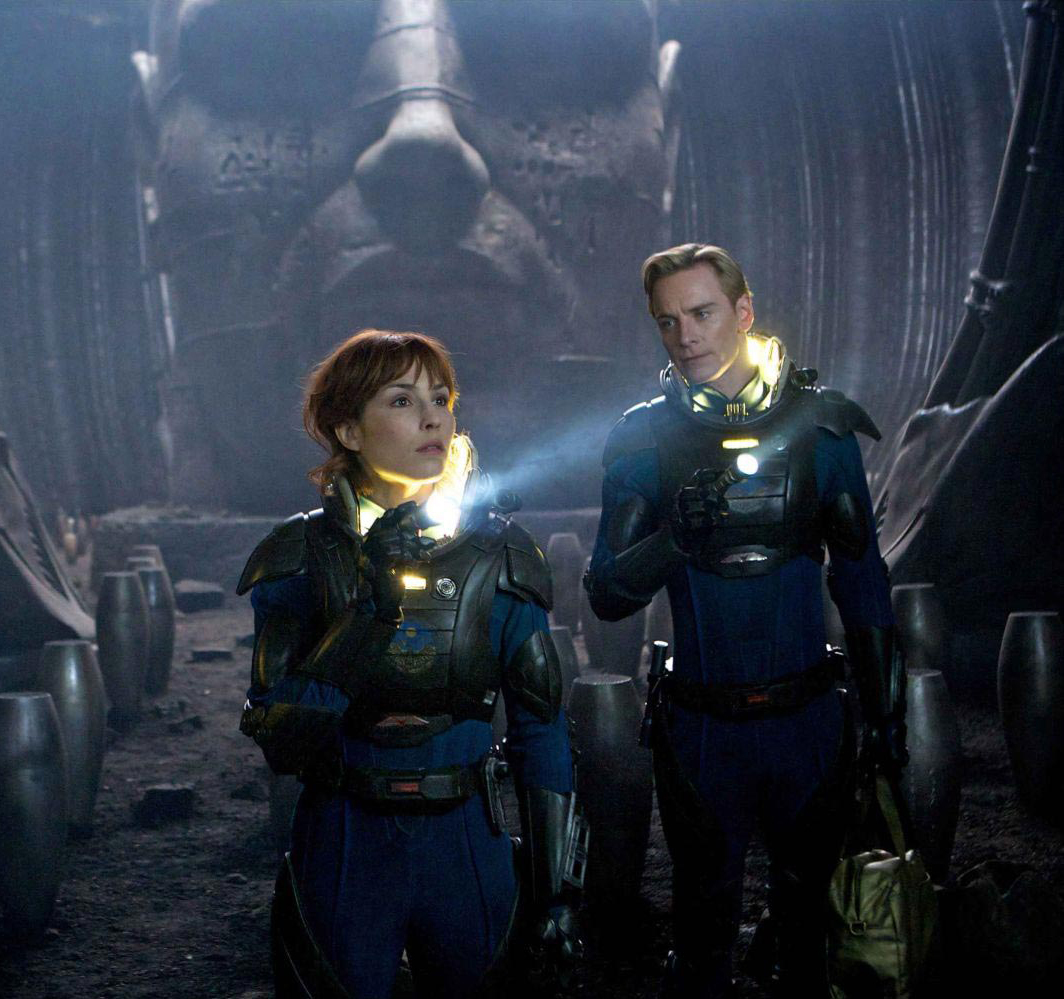
Scientist Elizabeth Shaw (Noomi Rapace) and her boyfriend/fellow scientist Charlie (Logan Marshall-Green) discover ancient cave paintings which appear to show how a race of aliens – dubbed ‘Engineers’ – had a guiding hand in the development of early humanity (as it turns out, they actually created human life on Earth). So, our intrepid protagonists jet off with a crew of fellow scientific folk from various fields of research, all of whom have been hired by the Weyland corporation (this is indeed a prequel, taking place pre-merger before the company is ‘Weyland-Yutani’, as we know it from the rest of the Alien series), and of course things spin out of control as they delve into the fundamental questions of existence, and come face to face with makers who seem less than benevolent.
The film certainly looks good, at least. A particular standout is the almost dreamlike opening scene, wherein one of the Engineers appears to sacrifice his own DNA in the creation of human life. Also, the creatures here are particularly icky and frightening (a huge, monstrous kind of proto-Facehugger appears in one scene and is genuinely horrific). Ridley Scott certainly still has a flair for visual design, and on that count Prometheus is undeniably strong.
It’s the storytelling that lets the film down, with some bafflingly lazy scripting and stilted dialogue. Supposedly intelligent characters behave in some scenes like total idiots just so the plot can progress in a certain way (the most irksome example being Rafe Spall’s biologist deciding that, when faced with an obviously hostile serpent creature, the best course of action is to treat it like a cute little puppy). There are also holographic visual recordings of the Engineers which appear seemingly at random, used as a lazy way of tossing off bits and pieces of backstory. They genuinely make no sense at all and feel entirely devoid of context (and don’t get me started on the ‘black alien goo’ which seems to do whatever the plot dictates it can at any given moment).
Perhaps the most frustrating thing about Prometheus is how self-important it feels. Scott seems to overestimate how interesting his plot actually is, teasing all these ‘Big Ideas’ about the creation of humanity; where we come from, why we’re here, and our ultimate destiny – but they’re all ideas which have been explored in more depth, and more entertainingly, elsewhere. The answers we do get feel ploddingly predictable, and by the end of the film there are only more questions raised. It’s no surprise that it was co-written by Damon Lindelof, co-creator and chief writer of the infamous TV series Lost, which was similarly nebulous and evasive when it came to what the ‘point’ was.
At its core, Prometheus feels like a lot of set-up with little pay-off; a two hour prologue for a movie which might actually do something interesting with the Alien series.
Hopefully Alien: Covenant will take the glimmer of potential Prometheus offered and make good on it.
After all, isn’t it about time we had another decent Alien movie?
_
Must See Movies: May

At Reel Steel we want to make sure you’re getting the most of your cinematic enthusiasm, so each month we put together our short list of some of the best new releases, from popcorn munching explosion fests to the often weird and wonderful.
Take a look at the trailers below and see what you think to this month’s recommendations!
Mindhorn
released Friday May 5th, 2017
Washed-up actor Richard Thorncroft (Julian Barratt) known for playing 1980’s British TV detective Mindhorn, works alongside the police to catch a serial killer who will only speak to Mindhorn – whom he believes to be real.
As the actor long past his prime returns to the scene of his greatest triumphs, he attempts for one last chance to reignite his glory days.
Alien: Covenant
released Friday May 12th, 2017
Bound for a remote planet on the far side of the galaxy, the crew of the colony ship Covenant discover what they think is an uncharted paradise.
While there, they meet David (Michael Fassbender), the synthetic survivor of the Prometheus expedition, and when they uncover a threat beyond their imagination, they find themselves in a deadly fight for survival.
This Alien prequel slots into the timeline of the sci-fi franchise following the events that took place in Prometheus, with a return to the Alien universe from director Ridley Scott.
The Red Turtle
released Friday May 26th, 2017
Through the story of a man shipwrecked on a tropical island, The Red Turtle recounts the milestones in the life of a human being.
This animated feature is co-produced by the award winning and world renowned Studio Ghibli (Spirited Away, My Neighbour Totoro), with a gripping story of survival and adventure, that reflects on the things most important in life.
– SPECIAL EVENT –

The Lodger
with live soundtrack
Friday May 5th, 2017
A serial killer is on the loose in London and the city is on high alert.
Meanwhile, the mysterious new lodger at the home of Mr and Mrs Bunting starts to attract suspicion – could he be the man police are hunting for?
The Yorkshire Silent Film Festival opens with this screening at the Abbeydale Picture House – Sheffield’s Grade II listed 1920’s picture palace cinema, the perfect setting for this masterpiece from Alfred Hitchcock, which will also be accompanied by the performance of an original new soundtrack.
More information and tickets available here –

Man With A Movie Camera
with live soundtrack
Sunday May 7th, 2017
This 1929 groundbreaking documentary captures city life in the Soviet Union over the course of a single day.
It’s an engaging and pioneering film about making a film that had a profound influence on the development of cinematic art.
This screening will be accompanied by a live soundtrack from Sheffield’s own Ensemble 360 – a joint event between Music In The Round and the University of Sheffield Festival of Arts and Humanities.
More information and tickets available here –
http://www.musicintheround.co.uk/event.php?id=1039
_
Free Fire

2017 – UK
Director: Ben Wheatley
Starring: Sharlto Copley, Brie Larson, Cillian Murphy, Armie Hammer, Jack Reynor, Michael Smiley, Sam Riley, Noah Taylor
Words: Josh Senior
Ben Wheatley is fast becoming the best British cult filmmaker of our times, and with Free Fire he shows no signs of stopping anytime soon. Hot off the back of dystopian caper High-Rise in 2016, he returns with this scaled down action comedy. Which is wickedly funny and as can be expected of a Wheatley film, gleefully bloody.
The basic premise is this, a gun deal between two gangs in a 70’s era Boston warehouse gone wrong. Which then leads to a mass shoot out, a free for all, and a pile of dead bodies. The comparisons to City on Fire and Reservoir Dogs are obviously there, but this film is far cleverer than either of the latter, with a razor sharp script and ingenious cinematography thrown in for good measure. What little soundtrack there is, is replaced with diegetic sound as bullets ricochet off metal and concrete and the only sound that dominates are the cries and groans of people as they get shot, or return fire.
This is all played for huge laughs and the star studded cast clearly had a lot of fun filming this, their chemistry and charisma spills onto the screen seamlessly.
For a film about a shoot-out it derives its comedy from its humanity. These crooks and villains are not action ready warriors, who dodge bullets and have endless amounts of stamina. The hilarity is watching each character slowly get weighed down by multiple bullet wounds and lack of blood as they all crawl around in the dirt, each attempting to reach their intended goal. Sharlto Copley’s Vern is willing to crawl through glass to reach for a briefcase of money, and Cillian Murphy’s Chris goes to similar depraving lengths to save his friends and make away with the guns he needs.
Free Fire is exactly as you’d expect it to be, a fantastically put together 90 minute blast of entertainment laced with the wit and gore we now come to expect from Ben Wheatley. He has proved himself to be one of our very best directors working today, a man who can try his hand in any genre whether that be; the gangster movie Down Terrace, the dark and foreboding Kill List, the black comedy of Sightseers, the surreal and mind-bending A Field in England or the nightmarish High-Rise. Each stands apart as an individually iconic piece of work which then knits together into the tapestry of Wheatley’s ever expanding collection of stunningly well made, and impressive independent films. Of which Free Fire is now the jewel in the crown. Kiss kiss, bang bang.
Raw

2016 – France
Director: Julia Ducournau
Starring: Garance Marillier, Ella Rumpf, Rabah Nait Oufella
Words: Christian Abbott
Raw by French filmmaker Julia Ducournau, her theatrical debut, is the latest addition to the cannibal sub-genre, while managing to remain entirely its own film. This is a visually striking work in both composition and content, a sort of merging of genre fiction and arthouse style. Ducournau, who also wrote the film, has delivered a true horror vision – stomach churning, disturbing and unsettling.
We follow a young girl, Justine (Garance Marrilier), a vegetarian on her first day of veterinary school. Soon she has to go through a series of ritualistic trials to be welcomed by the other students, one such trial – eating raw rabbit meat. Justine, much to her confusion and disgust, soon garners a taste for more.
The story of Justine’s cannibalistic self-discovery is the surface level of the film, as with all great horror’s, the narrative is there to explore deeper questions. Here, the film throws up the issues of exploring self, sexuality and place. Marrilier gives an exciting and engaging performance as Justine, managing to juggle the nuances of the story while making the more outlandish and consciously comedic moments believable.
The negatives of the film, while few, are note-worthy. For such a unique premise, it is rather predictable, with the more bizarre moments being thrown in to give a sense of uncertainty. Also, the theme of animal rights, something that should seem integral to the film is mentioned briefly and quickly forgotten. Seeing Justine come to terms with her desires vs her beliefs would have made for some fascinating philosophical questions but it is largely ignored.
However, that is not what the film was, and what is there is a refreshingly good piece of work in the horror genre. Ducournau is certainly a filmmaker to watch, Raw exudes promise and to see that potential blossom is just as exciting as the film we have now.
_
Ghost In The Shell

2017 – USA
Director: Rupert Sanders
Starring: Scarlett Johansson, Pilou Asbæk, Takeshi Kitano
Words: Christian Abbott
22 years after the original film changed the course of modern science-fiction, influencing and inspiring filmmakers who would later go on to make films such as The Matrix, I,Robot, Ex Machina among many others, now we have a Hollywood remake that is anything but inspired. The politics of this film have been debated since the announcement of Scarlett Johansson who was cast as the lead: The Major. Putting all that aside, judging the film on its own merit is rather disheartening – it is never a good sign when you are watch checking by the 15 minute mark.
The Major – a cyber-enhanced human to be used as a super weapon is tasked to stop the world’s deadliest hacker. That is the premise, on paper it sounds exciting, but the execution is so bland that even the flashiest of lights in the city of Neo-Tokyo’s vistas can’t save it. All character’s aside The Major are completely one-dimensional, many simply footnotes side of frame in the occasional scene. Johansson, with Under the Skin and Lucy under her belt has become known for these not-quite-human characters and again she excels in this. Unfortunately she is completely under served by a script that would rather dance past the philosophical discussions of the original film, rather focusing on the visuals and set pieces (which are impressive to be admitted).
That is largely the problem with the entire film, it is all surface, besides the gimmick of seeing these characters in live action, there is little reason to watch this when the outstanding original got it right 20 years ago.
The finished product is actually something of a disappointment, while many online seemed to want it to fail, I had hopes it would at least entertain, yet, it even failed in that. This will be forgotten to the garbage bin of science-fiction misfires. Pass.
 REEL STEEL
You must be logged in to post a comment.