Cult Corner: Dogtooth

2009
Directed by: Yorgos Lanthimos
Starring: Christos Stergioglou, Michelle Valley, Angeliki Papoulia, Christos Passalis, Mary Tsoni, Anna Kalaitzidou
Words: Nathan Scatcherd
Perhaps best known internationally as the director of cult hit The Lobster from 2015 (starring ‘big names’ such as Colin Farrell and Rachel Weisz), Yorgos Lanthimos is becoming a recognised name as his newest film, The Killing of a Sacred Deer, looks set to bring him even more critical adulation outside of his native Greece, having taken the Best Screenplay award at Cannes.
But it’s Dogtooth, his second full length Greek film, which really announced his strange, idiosyncratic style; an interest in pitch black subject matter and the inherent absurdities and dark humour that can arise from Very Bad Things.
Dogtooth places us into a deeply dysfunctional family unit. The patriarch of the house (Stergioglou) is a quietly unnerving, pathologically controlling slimeball who, with the aid of his emotionally damaged wife (Valley), keeps their three young adult children (Papoulia, Passalis and Tsoni) in a state of perpetual infantilisation and dependence on each other. Their parents regularly feed them lies about the outside world to further ingrain the trio’s dependence on their – in their hopeless eyes – saintly parents (for example, cats are explained to the children as being ferocious, bloodthirsty creatures they should stay away from and guard their house against at all costs. The children are also told that a recording of Frank Sinatra is actually their grandfather singing to them about the importance of family).
The film is shot through with such instances of off-kilter, underplayed humour, occasionally almost nudging the viewer and daring them to see the funny side of what is, when considered soberly, a genuinely disturbing and horrific situation.
It’s the relationship between the children that provides the film’s core; specifically the slowly dawning rebelliousness of the eldest daughter (Papoulia) as she realises that Mum and Dad might not be so trustworthy after all. Rather than explaining how the family got to such a state, or exploring the motives behind the father in particular (the closest thing the film has to an antagonist), Dogtooth instead focuses mainly on the strange, needful bond between these obliviously abused young people, as they play, fight, curry favour with their parents and explore their sexuality.
Dogtooth is by no means a comfortable film to watch, but it is a surreal, darkly funny and casually shocking study of one fascinatingly f*cked up family.
Spider-Man: Homecoming

2017 – USA
Director: Jon Watts
Starring: Tom Holland, Zendaya, Michael Keaton, Robert Downey Jr., Jacob Batalon, Marisa Tomei, Jon Favreau
Words: Josh Senior
Let’s start things off here with some trivia, Sam Raimi’s original Spider-Man in 2002 was the very first film that I sneaked into underage, a week or so before the advent of the 12A rating certificate when I was 11. In fact it’s probably the film that sparked off my obsession with cinema. The character was, and still is, my all time favourite across film and television. And every time a new cinematic iteration comes out I get excited, to a varying mixture of results.
Sam Raimi’s trilogy got off to a bang and then continued its strong work into Spider-Man 2, then Raimi lay waste to all his hard work by making Spider-Man 3, which was just schmaltzy and awful. It was his attempt to push back against the studios insistence of including the Venom character. He was never allowed to make Spider-Man 4.
Marc Webb then had a go with his indie sensibilities and produced the decent, Amazing Spider-Man in 2012 followed up by the slightly mixed Amazing Spider-Man 2 a couple of years later. He in turn was never allowed to follow things up and make Amazing-Spider-Man 3 & 4. Even though he had filmed lots of footage for them already.
Spider-Man’s cinematic life so far has been on the large, just O.K. A director really hasn’t come in as of yet and grasped what the character really stands for, and adapted him as he was from the comics.
Not until Sony decided to partner up with Marvel in 2015 that is…
The result of this happy marriage is Spider-Man: Homecoming, a re-introduction if you will, to Marvel’s most famous creation. Finally given the chance to shake things up in the now well established MCU. Jon Watts, hot off the back of low budget success with his film Cop Car takes the helm on this one… and you know what, someone has finally gotten it right.
The problem of “Spidermen-past” is that they never cast the role properly. Worried about having a superhero franchise fronted by a teenager Sony cast Tobey Maguire and then Andrew Garfield in the main role. Each time they told the character’s origin story they had a 30 year-old pretending to be 14, and then because of this they had to quickly brush past Spider-Man’s teen years and thrust him into adulthood. Thus leaving behind the most important parts that make Spider-Man who he is. Now, with Tom Holland in the lead role this issue can be revisited and built upon.
The “homecoming” in the title is a cute nod to the character’s return to Marvel, but also a direct reference to the high school ritual, the tradition of welcoming back former students and celebrating a school’s existence. It juxtaposes greatly the life of a crime fighting hero against the everyday trials and tribulations of teenage life. Even when Peter Parker is trying to save the world, he is still thinking about Instagram and selfies and whether girls like him or not. He is more grounded, and more believable.
Marvel has also dispensed with the traditional origin story, and after his introduction in Captain America: Civil War, we are dropped straight into Peter Parker’s life. He is already a hero (if one still learning his craft), and allusions to his genesis are only hinted at. We all know the story by now, so it’s time to get on with things.
Peter is moonlighting as Spider-Man, using his new suit provided by one Tony Stark and is desperate to prove himself. A challenge arises when The Vulture/Adrian Toomes, played by Michael Keaton embarks upon a spree of robberies using alien technology salvaged from the climatic events of The Avengers. However, Peter is warned by Stark to stay clear of The Vulture and not to put himself at risk. Which he obviously does, causing his suit to be taken away, all the while angering his new found nemesis. Peter has to spend the remainder of the film isolated from The Avengers and Iron Man with only his wits to support him, and as his high school life begins to put pressure on his social life, he struggles to keep his life as Peter Parker separate from his life as Spider-Man.
The real strength of this film is simply that, the duality of Peter Parker vs. Spider-Man, which is something the previous films addressed as well. However, his age in this film makes it the most interesting take on the character thus far. Especially in opposition to The Vulture, who is a man pushed to villainy, when his haulage company (who are dismantling the mess caused by The Avengers) have their contract taken from them.
Using some of the technology they have already salvaged, and feeling responsibility for his employees, Adrian Toomes becomes a reluctant villain and embarks upon an almost Robin-Hood type mission. He does transcend into Machiavellian overtures towards the end, drunk on power. But he is a character who we can partly sympathise with. His morality is only questioned further when pitched against a teenager who is trying to find his way in life.
This in essence is exactly what Spider-Man should be, and this is achieved in Homecoming. Overall, it hits all the right notes in terms of being a comedic piece that is high on action. It doesn’t raise the bar too high though, it may be the best Spider-Man film yet, but by no means is it the best Marvel film. This was most likely intentional, as the character still has a long way to go considering Holland’s six movie deal. With appearances in the next two Avengers films, he has also been tasked with ushering in the next generation of the MCU in this film’s sequel. Most likely taking over Iron Man’s leadership role.
The ensemble cast here is also really good; Robert Downey Jr. getting to Robert Downey Jr. a bit, Jacob Batalon as Ned, Peter Parker’s best-friend, Marisa Tomei as a younger and more valued Aunt May, Jon Favreau returns as Tony Stark’s aid Happy and a small cameo from Donald Glover doesn’t go amiss either. There’s enough here to really stand by this era for the character and press ahead into more daring ground. And even though all the trailers seemed to give you the entire plot, I promise you there’s enough twists and promises of stories to follow to keep you interested for whatever they decide to call the next film.
Let’s not call it Spider-Man: Graduation though, for the time being it’s cool to be in school.
Doc/Fest Diary 2017: Part One

Christian Abbot makes his annual pilgrimage to the world’s finest film festival which just so happens to take place in our great City of Sheffield. Taking in as many documentaries as his mind can handle, Christian provides us with his diary from the weekend. Below are films he managed to see at this year’s festival and his thoughts on each. Look out for Part Two, next week and enjoy!
Queerama (Opening night film)
Each year the festival prides itself in tolerance, openness and diversity, this year is no different and the choice of opening night film reflects this deeply. While these are aspects of society we can now pride ourselves upon, it wasn’t always so. It has been 50 years since the decriminalisation of homosexuality, something which now appears unthinkable to have ever once been viewed as such. Queerama reminds us of this once different worldview. The film is a series of clips and found footage scenes from documentaries past, television and home video. The footage is often shocking, not only in the scenes of men and woman hiding their identity on screen for daring to speak out but also in the fact that many were so open about their sexuality in a time that such thoughts alone would have been punishable in the eyes of the law. It is a film of mixed emotions, some of pride that as a country we have moved on from such dark times, but there was also a feeling of embarrassment and shame that this was ever the case. These feelings did not persist however as the film was followed by the opening night Ballroom, the vibe of which was pride, joy and optimism. This summates the festival as a whole, that we should never forget our past; we should accept it and take peace in ourselves for making a change and continuing it further with each coming day.
Click here for the Vimeo trailer!
The Road Movie
The festival this year set off to a light-hearted and easing tone, one which reflected the overall joy and optimism of the coming five days. Often we hear stories of the day to day goings on in Russian life, how polar opposite and regularly absurd it can be. The nonchalant attitude they have in the face of this absurdity is the driving force behind the first documentary this year. It is just that – a driving force. The picture is a series of dash-cam footages, presented in a way that is a stone’s throw from a compilation video from YouTube. Surprisingly however this works completely in the films favour. There is no reliance on narration or lynchpin dramatic moments; instead it is edited so effortlessly, guiding us through the hilarious to the shocking. Moments of carnage, violence, mishaps, dim-wittedness and a general lack of road safety are the substance here, and the pace is a perfect introductory feature into the festivals wider world of international intrigue.
Unrest
When it comes to the field of scientific research, medical illnesses and suffering at large, often the personal experience is marginalised as little more than a statistic. Unrest flips that notion over completely. Sufferers of ME (chronic fatigue syndrome) are largely one of the most misunderstood and underrepresented groups – often being seen as little more than lazy individuals. It is also an illness with effects woman on a much wider scale. It is one such woman that is the subject of her own making in this documentary, Jennifer Brea – a young, intelligent and most importantly healthy woman that in the midst of studying for her PhD at Harvard was taken into hospital for said illness. She was unable to leave her bed, confused and frustrated with the lack of answers from her doctors and careers, it was at this point she decided to turn a camera onto herself to show the world the effects of this debilitating suffering.
Unrest works mostly as a daily life style blog, revealing the day to day of an illness that is difficult to even imagine. Through her work she discovers a network of individuals online whom also suffer ME; it becomes not only her story but theirs – everyone that suffers this. A statistic many didn’t even know existed is laid bare by Brea’s intimate camerawork. The struggles of life, family and finding happiness are there for all to see – and the importance of being able to see it cannot be understated.
Do Donkeys Act?
Easily the most bizarre film of the festival and a contender for the year, we follow a donkey made protagonist of an existential and meandering thought-piece. It cannot be denied the film knows exactly what it is however; Willem Defoe narrates the film after all, revealing the inner thoughts and feelings of our awkwardly stubborn hero. The hook of the piece is this, to re-evaluate the Donkey as a dumb animal and see it as something more – something poetic. How does the film achieve this? By setting up a series of increasingly dramatic events for the donkey to inhabit – largely to varying results. The less said the better as this is truly a film to be seen as to be believed.
The Boy and The Beast
2015
Director: Mamoru Hosoda
Words – Joe H.
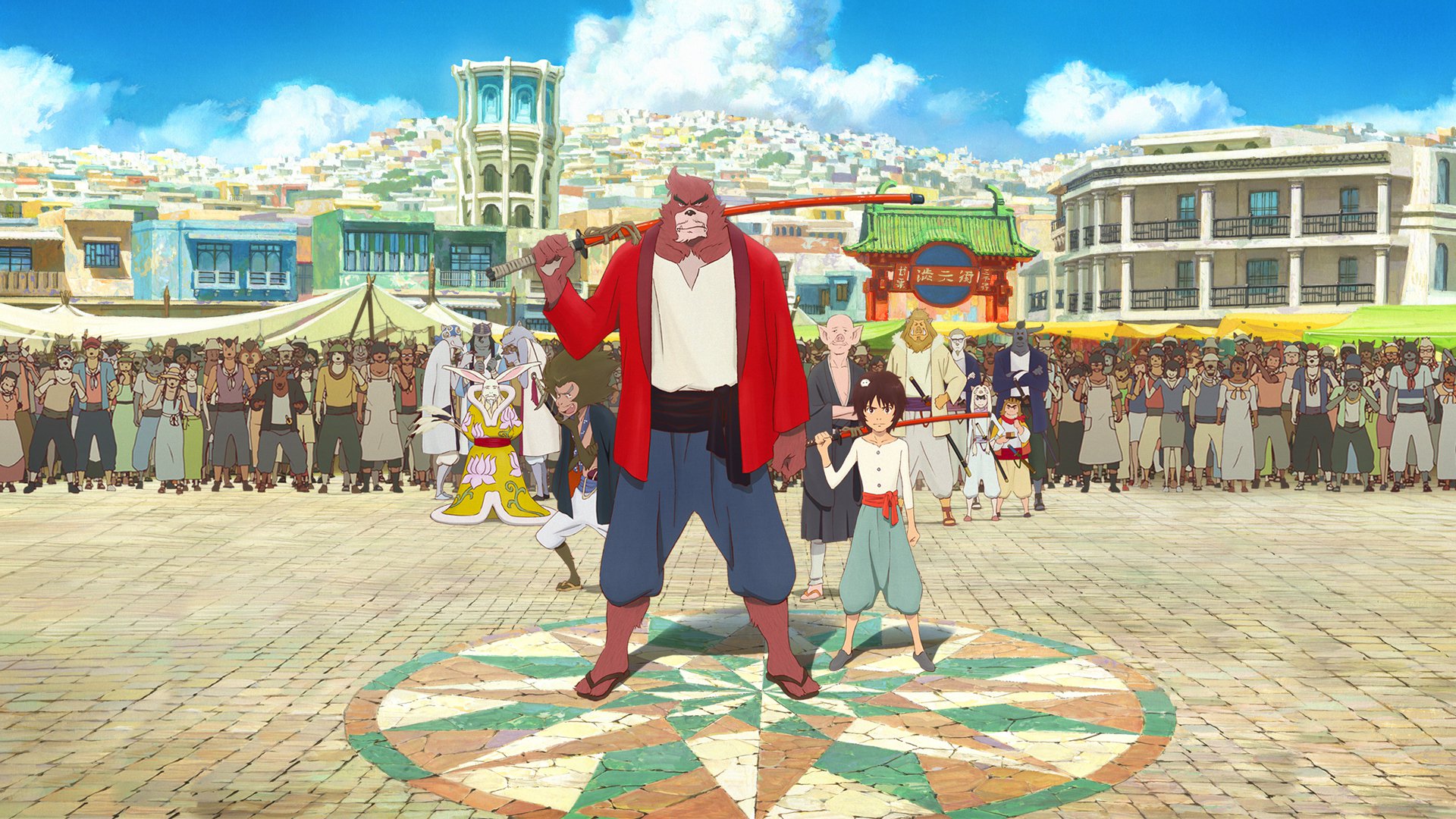
The fourth Anime feature from award-winning director Mamoru Hosoda – who previously brought us the spectacular vision of the danger in our digitally connected world in Summer Wars, and the critically acclaimed The Girl Who Leapt Through Time – The Boy and the Beast tells the story of Kyuta, a young orphan living on the streets of Tokyo after losing his mother, wandering aimlessly and carrying a weight of inner turmoil.
A chance encounter changes the course of his life however when he meets Kumatetsu – a crude, rough-around-the-edges warrior beast who’s been searching for the perfect apprentice. As he stumbles into Jutengai, the fantastic world of the beasts that exists alongside our own world, he finds that Kumatetsu may be taking on an apprentice for selfish reasons – to rise from being a Master, to becoming Lord of Jutengai.
As the two begin their training, it is quickly apparent that the two are so alike they clash – constantly arguing and refusing to give way to each other, the relationship between the two of them is charming, as despite their constant bickering, this unlucky boy and lonely beast together slowly form a bond as surrogate father and son.
A deeper narative begins to emerge here – with the growth of a child and of how the experiences we have shape us, we’re raised by many different people growing up and we become who we are through the people around us, while learning how to handle ourselves and realising that there are a lot of things we can’t do on our own.
The two characters find strength in each other as they go on a journey that brings new purpose to their lives, in the end having to face their own demons to overcome that which holds them back.
The animation is gorgeous – the incredible detail of the cityscape in the Tokyo district of Shibuya is something to behold, and with the enchanting world of Jutengai a lush and colourful environment, the two compliment each other with a hand-drawn warmth creating worlds both feeling equally real, along with great action and fluid detail during battle sequences.
The soundtrack is beautiful, both heartwarming and cheerful and accentuating the mood of scenes perfectly – with the full score since having its own special vinyl release via soundtrack specialists Milan Records.
It would be unfair to compare this film rather than view it in its own right, simply because it’s an animation from Japan, but for the many whose only experience of Japanese animation is the work of Studio Ghibli (many of the same animators worked on this feature), this is a film that will please in the same way, encompassing the same magic and wonder of Spirited Away and the action of Princess Mononoke.
This is a thoroughly enjoyable and touching story, well worth making the effort to see.
Must See Movies: July

At Reel Steel we want to make sure you’re getting the most of your cinematic enthusiasm, so each month we put together our short list of some of the best new releases, from popcorn munching explosion fests to the often weird and wonderful.
Take a look at the trailers below and see what you think to this month’s recommendations!
Spider-Man: Homecoming
released Friday July 7th, 2017
Taking place following the events of Captain America: Civil War, where we were introduced to this young web-slinging hero, a new enemy known as The Vulture must be faced, while under the guidance of a certain Mr Tony Stark.
It Comes At Night
released Friday July 7th, 2017
In the not-so-distant future, people have been forced to retreat into isolation to protect themselves from an unnatural enemy.
A man has managed to establish a home with his wife and son hidden deep in the forest, but his humanity is put to the test when a desperate young family arrive at their door.
As the horrors of the outside world creep ever nearer, paranoia and suspicion create tensions between the two families, as we see just how far someone will go to protect their own.
Following the surprise run-away success of the horror-thriller Get Out earlier this year, this tense and claustrophobic feature that relies more on psychological fear looks set to make waves with audiences.
The Beguiled
released Friday July 14th, 2017
From Sofia Coppola, director of Lost In Translation and The Virgin Suicides, comes this feature based on the novel The Beguiled by Thomas P. Cullinan.
An injured Union soldier arrives at an all-female Southern boarding school during the Civil War.
As he recovers, he takes advantage of his situation, but soon tensions lead to dangerous rivalries as he incurs the wrath of his hosts in this twisting drama.
Dunkirk
released Friday July 21st, 2017
In May 1940, Nazi forces advanced into France, trapping Allied troops on the beaches of Dunkirk.
Under air and ground cover from British and French forces, troops were slowly evacuated from the beach using every naval and civilian vessel that could be found.
Acclaimed director Christopher Nolan (Inception, Interstellar, The Dark Knight Trilogy) directs this World War II thriller about the evacuation of Allied troops before Nazi forces can take hold, with longtime collaborator Hans Zimmer providing the soundtrack, this is a film of sunspense and survival.
Okja
2017
Director: Bong Joon-ho
Starring: Seo-hyeon Ahn, Tilda Swinton, Paul Dano, Jake Gyllenhaal, Lily Collins, Steven Yeun, Giancarlo Esposito, Shirley Henderson
Words: Joe H.
Bong Joon-ho is a South Korean film director whose previous credits include the critically acclaimed films The Host, Snowpiercer and Mother, being known for creating features with a strong subject matter, often with dark humour around characters having to overcome the odds to avert tragedy – his latest feature Okja is no different.
We are introduced through a bombastic presentation to the world to a new concept from the much hated Mirando Corporation, with CEO Lucy Mirando (Tilda Swinton) trying to shed the image of her father and sister before her by taking the company in a new direction of environmentally friendly and sustainable activity – with the introduction of a Superpig, which will be bred by the Mirando Corporation for the sole purpose of global consumption, aided in promotion by television wildlife presenter Johnny Wilcox (Jake Gyllenhaal).
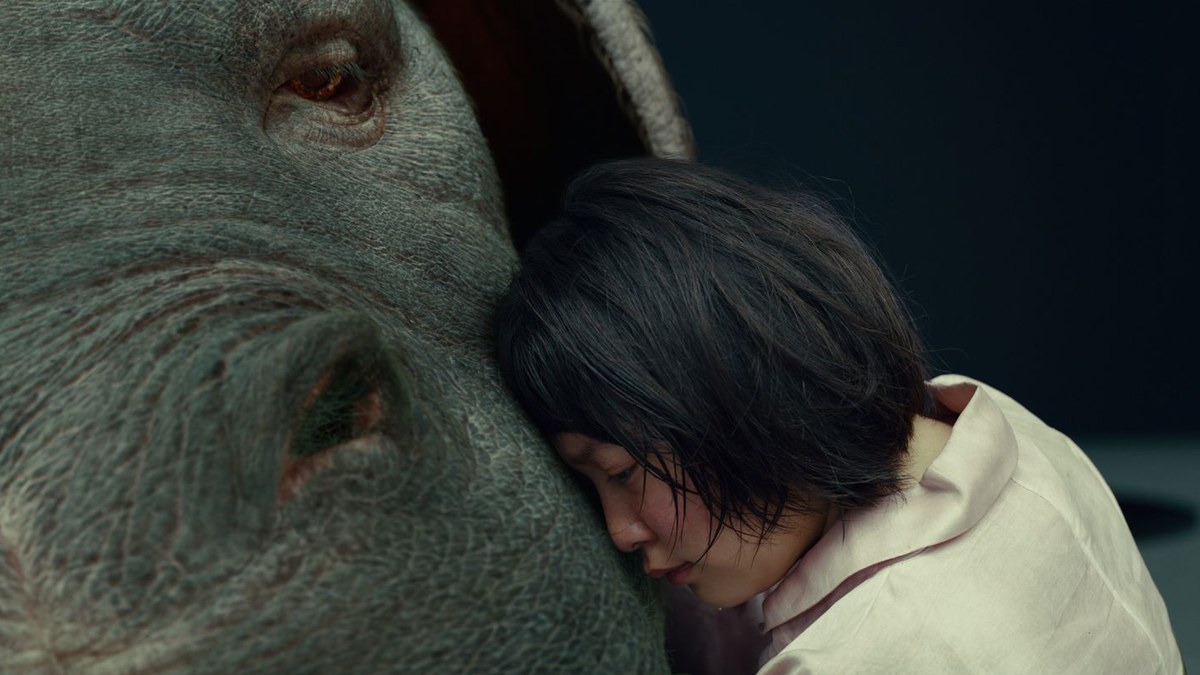
We meet Okja, who for 10 idyllic years has been under the care of Mija and her grandfather – the farmer tasked with raising the animal in their small piece of paradise at their home in the mountains of South Korea.
We see the relationship Mija and Okja have developed with each other, something so much more than an owner and a pet, these two are friends who care for each other.
For those familiar, in these opening scenes you may immediately be hit by the feel of Studio Ghibli’s My Neighbour Totoro – as Mija sleeps on the belly of the giant animal in the middle of the forest (just as Mei did with Totoro), in heartwarming scenes of this young girl with her gentle-giant friend.
However these moments of a near-perfect life lull you into a false sense of security, as Mija finally learns of the true place of Okja and her existence when the Mirando Corporation come and take Okja for themselves, transporting her to New York with the plan to unveil her to the world.
So then with no plan other than rescue, Mija sets out for her dearest friend. It’s during this that she encounters the Animal Liberation Front, a group fighting to expose the real intentions of the Mirando Corp, headed by Jay (Paul Dano) and Red (Lily Collins), who team up with Mija to save Okja from her consumer fate.
For those who have seen this director’s previous “creature feature” film The Host (it’s a film worth making the effort to see), the journey of the main character going from average person turned hero with an unrelenting force to do what is right will be one that is familiar, with action-lead sequences delivering a mix of danger, suspense and comedy.
The characters here are all turned up to 11 (some being so off-the-wall they wouldn’t be out of place in a Wes Anderson film), it’s well acted with no fault to be found with a single performance – Paul Dano as the committed and caring animal rights activist Jay, Jake Gyllenhaal’s eccentric and slightly unhinged Johnny Wilcox, Tilda Swinton (and Tilda Swinton) as both corporate CEO Lucy Mirando and her heartless twin sister Nancy (a clear good twin vs evil twin), but it’s Seo-hyeon Ahn as Mija that steals the show, carrying the story with a heart-filled character and determination driven by her love of the endearing animal.
There is an under-lying message with this film, really brought home by the end of the story, in that our treatment of livestock and our consumption of meat can be something cruel and grotesque, ending with some brutal and heartbreaking slaughterhouse scenes.
However this film has been in the spotlight for reasons other than its message or originality – the controversy that this Netflix feature brought to the Cannes Film Festival earlier this year was something which has opened up a wider debate around the release of feature films (leading to the festival actually changing its rules so as to now only include films which have a cinema release). It was widely discussed that the public should be able to see a film without having to be subscribed to Netflix, through by just being able to buy a cinema ticket.
There has been a limited cinema release for this feature (although this does seem more like Netflix slightly giving way to criticism), and it would be all the better to see this film on the big screen, but it’s a real shame that unless you go and get yourself a subscription to Netflix (if you’re someone without it), you might never watch this film.
This really is a fantastic movie, in whatever way you get a chance to see it you’ll be happy for doing so.
The difficulty in pulling off a film of such eclectic entertainment – one that can have you on the edge of your seat, make you laugh, be a fairy tale action adventure through to coming-of-age drama for its young female central character, with a social satire of corporate greed and consumer culture all while carrying a narrative throughout is a testament to the director along with co-writer Jon Ronson (the man behind the fantastic musical comedy drama Frank).
This story is so many things at once, with a heart and a conscience – a heartwarming tale and one of the most original films you will see all year.
Wonder Woman

2017 – USA
Director: Patty Jenkins
Starring: Gal Gadot, Chris Pine, Danny Huston, Elena Anaya, David Thewlis, Connie Nielsen, Robin Wright
Words: Christian Abbott
The superhero movie is a staple of cinema; it has been now for over a decade. Year after year there is a deluge of films centered around some of our favourite caped crusaders (and some of our not-so-favourite). These films cannot be called a genre onto themselves, but rather a formula which can be retro-fitted onto a variety of genres – often to great effect.
Wonder Woman is no different; it is an out and out war movie. Set during the final weeks of WWI, we find Diana Prince, Wonder Woman herself (Gal Gadot) thrust into a world she could never have imagined – our own. Living on Paradise Island since birth, an island inhabited solely by Amazonian women, she witnesses a plane crash just offshore. That plane was piloted by Steve Trevor (Chris Pine), an undercover US operative whom warns the island of the war to end all wars. Diana hears of this and seeks to help humanity as it is not only her duty, but destiny.
Director Patty Jenkins has produced a film that feels entirely detached to the rest of the DCEU, to very much its benefit. Without the shackles of needing to adhere to an established continuity, being set 100 years apart from the events of the other films allows for that freedom. Patty Jenkins can flex her creative muscles and create a piece of genre-fiction like no other in modern Hollywood.
Shockingly, this is the first female led superhero film in over a decade, and is so far above the others in this sub-genre that they are not even worthy of note. DC has rightfully trusted their leading lady to start a franchise of her own that this seemingly non-risk has certainly paid off – almost entirely due to the two charismatic leads.
Gal Gadot as the title character fulfils all the requirements needed for such a character – she’s strong, fierce but gentle and kind, fish-out-of-water-funny and intelligent. Diana may be in unfamiliar lands but she certainly commands every scene.
Gadot’s entry into the DCEU was in last year’s Batman v Superman: Dawn of Justice and it was arguably the defining moment of that film. Expectations were high after seeing her more than hold her own against the two biggest heroes of all time – and for her, they’ve been met.
Steve Trevor, the love interest and charming but cocky soldier is equally delightful to watch. Chris Pine has finally come into his own here after a variety of misses and weakest links in other hit or miss franchises.
Together they form one of the most believable and engaging couples on screen. It is a joy to watch their scenes play out with both vying for control in a variety of increasingly audacious set-pieces.
For DC, this is a much needed crowd pleasing romp that should be enjoyed by many, for Patty Jenkins this is a career defining moment, for Gal Gadot the same and for women everywhere (and men), this is the superhero movie they have been waiting for.
A refreshing change from the dark and overly-serious tone of the DCEU and a wholly entertaining film in its own right.
Berlin Syndrome
2017
Director: Cate Shortland
Starring: Teresa Palmer, Max Riemelt
Words: Carly Stevenson
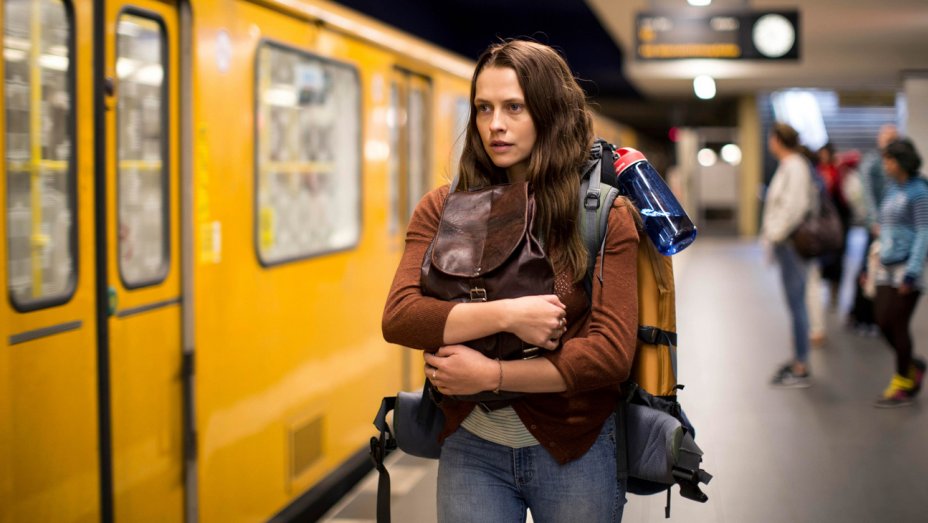
Cate Shortland’s third feature follows Australian backpacker Clare as she photographs DDR architecture on a solo trip to Germany.
Shortly after arriving in Berlin, she meets charismatic teacher Andi, who happens to live alone in an abandoned apartment block. Alarm bells ring, but Clare doesn’t hear them because Andi seems far too cute, calm and cultured to be a threat.
The plot escalates when he takes her post-coital “I wish I didn’t have to leave” comment literally and locks her in. By the time she realises that the apartment is escape-proof, it is too late; her SIM card is missing and she finds creepy Polaroids of her asleep. The photographer becomes the (non-consenting) subject.
(Note: this is by no means the only instance of clever foreshadowing in the first half of the film alone).
Berlin Syndrome knowingly conforms to the conventions of female captivity narratives even as it subtly undermines them.
In interviews, Shortland has discussed the influence of fairytales on Berlin Syndrome – particularly how they ‘eroticise a very immobilised, trapped heroine’ (Nick Hasted, The Independent, 8 June 2017).
The relationship between Andi and Clare certainly takes on this quality as the film navigates difficult psychological terrain. Clare’s continued sexual attraction to Andi during her imprisonment is ambiguous: is she simply playing along to appease her captor, or is their relationship more complex?
Though the film shies away from overt horror, the suggestion of potential nastiness lurks in the corner of every shot. Rather than focusing on the spectacle of trauma, Shortland places female strength at the centre of her storytelling.
Clare’s transformation from naive tourist to survivalist elevates the film from its generic conventions and affords Teresa Palmer an opportunity to demonstrate her hitherto unacknowledged acting credentials. Like the film’s protagonist, the audience are held captive by her nuanced performance.
In terms of tone and pace, Berlin Syndrome has more in common with Personal Shopper than it does with most abduction thrillers, not least of all because Teresa Palmer and Kristen Stewart look as if they could be related.
Twitter: @stevensoncarly
Net Picks: War Machine

Net Picks is your weekly digest of some of the best movies currently playing on Netflix. With Netflix Originals now giving directors more finance, and more freedom to create the stories they want. This area is the fastest emerging market in film and offers a real alternative to film-making traditions. We’ll be looking each week at films that are either solely viewable on Netflix, and occasionally films that had limited cinema releases and are worth catching online.
2017 – USA
Director: David Michôd
Starring: Brad Pitt, Anthony Hayes, John Magoro, Ben Kingsley
Words: Josh Senior
David Michôd along with his compatriot Andrew Dominik (The Assassination of Jesse James, Killing Them Softly) is currently flying the flag for Australian film-makers in Hollywood. From the success of his first two features; the brooding family crime saga Animal Kingdom, and the dystopian revenge thriller The Rover, Michôd was given the keys to the Netflix war-chest and Brad Pitt as his lead star to come up with something to continue this Antipodean era of cinematic fruition.
War Machine is the product of this happy alliance, an at times oddball whirlwind tour of life during the Afghanistan war from the vantage point of fictional General Glenn McMahon (Pitt).
Loosely based upon American General Stanley McChrystal, the film follows McMahon and his team of followers, after he is given the reigns of American operations in the Afghan conflict. Tasked with “winning the war”, he is conflicted by his will to defeat his enemy and appease the will of the American Government who want to scale back from the war and take the troops home.
Pitt plays McMahon in typical fashion, his performances in Inglourious Basterds and Fury make him perfect for the job. He manages to deliver a great dose of dry humour in this restrained and at times rather mellow performance.
The film itself is rather bizarre and flits from one issue to the next without pause or concern for its viewers understanding. It merits and deserves repeated viewings. What it does well in however, is conveying an image of war that we don’t often see. The ‘Post Iraq/ Afghan War Movie’ genre has so far concerned itself with “guns in the desert” flicks like The Hurt Locker, Green Zone etc. This film is very much a behind the scenes look at a War-time operation and the emotions and decisions that need to be made in a varying degree of situations. It is less concerned with bullets than it is with political maneuvering and budget management.
It does attempt to show war neither as a negative or a positive, merely a necessity of life. It revels in the mundane nature of it all. The fact that it’s referenced directly as a machine is pertinent.
The purpose of McMahon’s whole life (as is pointed out to him by a journalist) has built towards this moment, he has been trained, groomed and conditioned for war, and as his influence begins to wain he begins to question his relevance in the conflict, his place in the machine.
It feels very much like a hipster version of Full Metal Jacket, updated and re-tooled for the 21st Century. A sprawl of madness that lurches from comedy to tragedy at the flip of a coin. Overall, a long and at times tricky watch, but one that is certainly worth sticking out to the end.
Must See Movies: June

At Reel Steel we want to make sure you’re getting the most of your cinematic enthusiasm, so each month we put together our short list of some of the best new releases, from popcorn munching explosion fests to the often weird and wonderful.
Take a look at the trailers below and see what you think to this month’s recommendations!
My Life As A Courgette
released Friday June 2nd, 2017
This 2017 Oscar nominated stop-motion animation tells the story of Courgette – a nine year old boy who is placed in a childrens home after losing his mother.
At first he struggles to find his place in this new and strange environment, but soon he learns to trust again.
A mature story that deals with the complicated issues of growing up in a sensitive, thought-provoking and humorous way, this is a film for audiences both young and old.
Wonder Woman
released Friday June 2nd, 2017
Gal Gadot plays a princess on the island paradise of Themyscira, whose encounter with pilot Steve Trevor (Chris Pine) leads her to the war-torn landscape of Europe during the First World War, where upon she discovers her full power and her true destiny.
The DC Universe brings us a comic-book movie with a female superhero in the lead role and a female director in the driving seat (Patty Jenkins – who took the glorious decision to shoot this feature on film instead of digital).
With the appearance of Wonder Woman being a highlight of last year’s Batman v Superman, this origin story will no doubt also act as a tie-in for the forthcoming Justice League movie released later this year.
Okja
released Friday June 23rd, 2017
This feature tells the story of a young girl, who risks everything to prevent a large corporation from kidnapping her best friend – a massive animal named Okja.
Acclaimed South Korean director Bong Joon Ho, proving he can create monsters with the 2006 sleeper-hit The Host, introduces us to a creature of a very different kind in this story about the relationship between humans and animals.
A limited cinema release followed by a Netflix online exclusive from June 28th.
– SPECIAL EVENTS –
Sheffield Doc/Fest
Friday June 9th to Wednesday June 14th, 2017
The Sheffield International Documentary Festival returns with a programme of powerful stories from around the world.
Taking place at various venues across the city, where along with film screenings and special guests (including Louis Theroux, Stacey Dooley and Ian Hislop), will feature 3-D, immersive cinema and Virtual Reality.
more info and tickets available here:
Battle Royale
Saturday June 24th, 2017
There are fewer cult movie favourites held in higher regard than the bloody and influential film based on the book by Koushun Takami – Battle Royale.
Set in a dystopian world, a class of Japanese high school students are pitted against each other in a fight to the death, where the last one standing is granted their freedom.
This horror thriller puts friendships to the test, as teenage adolescence abandons trust and innocence, with the students forced to play the game or die (watch out for a scene stealing performance from Takeshi Kitano as the class teacher).
The Girl Gang host this immersive cinema screening, which along with the main feature will include an interactive party to end the world.
This evening will be the closing party to Sheffield’s Festival of Debate.
more info and tickets available here:
https://www.facebook.com/events/1447719242202518/
 REEL STEEL
You must be logged in to post a comment.