Predator

1987
Director: John McTiernan
Starring: Arnold Schwarzenegger, Carl Weathers, Elpidia Carrillo, Bill Duke, Richard Chaves, Sonny Landham, Shane Black, Jesse Ventura, Kevin Peter Hall
Words – Nathan Scatcherd
“If it bleeds, we can kill it.”
“I ain’t got time to bleed.”
“GET TO THE CHOPPER!”
I’m willing to bet that if you’re reading this, you know all the lines.
Predator is simply one of those films which planted itself in the popular culture landscape upon its release in 1987, and has stayed prominent over thirty years since in the minds of sci-fi action movie fans everywhere.
Following James Cameron’s Aliens from the previous year, it’s obvious the film was an attempt to ride the contemporary trend for a certain kind of alien monster movie action (although it’s more of a cult film than Cameron’s gung-ho crowd-pleaser, and as a whole, Predator has charms very much its own). The film would launch director John McTiernan into the big leagues of action film-making – he would of course go on to make Die Hard a year after this – and showcases a consummate muscle-flexing, vowel-manging action hero performance from Arnold Schwarzenegger.
Schwarzenegger was by this point one of the biggest movie stars in the world – people knew him as Conan; John Matrix; The mother-flipping Terminator – and it was arguably his star power that drew audiences to Predator, which could have easily been written off as another alien movie trying to cash in quick. Of course, the cult of personality surrounding Arnie has had no small part in sustaining the film’s general popularity since then, although the film does amount to more than a simple vehicle for The Austrian Oak.
Our story is appealingly uncomplicated. A team of soldiers, led by Major Alan “Dutch” Schaefer (Schwarzenegger), are dropped into the (fictional) Val Verde jungle along with CIA agent and former commando Dillon (Weathers), an old friend of Dutch’s (who Dutch is nevertheless hesitant to have along). They are told they are to be rescuing allies being held hostage by rebels in the jungle, although they soon find their efforts at rescue are in vain, as they realise they are the ones being hunted… and not by any mere rebels. What is, for its first hour or so, an entertaining if fairly standard ‘men on a mission’ movie slowly becomes a tense game of cat and mouse, as these hardened military men are picked off by a (mostly) unseen hunter until – much like Ripley towards the end of Ridley Scott’s Alien – it’s down to Dutch and the titular predator in a one on one battle of wits as much as brawn.
Dutch’s team is made up of a solid cast of character actors; Bill Duke as the unhinged Mac and Jesse Ventura as the team’s “God damn sexual tyrannosaurus” tracker Blain are particular highlights, and Shane Black (who would go on to direct Iron Man 3 and The Nice Guys) is the team’s wiry, smart-mouthed radio operator.
Shane Black is due to helm the upcoming The Predator movie, and it’ll be fascinating to see what he does with his return to the franchise, this time in the director’s chair.
Of course, the titular Predator (Kevin Peter Hall) is as much a star of the film as Arnie. Despite not being visible for much of the film (a neat trick which no doubt saved a ton of money on special effects), the extraterrestrial hunter makes its presence felt with chilling tactical precision, picking off its prey, skinning them and taking their spinal columns with skulls still attached.
Anna Gonsalves (Carrillo), the local guerrilla woman the team take with them, calls it “the demon who makes trophies of men”, and that’s pretty much the Predator’s whole MO right there; an alien hunter who sees Dutch and his men as worthy quarry, and fancies a few new spinal column CD racks.
The Predator’s design, by the great Stan Winston, would of course go on to become an instantly recognisable piece of sci-fi iconography; a sleek, tribal, instantly marketable alien badass which has gone on to inspire comic books, video games and all other manner of merchandise (as well as of course three ‘official’ sequels and two Alien vs. Predator movies) based pretty much solely off how cool it looks. The original design during production featured a long neck, backwards-bent legs and a Cyclopean eye; due to the difficulties of filming the design in the jungle environment, the idea was scrapped and Winston had to come up with something else in short order.
The rest, as they say, is history, and over thirty years later, the Predator remains one of the most intriguing sci-fi monster figures, with a primal code of honour and apparent dark sense of humour (the Predator takes vocal recordings of its prey, and uses this to laugh mockingly at Dutch during their climactic chase/fight).
Predator is over thirty years old now, and stands up as a prime example of violent, darkly funny, macho-laden 80s action goodness. And of course, the Predator itself remains one ugly mother…
You know the line.
M.F.A.

2017
Director: Natalia Leite
Starring: Francesca Eastwood, Clifton Collins, Michael Welch, Leah McKendrick
Words: Carly Stevenson
“What if we’re not prepared?” asks art student Noelle, the protagonist of Natalie Leite’s powerful ‘rape revenge’ narrative, which drives a pointed blade into the toxic masculinity of campus culture.
Leite’s film revolves around questions of accountability and explores what happens when individuals are let down by the institutions that are supposed to protect them. In the wake of the recent Weinstein scandal, there has never been a better time to interrogate this issue.
M.F.A exposes a grim reality: we still live in a society that teaches victims how to avoid being raped rather than teaching perpetrators not to rape. This is a refrain that haunts the film’s thoughtful dialogue, which is largely delivered by Francesca Eastwood, whose mesmerising performance goes a long way in elevating M.F.A from the murkiness of its sub-genre. It is never easy to make art from such a delicate and triggering subject matter, yet Leite handles it with due sensitivity.
As Noelle (Francesca Eastwood) learns to channel her traumatic experience into a creative outlet, her art and her character undergo a transformative development. Her initial timidity gives way to empowerment as she becomes more confident, frank and self-aware. And yet, the memory of her assault still lingers, invading her relationships as well as her thesis exhibition project. It is worth mentioning that the circumstances of Noelle’s rape are critical to the film’s message: she is raped by someone she knows and is sexually attracted to. What starts off as a consensual ‘hook up’ quickly turns into a devastatingly casual assault, which leaves Noelle feeling ashamed, confused and violated. What is even more devastating is that she is not the first female to be brutalised by a fellow student(s) in this story. She is, however, the first to take matters into her own hands after the University and the police fail to take the offence seriously.
M.F.A is the perfect length for a thriller/horror film. In just over 1 hour 30 minutes, Leite’s dizzying portrayal of a Noelle’s journey through the stages of shock, disbelief, anger, vengefulness and guilt subversively places the victim in a position of power, allowing the audience to bear witness to the reclaiming and restructuring of her identity.
While M.F.A isn’t a conventional recovery narrative, there is something grotesquely satisfying about Noelle’s quest for justice. And while we do not condone her violence, Leite invites us to think carefully before condemning it outright.
Dracula: Prince of Darkness

1966
Director: Terence Fisher
Starring: Christopher Lee, Barbara Shelley, Andrew Keir, Francis Matthews, Suzan Farmer
Words: Oliver Innocent
Hammer’s first sequel to their immensely popular take on Dracula took eight long years to materialise but, at first glance, it appeared not very much had changed at all; Castle Dracula still stood tall as an ominous beacon guiding visitors out of the dark woods and into its eerie glow, the locals were still superstitious, and lashings of Hammer’s patented bright red blood still flowed freely.
What had changed in the intervening years is that Hammer had developed an in-house style informed by the success of their first two Gothic horror projects, The Curse of Frankenstein (1957) and Dracula (1958), both of which were directed by Terence Fisher and featured Peter Cushing and Christopher Lee.
Hammer’s brand of Gothic horror, or Hammer Horror as it became known, was typified by period settings, garishly vivid colour cinematography, a recurring cast of actors and filmmakers, a very British feel, and a mischievous desire to shock audiences and critics alike with an unprecedented amount of on-screen sex and violence.
Although Terence Fisher’s Dracula: Prince of Darkness (1966) is invariably steeped in the same Gothic miasma as its predecessor – all the usual Hammer Horror trappings audiences had become accustomed to are present and correct – when compared with Hammer’s first Dracula it reveals itself to be a very different beast indeed.
One of the most blatant alterations which differentiates the film from its predecessor is Lee’s much more animalistic portrayal of the Count. In Dracula he portrayed the Count as a kind of extreme schizophrenic who, on the surface, appeared to be a polite aristocratic gentleman, but at the sight of blood could explode into a maelstrom of raging bloodlust. In the sequel Lee strips the Count of his human qualities, coming across as more beast than man. Lee’s intention to make the Count less human can clearly be seen in his refusal to speak, instead communicating with snake-like hisses and demonic growls. It is as if being brought back from the dead a second time round has caused the Count to lose even more of his humanity.
Perhaps the most significant difference, however, is that Cushing does not return to reprise his role as Van Helsing. Considering that Cushing’s Van Helsing acted as both wise mentor to the uninitiated and the Count’s action hero nemesis in the first film, it was a given that his absence would necessitate something of a change of direction for the belated sequel. While the film does boast a Van Helsing-like figure in the form of Andrew Keir’s Father Sandor, he is by no means the film’s central protagonist as Cushing was in the previous film. His appearances work more like bookends, introducing the topic of vampirism when all around him are afraid to do so, and aiding in bringing about the destruction of the Count at the film’s close. Lacking the vampire fighter and the vampire, the midsection acquires a whole new set of dynamics as the film becomes less interested in a battle between good and evil, and more concerned with exploring how naïve innocence can be corrupted by unseen forces of malevolence.
The change of focus, from a simple tale of good versus evil to a more subtle examination of the tainting, all encompassing power of evil, makes for a far different viewing experience.
Whereas the first film revelled in bombarding unsuspecting viewers with an extremely visceral, action-centric experience, the second Dracula forgoes this route, instead opting for a much more atmospheric tone. Indeed, it is telling that while in the first film Dracula makes his debut appearance a mere few minutes into the film’s runtime, the sequel makes the viewer wait until nearly half way through the film until they even get a peek at the titular character. Although this refusal to show Dracula until the middle of the film was undoubtedly a disappointment to many of the Count’s most ardent fans, it actually works in the film’s favour. Instead of a simple rehash of the first film, Dracula: Prince of Darkness is given its own identity. Free to blossom as a separate entity rather than a pale imitation of the previous instalment, it emerges as a much more effective film than its status as a horror sequel would seem to suggest.
Unlike most sequels which tend to jump straight back into the action, Dracula: Prince of Darkness deliberately takes its time to build an atmosphere of dread before the more familiar vampire action ensues. The eschewing of the action-oriented set-pieces of the first film (at least in the first half) allows the second film to establish an uneasy aura perpetuated by the tension of not knowing when the Count will make his appearance. The Count’s absence helps conjure a great sense of foreboding as if his spirit permeates the film’s settings as an unseen, intangible force forever threatening to manifest itself in its red eyed, sharp fanged form.
This is most apparent in the scene where the English tourists arrive at an eerily deserted Castle Dracula, a place so associated with the image of the Count. In the Count’s absence the Castle acts as a kind of stand-in, conveying the Count’s elegant style with its Gothic architecture, his sinister unknowable mind with its dark hallways, and his unquenchable bloodlust with its brutal medieval weaponry. In fact, with its Castle imbued with a malevolent personality, the first half of Dracula: Prince of Darkness feels more akin to an Old Dark House film than a vampire film.
The film can also be seen to foreshadow the slasher films of the 1980s as the tourists begin wandering off on their own in the Castle at night, investigating strange noises before being killed off one-by-one.
Despite its apparent similarity to other horror films, Dracula: Prince of Darkness still manages to maintain its own unique identity, mostly as a result of its interweaving of an ominous, tense atmosphere with the familiar vampire folklore. Unfortunately, once the surviving tourists flee Castle Dracula much of the film’s atmosphere is lost, abandoned in favour of a more conventional action approach reminiscent of the preceding Dracula’s finale. However, one can easily forgive this mid-section lull as the action returns to Castle Dracula for one of Hammer’s most unforgettable endings. In a thrilling turn of events the Count becomes trapped on the Castle’s frozen moat as the heroes shoot the ice. Of course, being vulnerable to flowing water, the Count’s reign of terror is brought to an abrupt end as he plunges into the icy depths. The film then closes on the haunting image of the Count’s monstrous visage floating just beneath the frozen surface, threatening an imminent return.
As well as being a remarkably inventive way to put an end to the Count’s evil, this ending perfectly encapsulates the film’s vastly different approach to Hammer’s first stab at the Dracula legend. In contrast with the first film’s finale, Dracula: Prince of Darkness does not end with a physical battle. Instead, the Count is dispatched from a distance as the ice protecting him from a watery demise is simply shot away. When compared with Lee and Cushing’s brutal, immensely physical brawl at the end of Dracula, this ending seems astonishingly ethereal as no real battle has taken place, and the Count’s fate possesses a disquieting ambiguity not found in the first film’s seemingly definitive disintegration sequence. It, like much of Dracula: Prince of Darkness, has an overarching otherworldly atmosphere which, despite the return to a more conventional approach towards the end of the film, marks it as one of the strongest, most unique entries in the Hammer canon.
Blade Runner 2049

2017
Director: Denis Villeneuve
Starring: Ryan Gosling, Harrison Ford, Ana de Armas, Jared Leto, Sylvia Hoeks, Robin Wright, Mackenzie Davis, Dave Bautista
Words: Christian Abbott
With the original Blade Runner, Ridley Scott created a dark, art deco infused world. A world bathed in rain and neon in equal measure, defining the now prominent sub-genre of neo-noir.
For 35 years that world has fascinated fans and newcomers alike. The mysteries left open, the philosophical questions it brought forward and the palpable feeling of believability in a reality that goes beyond fiction and becomes a dreamlike vision of an alternative future.
Over the coming decades and the numerous re-edits of the original film by Ridley Scott himself, it is now seen as the masterpiece it is, a defining moment in genre fiction and science fantasy at large.
The prospect of reaching the heights of this film seemed almost impossible, yet with Denis Villeneuve (of Arrival fame) working alongside Ridley Scott and Roger Deakens behind the camera, this sequel seemed the best it could possibly be.
Set 30 years after the events of the original, we now follow the young Officer K – a blade runner. His job is to “retire” the older model replicants, the ones that could deny their programming. On one such job K stumbles upon a mystery, one with which the ramifications could alter the very meaning of humanity.
“More human than human” was a line frequently spoken in Scott’s original, a phrase that permeated the fabric of this strange world. Villeneuve has applied it to this sequel in new and exciting ways. He subverts many of our expectations and truly gives his work its own identity, outside of the looming shadow of the original. Hampton Fancher and Michael Green have written and constructed a sequel uninfluenced by the pace or ideologies of modern Hollywood filmmaking. The aforementioned pace is slow and deliberate, at times too much so, yet it has been done to allow us to soak up the atmosphere of this world.
There are long stretches of silence, which is the most surprising aspect of this film; Vangelis famously scored the original with a now timeless sound. The music bled into the environment in a way few films can hope to accomplish.
Hans Zimmer and Benjamin Wallfisch have taken over duties this time and while the expected deep-electronic score is there and brilliantly constructed, it is the active choice to withhold on sound in many moments that adds to 2049’s unique feeling.
Of course, Villeneuve has kept the story in line with the events of Scott’s original, but with the added benefit of technological advancements, it has allowed him to open up this world in vast new ways. We see beyond the alternative LA, one which now seems more in line with Mega City One, the constant rain, adverts oscillating for space, dirt and darkness have never looked more beautiful. Roger Deakens once again proves he is one of the finest cinematographers working today.
On a purely visual level, this is one of the most stunning films ever conceived. Shots leave you in awe, the construct is astounding. On a technical level, this is as good as Hollywood gets. Sadly the story doesn’t quite live up to the visuals. While it is an intriguing narrative, the contents can feel shallow. It rhymes with the film but many of the issues have been covered not only in the first but in the 35 years following it. The ending in particular feels slightly unsatisfying, leaving things open for more films.
With that said, it can’t be stressed enough how phenomenal this movie can be at times, there are scenes that stick with you for days after seeing it. Villeneuve in expanding this world has revealed its true ugliness; society has descended to its base levels. It is truly as disturbing as it is beautiful to behold. If the original was a dream, this is a nightmare – one that must be seen to be believed.
Hellraiser
1987
Director: Clive Barker
Starring: Doug Bradley, Ashley Laurence, Clare Higgins, Andrew Robinson, Sean Chapman, Nicholas Vince
Words – Oliver Innocent.
Following in Stephen King’s footsteps and quickly rising to prominence in the mid-1980s, Clive Barker went on to become one of the most prolific, imaginative and well-known horror authors of the late 20th century.
Kicking off with Books of Blood, a collection of macabre, violent, sexually explicit tales, Barker continued to hone his skills and build his reputation with his first novel The Damnation Game and The Hellbound Heart novella, before venturing into more experimental waters with the epic fantasy-horror hybrids Weaveworld and Cabal. These stories showcased an almost unparalleled imaginative ability to conjure fantastical worlds and characters that somehow still seemed impossibly real.
However, by 1987 it became clear that Barker was not content with his creations just being confined to pen and paper. He yearned to see them in the flesh, to visualise what was once a few lines of descriptive writing. There was only one medium for it then; film.
Barker’s debut feature turned out to be one of the standout genre offerings of the 1980s; no mean feat considering it was a small independent British feature released at a time when horror cinema was dominated by hugely successful American franchises like the Nightmare on Elm Street and Friday the 13th series. Indeed, not since the heyday of Hammer had a British horror film been able to stand shoulder to shoulder with its American counterparts, and not until the resurgence of British horror in the early 2000s with the likes of 28 Days Later and The Descent would one be able to again.
Based on The Hellbound Heart novella, a gory tale of demons, lovers brought back from the grave, and portals to another world, Hellraiser certainly ticks all the boxes to delight fans of raw, bloody, effects-laden ‘80s horror cinema. However, Barker also brings something altogether different to the table; an indelible sense of imagination coupled with a synthesis of the beautiful and the grotesque hitherto almost unheard of in a genre that was, at the time, all too susceptible to succumbing to its own clichés. Make no mistake, Hellraiser is still gory and nasty, oftentimes exceedingly so, but it stands out from the crowd with its refusal to adhere to the rules.
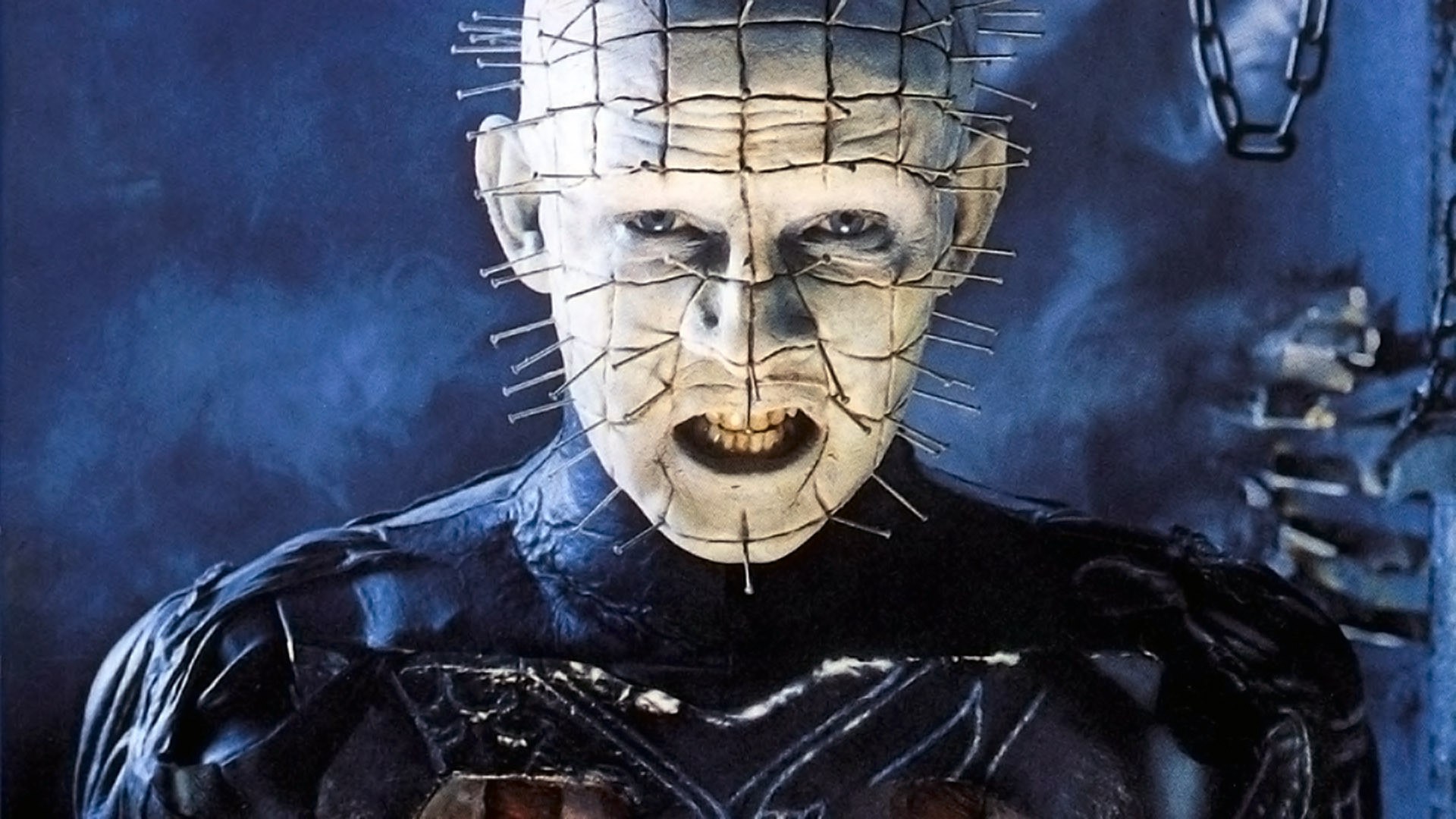
Brimming with imaginative touches (unsurprising if you’ve read any of Barker’s work), Hellraiser impresses with stunning imagery and lofty concepts. There’s the mind-blowing idea that another plane of existence can be reached via the exquisitely-designed Lament Configuration puzzle box (a Rubik’s Cube from hell, if you like), a place of intense pain and pleasure, hooks, chains and tearing flesh, and, of course, the iconic image of the Cenobites. Unlike nothing seen before, the Cenobites are at once elegant yet violent, magisterial yet sadistic, sexual yet monstrous. They are the perfect embodiment of the film’s amalgamation of the beautiful and the grotesque. The lead Cenobite, referred to in the sequels as Pinhead, is the image that really struck a chord with horror fans, his signature rows-of-pins-nailed-into-his-head look, and Doug Bradley’s commanding performance cementing his position as an icon of horror, just as recognisable as Freddy Krueger or Frankenstein’s Monster.
As impressive as the image of Pinhead and the Cenobites is, however, Hellraiser (at least the first film in the series that is) isn’t really about them. At its core, it’s a dark love story focusing on the twisted affair between the repressed Julia and her sexually-adventurous and quite deranged brother-in-law Frank. It’s a film about the lengths people go to for the people they love, Julia killing unwary men she has seduced in order to bring back her long lost lover with their blood. It also concerns how far people are willing to go to attain the ultimate sexual experience (pleasure and pain, indivisible) as Frank tracks down the puzzle box, enters another world, and literally gets torn apart. The real villain of the piece, Frank is a truly frightening monster, resurrected with blood in a bravura effects sequence, he returns as a skinless terror that will stop at nothing to escape the clutches of the Cenobites.
The perfect accompaniment to the film’s warped love story is Christopher Young’s stunning score which encompasses the romantic and the horrific in sweeping, orchestral gothic melodrama.
A big hit upon its initial release, Hellraiser’s reputation has only grown in the years that followed. Barker followed up his debut with the misunderstood Nightbreed and the OK Lord of Illusions, neither of which lives up to the promise of his first film. Hellraiser itself has spawned a seemingly never-ending franchise, the first few sequels showcasing some good ideas although losing the mystique of the original as they go into the Cenobite’s origins, while the later ones descend into direct-to-video hell.
You can’t go wrong with the original though, a proper blood and guts horror film which, due to Barker’s ability to distil his fertile imagination into a compelling storyline, still impresses over three decades later.
–
Must See Movies: October
At Reel Steel we want to make sure you’re getting the most of your cinematic enthusiasm, so each month we put together our short list of some of the best new releases, from popcorn munching explosion fests to the often weird and wonderful.
Take a look at the trailers below and see what you think to this month’s recommendations!
Blade Runner 2049
released Friday October 6th, 2017
Few films have generated as much excitement as this feature – set 30 years after the original landmark sci-fi film, we see Ryan Gosling star as a new generation of android hunter that must join with Harrison Ford in a return to his role as Rick Deckard.
With Denis Villeneuve (Arrival, Sicario, Prisoners) as director, cinematographer Roger Deakins (Skyfall, The Shawshank Redemption, No Country For Old Men) in place, and a soundtrack produced by Johann Johannsson (Arrival, Sicario, The Theory Of Everything), Hans Zimmer (Dunkirk, Inception, The Dark Knight Trilogy) and Benjamin Wallfisch (It, Hidden Figures)
– anticipation for this one is huge.
Loving Vincent
released Friday October 13th, 2017
Loving Vincent explores the life and controversial death of Vincent Van Gogh, told by his paintings and by the characters that inhabit them.
In the world’s first fully painted feature film, Loving Vincent was first shot as a live action film with actors, then hand-painted over frame-by-frame.
Every one of the 65,000 frames of the film is an oil-painting hand-painted by over 100 professional oil-painters.
The film brings the paintings of Vincent Van Gogh to life to tell his remarkable story, with the film’s soundtrack composed and arranged by Clint Mansell (Black Swan, Requiem For A Dream, High Rise, Moon).
Thor: Ragnarok
released Friday October 27th, 2017
Thor finds himself on the other side of the universe without his mighty hammer, and in a race against time to get back to Asgard to stop Ragnarok — the destruction of his homeworld, at the hands of an all-powerful new threat, the ruthless Hela (Cate Blanchett), as she sets out to bring the Asgardian civilization to its knees.
With the current chapter of the Avengers marking a new phase with the upcoming Infinity War next year, this feature will play a pivotal moment in the Marvel Cinematic Universe.
– SPECIAL EVENTS –

Celluloid Screams
Horror Film Festival
Friday 20th – Sunday 22nd October, 2017
Celluloid Screams returns with a selection of horror films from around the world, including the annual secret film screening, special guest Q+A’s, and anniversary screenings of Hellraiser and Suspiria.
More info here –
The Cabinet of Dr Caligari
Saturday October 28th
The Abbeydale Picture House
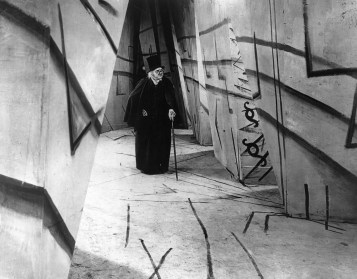
The Yorkshire Silent Film Festival brings a special event with a live soundtrack to Sheffield’s own 1920’s picture palace cinema.
The Cabinet of Dr Caligari will feature as part of a double-bill screening with Battleship Potemkin.
Details here –
facebook.com/events/148216579094482/
mother!

2017
Director: Darren Aronofsky
Starring: Jennifer Lawrence, Javier Bardem, Ed Harris, Michelle Pfeiffer, Domnhall Gleeson, Brian Gleeson, Kristen Wiig
Words: Nathan Scatcherd
There’s something fantastic about walking into a film you know next to nothing about.
We live in the age of the teaser (not forgetting the initial teaser for the teaser); the trailer showing all the best moments; the barrage of clips and TV spots; the cast and crew talking up every detail in pre-release press interviews… and to be able to take a chance on a movie (an admittedly confident chance here, given the people involved) and go in blind, is an increasingly rare and special thing.
Darren Aronofsky’s newest film absolutely merits this approach.
It is at once many things – paranoid thriller, study of an abusive relationship and yes, as the trailers would have you believe, a horror movie – and to talk about its ultimate concerns without spoiling anything is a difficult task.
Suffice to say, once mother! shows its hand and reveals what it’s ‘about’ early on, it steadily reveals itself to be a genuinely ballsy, personal, madcap labour of passion; a delirious, blackly comic satire which will be sure to utterly horrify some as much as it will thrill others.
Our point of identification is Jennifer Lawrence’s unnamed mother of the title (none of the characters actually have names, referred to in the credits with archetypal titles as ‘Him’, ‘Man’ and ‘Woman’). She is timid and house-proud, fixing up the childhood house of her much older husband (Bardem), which burned down an unspecified amount of time ago. Bardem’s character is a poet who has been struggling with writer’s block. He is somewhat cold to his almost subservient wife, and prone to moments of arrogance and self-pity.
Ed Harris shows up claiming to have thought the house was a bed and breakfast, and is welcomed in by Bardem with a strange eagerness and friendliness. Pretty soon the man’s wife (Pfeiffer) appears, followed by their two sons. The house quickly begins to fill up with fanatical fans of Bardem’s poetry who just won’t leave, and act increasingly rudely towards Lawrence’s put-upon housewife. She slowly begins to worry that she is losing her mind as her husband’s rabid fans keep him increasingly distant from her, while inspiring his desire to create poetry again – and other things.
One of Aronofsky’s main strengths is his ability to create an atmosphere of seething tension – think back to the building paranoia of Black Swan, or basically all of Requiem for a Dream – with mother! he has turned these instincts up to eleven; we stay with Lawrence throughout the film, seeing her slow disintegration as she is hit with insult after insult as she simply tries to, in her own words, create a “paradise” to live in. Unfortunately her character doesn’t have much agency or personality of her own, which could be the whole point depending on how far one reads into the film’s messages, although it still slightly undercuts any identification with her beyond the visceral; she is there to project, more than anything, although to say more there would be to drift into spoiler territory.
Matthew Libatique’s cinematography is tight and claustrophobic, drawing us into every nook and cranny of the huge, increasingly threatening house as it begins to fall apart with abuse, and often filling the frame with tight close ups of the mounting horror on Lawrence’s face.
Whatever else has been said about mother! (and it’s already inspired some extreme division), it is undeniably one of the strangest, most personal films made by a major studio in quite some time.
Aronofsky is clearly working through some stuff with this film, and the various thematic and parabolic elements he’s woven into his dream-logic narrative are bound to be confounding to some, and downright offensive to others.
Just go in blind.
IT
2017
Director: Andres Muschietti
Starring: Bill Skarsgard, Jaeden Lieberher, Jeremy Ray Taylor, Sophia Lillis, Finn Wolfhard, Chosen Jacobs, Jack Dylan Grazer, Wyatt Oleff, Nicholas Hamilton
Words: Carly Stevenson
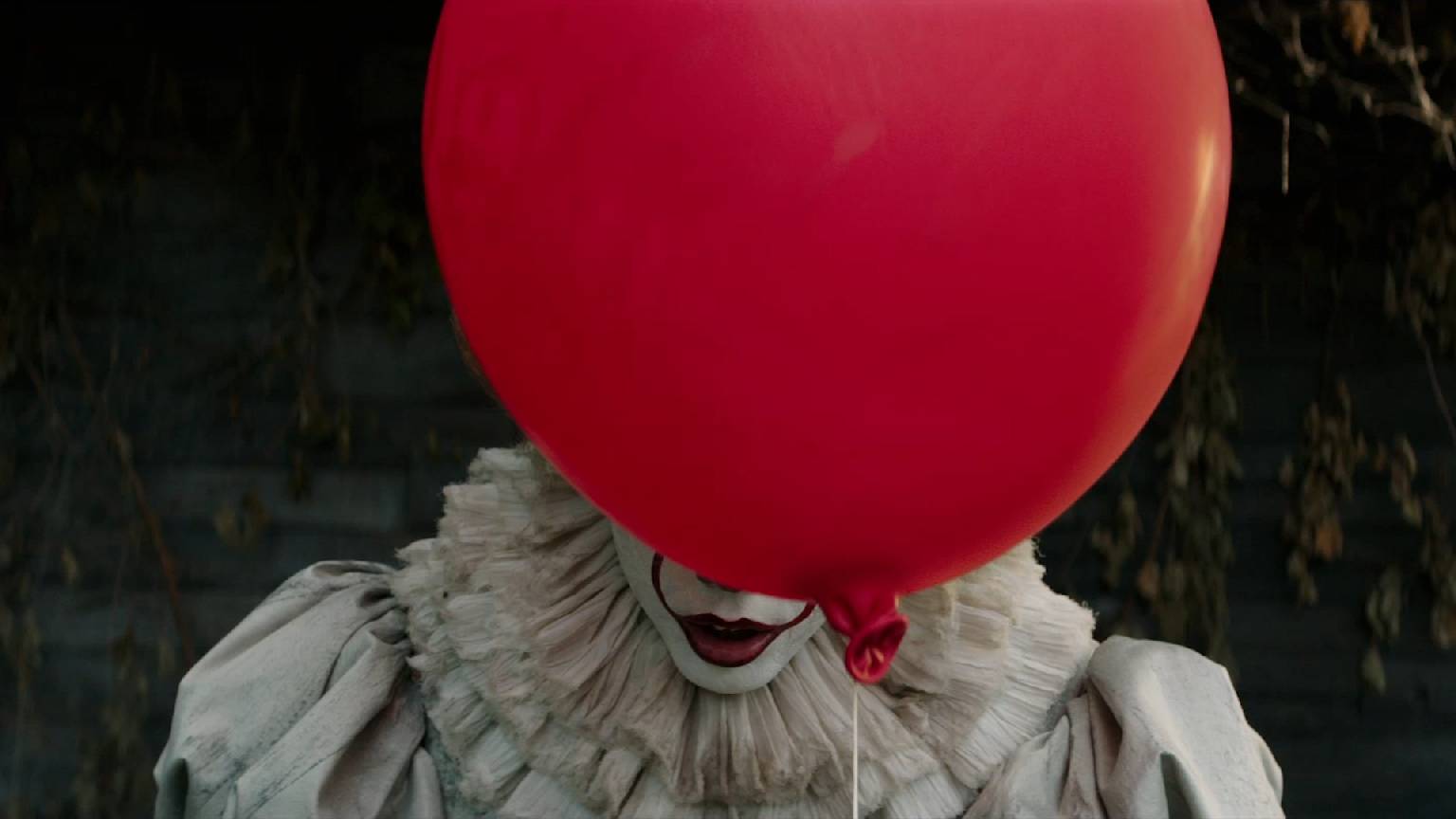
27 years after the 1990 miniseries aired, Warner Bros have finally reanimated Pennywise the Dancing Clown to terrify horror fans and coulrophobics again – this time on the big screen.
Although Andy Muschietti’s revival is not radically different to the ‘original’, the slick visual effects enhance the film’s shock-value ten-fold, without reducing the horror to a series of jumpy moments. The use of unnerving jerky movements and CGI monsters is, perhaps, a little overdone at times, yet they arguably mirror the hyperbolic and surreal quality of Stephen King’s prose. Let’s not forget that the book features a bonkers sequence in which the protagonists use an ancient ritual to enter the mind and body of It in an attempt to work out how such a being can be defeated.
Muschietti’s film omits the trippy sci-fi elements from the book (for now) to focus on friendship, which becomes a force that weakens It’s hold over the characters. ‘The Losers Club’ are an immensely likeable ensemble of outcasts, whose personal demons interact with the nightmarish hallucinations conjured by It.
Like all of King’s novels, relatable characters are the backbone of the narrative, and the film stays true to this principle. The characters each have a distinct personality, making sure we are emotionally invested in their journey as a group and as individuals. Even the generic bully Henry Bowers has a vaguely sympathetic backstory; his dysfunctional relationship with his violent father awakens a different kind of monster in him, which Pennywise exploits in an effort to eliminate the threat posed by ‘The Losers’.
Bill Skarsgard is unrecognisable in the role of Pennywise. The makeup department have done an excellent job of camouflaging his otherwise pleasant face and transforming him into a walking nightmare. Even if you’re not particularly afraid of clowns, prepare to be unsettled by the sight of balloons after seeing this film. The day after It premiered, I found myself physically freezing at the innocent sight of a pedestrian clutching a handful of balloons. It only took me a few seconds to realise that she had obviously purchased them from the nearby joke shop, but the image still made my stomach flip. Such is the power of this latest incarnation of Pennywise (though, as someone who was traumatised by the mere sight of Tim Curry on the holographic VHS of the 1990 version, I admit that I’m probably more susceptible to such a visceral reaction than the average film-goer).
Like Netflix’s Stranger Things, It pushes all the late-80s nostalgia buttons. In keeping with the novel and the miniseries, the events take place in the fictional town of Derry, Maine – a seemingly cursed town inhabited by questionable parents and wayward kids. However, a crucial temporal displacement has been made in order to bring Pennywise into the present day: the film is set entirely in the late 80s. Altering the timeline was a bold move, but undoubtedly a sensible one for the sake of coherence; it would have been difficult to replicate the novel’s structure, which alternates between the 50s (when The Losers are kids) and the 80s (when they are adults). Chances are, the next filmic chapter will strike a very different tone.
At the risk of sounding pretentious and predictable, screen adaptations are seldom as scary as the books they follow, simply because our imaginations are capable of conceiving far greater horrors than any Hollywood production can muster. Nevertheless, Muschietti’s version stays as close to King’s novel as an adaptation feasibly can, without compromising on pace. The impeccable opening scene faithfully echoes King’s writing without stagnating over the finer details. This sleek, dreamlike sequence owes much of its poignancy to Benjamin Wallfisch’s haunting score, which has a distinctly Spielberg-esque quality.
For many viewers, particularly younger ones, this will be their first encounter with It, and so the inevitable question on everyone’s mind is: does it sink or float? It is difficult – if not impossible – to avoid making pointed comparisons between an adaptation and its previous versions, but for the sake of new audiences, we must try to distance Muschietti’s version from previous manifestations.
It has many merits: a strong cast of promising young actors, characters you actually care about, genuinely disquieting thrills and, most importantly, a self-referential quality that allows the film to succeed where other re-adaptations in recent years have failed.
Must See Movies: September
At Reel Steel we want to make sure you’re getting the most of your cinematic enthusiasm, so each month we put together our short list of some of the best new releases, from popcorn munching explosion fests to the often weird and wonderful.
Take a look at the trailers below and see what you think to this month’s recommendations!
Una
released Friday September 1st, 2017
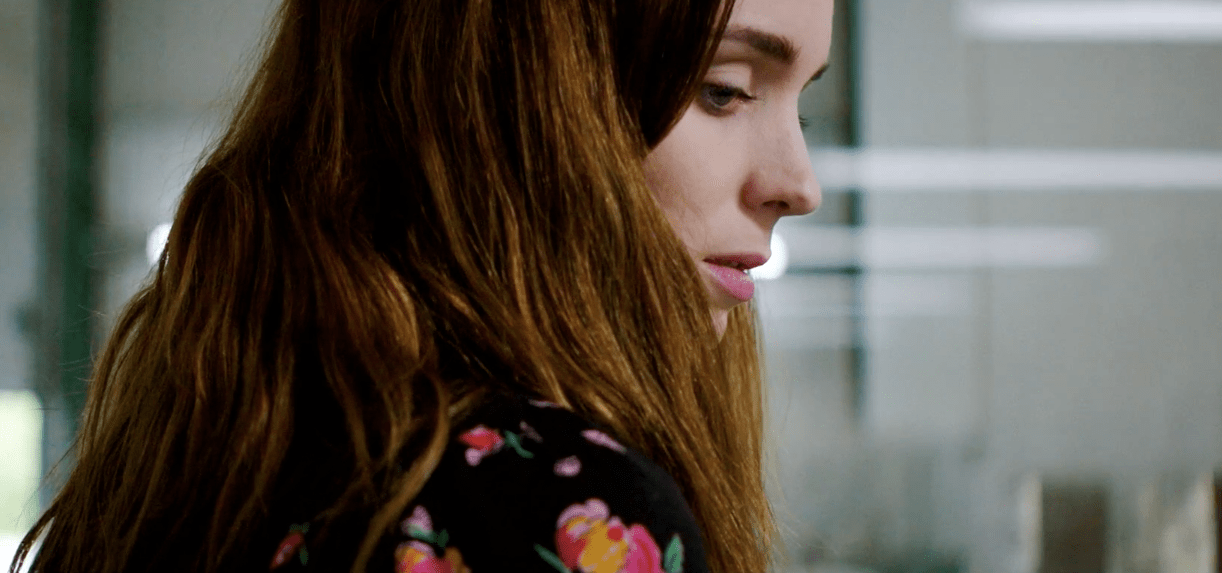
Based on the award winning play ‘Blackbird’, Una follows a young woman’s journey to reclaim her past.
Fifteen years earlier, Una ran away with an older man, a crime for which he was arrested and imprisoned, but when she comes across a photo of him in a trade magazine, she tracks him down, and her arrival threatens to destroy his new life and derail her stability.
Starring Rooney Mara (A Ghost Story, Carol) and Ben Mendelsohn (Rogue One, Animal Kingdom).
Patti Cake$
released Friday September 1st, 2017
A story of hope over adversity, Patricia Dombrowski (a.k.a. Patti Cake$) dreams of musical superstardom in an unlikely quest for glory from her hometown of Jersey, where her life is going nowhere.
Against all the odds, Patti sets out to reach the big time in the ultimate underdog story.
Mother!
released Friday September 15th, 2017
A couple’s relationship is tested when uninvited guests arrive at their home, disrupting their tranquil existence, in this psychological horror thriller about love, devotion and sacrifice from Darren Aronofsky (Black Swan, Requiem for a Dream).
– SPECIAL EVENT –
La La Land
Outdoor Screening – Sheffield Amphitheatre
Saturday September 30th, 2017
Sensoria Festival returns in 2017 with a host of film events across Sheffield, including this screening of the story for those who dare to dream.
More info and tickets available here –
www.sensoria.org.uk/events/la-la-land-outdoor-screening/
Patti Cake$
2017 – USA
Director: Geremy Jasper
Starring: Danielle Macdonald, Bridget Everett, Cathy Moriarty, McCaul Lombardi, Mamoudou Athie, Siddharth Dhananjay
Words: Rhiannon Topham
A story chronicling the underrepresented world of women in music? Yes please.
To most people, the eponymous star of Patti Cake$ is New Jerseyite Patricia ‘Dumbo’ Dombrowski, whose fluorescent dreams as a disciple of her musical hero O-Z fuel her true calling in life – success on the rap scene as Killa P.
Turning the camera away from music videos and commercials to his first feature film, writer-director Geremy Jasper tells a touching tale of aspiration overcoming circumstance.
Patti (played superbly by breakout star Danielle Macdonald) is stuck in a rut. At 23, she feels she “ain’t done sh*t”; her life is a perpetual cycle of work to pay off her beloved Nana’s medical bills, coping with her mother who seems to have raised Patti in a shadow of bitterness because she passed up the opportunity of a singing career while pregnant with her for the displeasures of married life, and so she now coerces Patti to entertain her mild alcoholism because “blood is thicker than Jäger”.
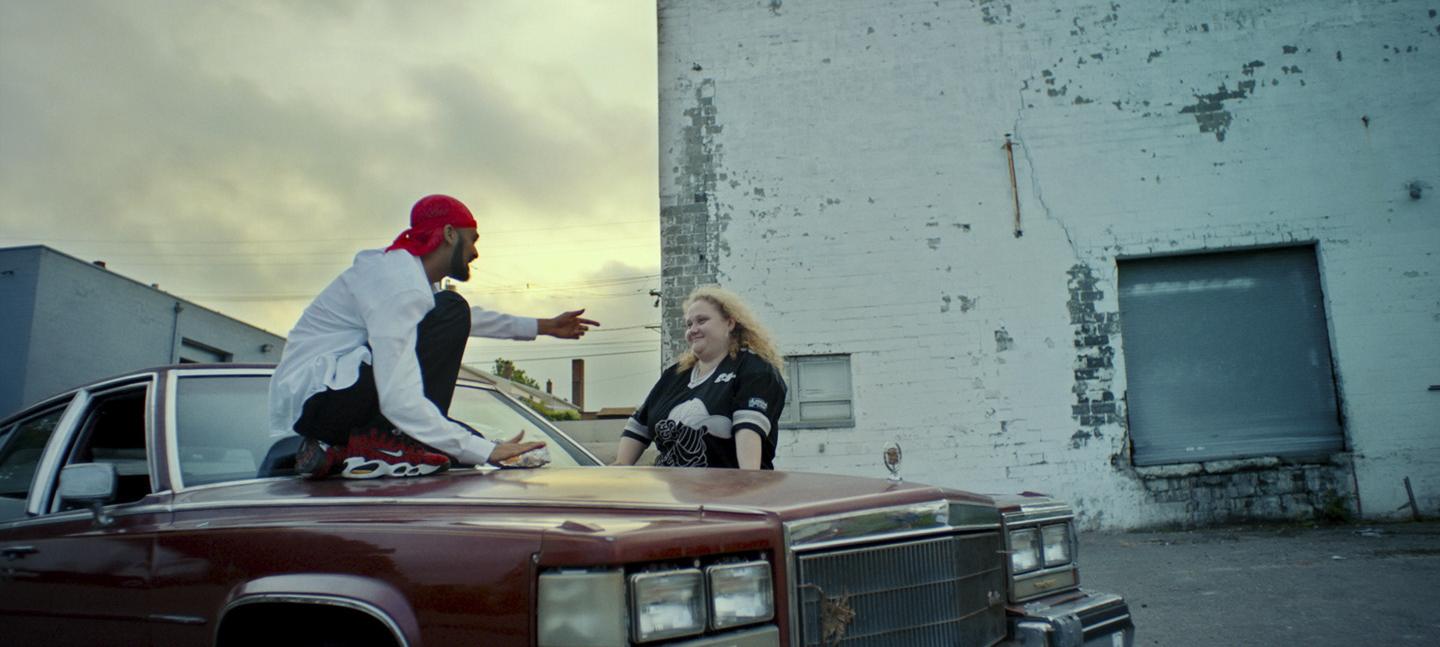
To find solace from this, Patti spends her spare time filling reams of paper with rap lyrics that are only performed on the bonnet of her dilapidated Cadillac to her loyal best friend, Hareesh a.k.a. Jheri. She is constantly ridiculed by her peers and taunted for her appearance, but is most discouraged by her mother, who believes that as a white, overweight young woman from a downbeat suburbia, Patti just doesn’t fit the profile of a musician, nevermind a rapper.
This vilified, unsatisfactory life is what fuels Patti’s crude and intimate lyrics, which her Nana describes as “sick”, as does Jheri but in a very different sense. Patti is better at articulating her opinions when pushed unwillingly into a car park rap battle than almost every idiot in her small town could imagine. Her thoughts are poetry, there’s intense artistry in her soul. Her mother may bark that Patti ought to act her race, but Patti’s progressive outlook on life and fierce self-regard transcend the mundanity that is expected of her.
Contrary to her seemingly natural talent for spitting bars, Danielle Macdonald had never rapped prior to landing the leading role. Proving she was the perfect choice for the character, Macdonald’s impressive commitment to Patti adds a degree of authenticity to a performance so charismatic you almost begin to believe she is Patti, that this is a film accounting the life of a real person and not a fictitious one.
Patti Cake$ does, to a certain extent, rely on some familiar markers of a lower-class underdog story: the doubtful parent holding their tortured child genius back; the ailing elderly family member who sees the true power of their talents; an encounter with the idol who turns out to be a terrible person which disheartens but ultimately motivates the protagonist to succeed; an unlikely new friendship which leads to romance.
Patti’s story may have been written in the spirit of a cliché, and feature an ending some may predict, but this is an engaging story – one that speaks to anyone who’s felt like their best isn’t good enough.
 REEL STEEL
You must be logged in to post a comment.