Three Billboards Outside Ebbing, Missouri
Director: Martin McDonagh
Starring: Frances McDormand, Sam Rockwell, Woody Harrelson, Lucas Hedges, Caleb Landry Jones, Abbie Cornish, Peter Dinklage, Sandy Martin
Words: Nathan Scatcherd
Playwright and director Martin McDonagh appears – like most creative types – to be fixated on certain recurring themes: sin and redemption; the fundamental murkiness of morality; and pitch black comedy arising either from jolts of violence (usually of the incidental, clumsy variety) or a smattering of lovingly-written profane dialogue.
Three Billboards Outside Ebbing, Missouri feels like McDonagh’s second best cinematic expression of all these hang ups (In Bruges is still his best film by quite some way for my money), and it’s probably the most subtle, ‘grown up’ entry in his filmography so far, but it mostly feels like a good film stretching a little bit too self-consciously to be a really great one.
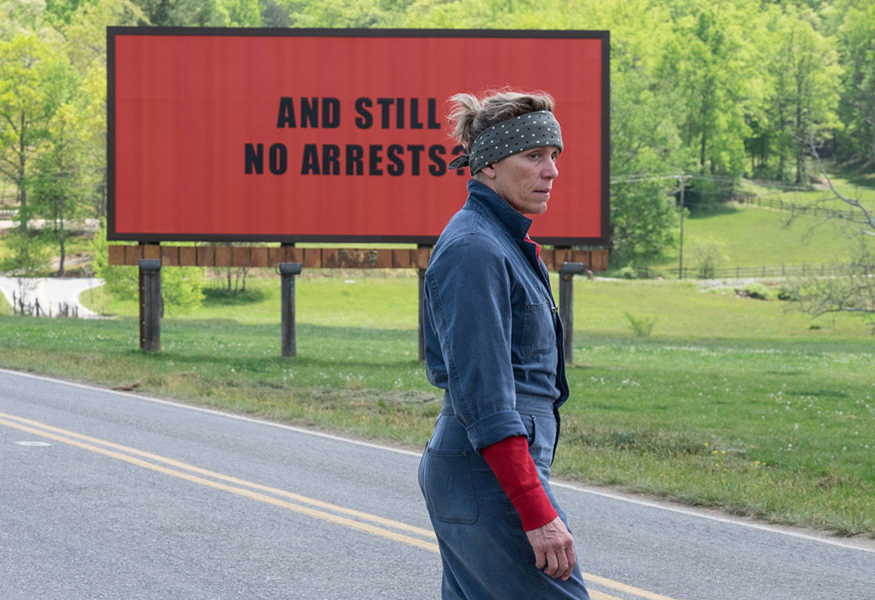
Our story is that of Mildred Hayes (McDormand) – a fierce, tough woman who erects the titular three billboards publicly calling out the local police department over their failure to find the person responsible for her daughter’s rape and murder a few months previously. The subsequent furore over the billboards brings Hayes into conflict with – among others – well-meaning, cancer-stricken Sheriff Willoughby (Harrelson) and racist troglodyte officer Dixon (Rockwell), and topples the first domino towards both violent confrontation and the possibility of forgiveness and personal growth.
The film constantly plays with the audience’s perception of its characters and their respective moralities – and any subsequent expectations of where the plot will go and what will happen to whom – to the point where it actually starts to feel slightly smug and self-satisfied. You can almost hear the gears turning in McDonagh’s head – “what can I do here that they won’t expect?” – and funnily enough, once that card has been played a couple of times, the unexpected begins to be, well, expected. The occasional self-indulgence unfortunately extends to some of the writing; McDonagh’s playwright impulse of giving his characters sharp, clever-clever dialogue slightly undercuts the naturalistic hard-luck feel he appears to shoot for in every other aspect of the film (and one line of dialogue actually made me roll my eyes with its ham-fisted, obvious attempt to be shocking coming off instead as slightly embarrassing, like when a kid way overuses a swear word they just learnt).
I’m aware this all sounds very negative; if nothing else, I’m glad to get Billboards’ relatively minor stumbles out of the way so I can move onto the good stuff, which does fortunately make up the majority of the film (if not, admittedly, the majority of this review).
The performances really are strong all round, with McDormand wonderfully portraying the frequently caustic but always understandable brew of rage, regret and determination driving Mildred, and Rockwell bringing an emotive performance as the law-breaking Officer Dixon.
Billboards is beautifully shot by Ben Davis, finding a stroke of melancholy in its images of rural working class America. The road alongside which the billboards are set up looks like one of the loneliest stretches of gravel in America, maybe the world.
The film also has a vein of McDonagh’s trademark caustic humour running throughout, and the funnier moments generally land. At the very least they perform the valuable function of stopping some of the more emotionally heavy details of the plot from overtaking the film’s overall tone, balancing deftly on the knife’s edge that makes the ‘black dramedy’ so difficult to get right as a (sort of?) genre.
My Neighbour Totoro

1988
Director: Hayao Miyazaki
Words: Christian Abbott.
Some have called this the gateway film into the works of Studio Ghibli, Hayao Miyazaki, even Japanese animation itself, and it isn’t hard to see why.
This is a film about, and a celebration of, child-like wonder. It’s about the power of imagination, discovery, joy and spirituality. It is the essence of what a family film should be. There is no conflict, villains or terror – just family and fantasy. It’s no surprise that Totoro himself has become the iconic mascot for Studio Ghibli.
_
Since its release in 1988, it has managed to build a massive following across the globe. Its simplicity and earnest qualities make it relatable to almost anyone. Those unfamiliar with the works of anime will still recognise the characters and creations of this astonishing piece – a true testament to its longevity and quality. Critics and audiences alike have consistently called this one of the greatest animated features – often siting it high in rankings for best of all time.
The mastermind behind it all is Hayao Miyazaki, the man that hand-crafted the film lovingly frame by frame. The attention to detail is astounding – little moments like a leaf in the air or the grass swaying in the wind are what bring this already beautiful film alive. Miyazaki creates scenic vistas with the familiar anime style of bold, caricature-esque people and creatures to bring all the expression and nuance to the storytelling.
We follow two young girls, Satsuki and Mei Kusakabi, as they move to a new home with their Father to be closer to the hospital their Mother is in. The story is a far cry from the narratives of animation in the West; it is a simple story of a family making the best of an uncomfortable situation, and still finding happiness. Illness is something rarely tackled in animated features but Miyazaki did so here with grace and subtlety.
The new home the girls move into is quickly found to be haunted, but this haunting is benevolent. Little black dots of soot invest the house, scurrying through the darkness away from the light – what sounds scary actually is used to bring more levity, these spirits are as innocent as the girls chasing them. On top of it all, the Father encourages the girl’s faith in the spiritual world, helping them to grow their imaginations and their humility.
But it isn’t all about the family; there are also the creatures of the forest that inhabit this strange and wonderful world. Totoro, a spirit animal of Miyazaki’s creation is no monster – he is a big, fluffy sloth-like giant that sleeps as long as his smile is wide. His friends, two small creatures, one being closer to a bunny and the other a smaller version of Totoro – all help the girls along the way in one form or another. Of course, Cat Bus is the other amazing creature here, a massive twelve-legged cat with a hollow inside so Totoro can get around town. There really isn’t anything else like it.
The world of My Neighbour Totoro is a quiet and peaceful one, utterly benign. The characters that inhabit it are all kind, helpful and endearing while remaining complex enough to invest in. This is a pure example of how narrative doesn’t need darkness to create tension or suspense. Ironically, with all the majestic outlandishness the film offers, it shows how the stories of our lives are the most compelling. The heart of this film grows as you watch it, from moment to moment there is so much love between family, friends and nature.
Over the decades that Miyazaki has been creating and perfecting the worlds of animation, he has remained consistent in the creativity and dexterity of his work. The brilliance of animation is what it allows artists to do, there is no limit except the imagination – it costs no more to draw a battle as it does a landscape. Miyazaki has consistently given us world after world of pure fantasy, with this being a standout in a career of exceptionality.
There has been an ongoing debate for decades now, to watch world cinema with an English dub, or with subtitles for the original voice acting. For me, there is no contest. The original Japanese dub will always be superior – it provides all the nuance and subtle inflections of speech that just become lost in the translation. There is something wonderful about listening to the original actors bring their own emotions into the writing Miyazaki perfected.
Miyazaki has gone on since the release of this film to create some of the most iconic and endearing films of all animation. From the Oscar winning Spirited Away to Howl’s Moving Castle, from Ponyo to The Wind Rises – My Neighbour Totoro will always be his most pure. It is a film that never fails to make you smile, and if you are new to Miyazaki, there is no better place to start than right here.
–
–
Must See Movies: January 2018

At Reel Steel we want to make sure you’re getting the most of your cinematic enthusiasm, so each month we put together our short list of some of the best new releases, from popcorn munching explosion fests to the often weird and wonderful.
Take a look at the trailers below and see what you think to this month’s recommendations!
Jupiter’s Moon
released Friday January 5th, 2018
While illegally crossing a border to escape his war-torn home, a young immigrant is shot and taken to a refugee camp – wounded and in shock, he discovers that he can mysteriously levitate at will. The doctor treating his wounds smuggles him out intent on exploiting his extraordinary secret, while pursued by the authorities through a world where miracles are trafficked for small change.
A story exploring national, religious and personal identity from White God director Kornel Mundruczo.
Three Billboards Outside Of Ebbing Missouri
released Friday January 12th, 2018
After months have passed without a suspect in her daughter’s murder case, Mildred Hayes (Frances McDormand) makes a bold move, painting three signs leading into her town with a controversial message directed at the town’s chief of police (Woody Harrelson).
When his deputy Officer Dixon (Sam Rockwell), a man with a penchant for violence gets involved, the battle between Mildred and the local law enforcement gets heated.
A dark comedy-drama from director Martin McDonagh (In Bruges, Seven Psychopaths).
Coco
released Friday January 19th, 2018
Despite his family’s generations-old ban on music, Miguel dreams of becoming a musician like his idol, Ernesto de la Cruz. Desperate to prove his talent and following a mysterious chain of events, Miguel finds himself in the stunning and colourful Land of the Dead. Along the way, he meets charming trickster Hector, and together the two embark on an extraordinary journey to unlock the real story behind Miguel’s family history.
From Lee Unkrich – director of Toy Story 3, Monsters Inc and Finding Nemo, this latest feature from Pixar tells a story of culture and family.
Star Wars: The Last Jedi
2017 – USA
Director: Rian Johnson
Starring: Daisy Ridley, Mark Hamill, Adam Driver, Carrie Fisher, Oscar Isaac, John Boyega, Domhnall Gleeson, Andy Serkis, Gwendoline Christie, Kelly Marie Tran, Laura Dern, Benicio Del Toro
Words: Josh Senior
Star Wars matters, that much is true, and considering my emotive response to the franchise’s return in The Force Awakens two years ago (you can read that review here, if you like), it’s safe to say I’m fully invested. But if you’re not, you should be too.
Star Wars: The Last Jedi, the eighth entry in the sequential Star Wars cannon (9th when you add in Rogue One), is quite simply perfect, in every way. It’s a blockbuster in every sense of the word, but it’s such a marvellous and grand-operatic continuation of George Lucas’ original work that it’s hard to get too peeved that the best film in 2017 is the film with possibly the biggest budget.
Rian Johnson takes over the reigns here from J.J Abrams whose re-introductory Force Awakens guided us all back into the Star Wars Universe with a gentle and knowing nod to films past. Johnson grabs that notion, and from the off dispenses with it entirely. There is nothing in The Last Jedi that feels old, or retrodden, it’s a wonderful film and story in its own right. Building off of a very solid initial platform Johnson twists and manipulates the character threads established in Force Awakens and interweaves events together in a pulse-racing dash across the galaxy.
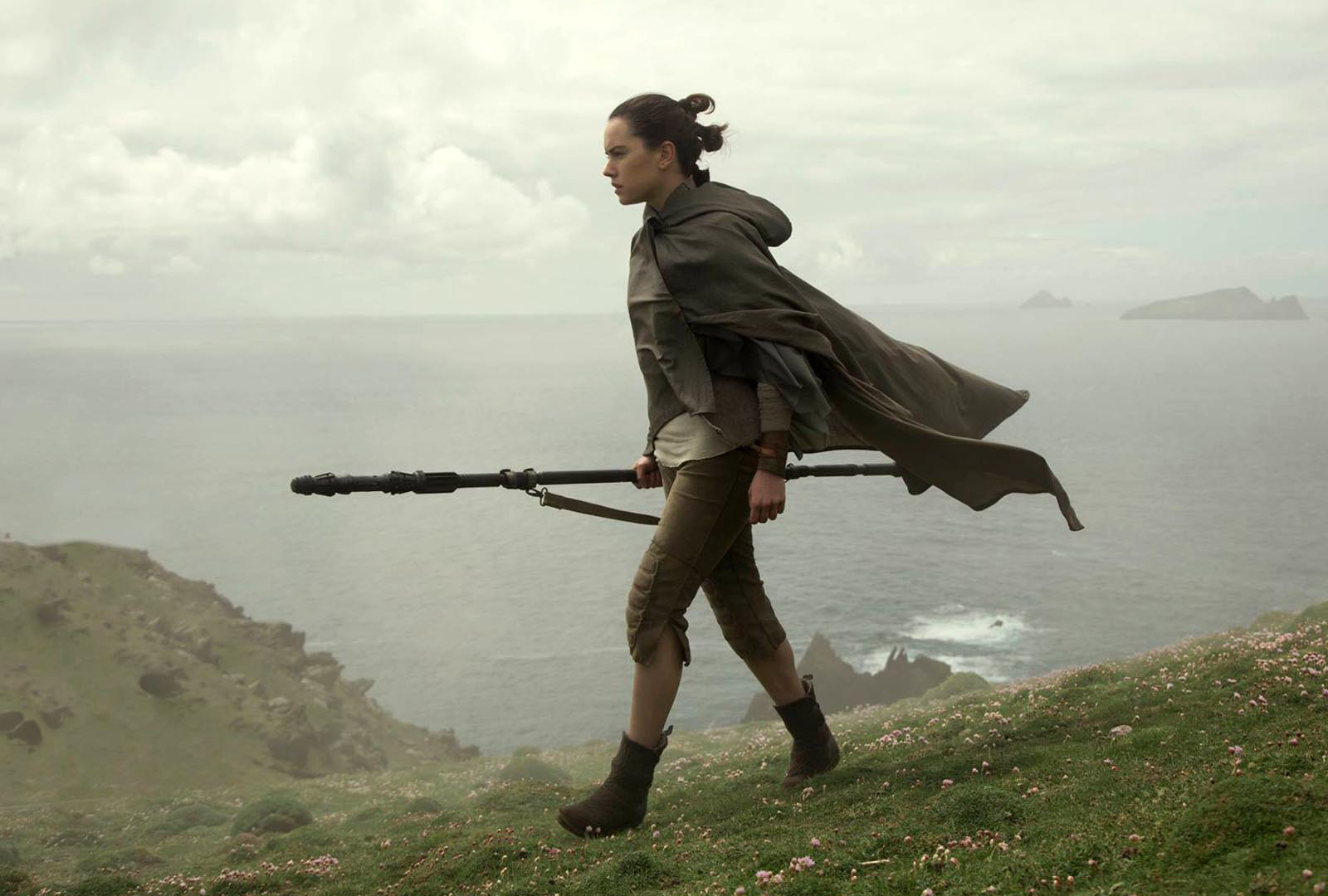
Rey has finally found Luke Skywalker, and Finn, Poe and Kylo Ren all have missions of there own to complete. All of these threads run along side each other meticulously and we jump from each mini-adventure to the next until they all come to a perfectly pitched final conflict, where the characters finally collide. For a film at over two and a half hours long you don’t have much time for pause or reflection.
All of this however would be useless without the superb cast of acting talent at Johnson’s disposal and he does a very good job of bringing in the new stars with the old, Daisy Ridley’s scenes with Mark Hamill are particular stand outs. Carrie Fisher also gets much more screen time and really shines throughout. There’s too many to list in detail but everyone mentioned above has there moment to impress, with a slight favourite being Benicio Del Toro’s new character, but everyone is on fine form.
It’s hard not to worry when something so beloved across the world is passed into the hands of a new film-maker, but Disney deserve great credit with this film (as well as with Rogue One) for making the simple choice to hand the reigns of Star Wars over to people who grew up inspired by the original films, which Rian Johnson and Gareth Edwards both were. The franchise’s popularity and scale are unmatched, but one wrong move could bring the whole thing down. The Last Jedi offers up plenty for Star Wars purists, as well as taking the narrative to new places. It’s a moral tale that blurs the distinction between The Light and The Dark sides of The Force and takes an introspective look at its characters. It questions their actions and beliefs, and that of the wider geo-political universe in which this all exists. That in a nutshell is why they are adored, and will endure onward into Episode Nine, and hopefully… surely… beyond…
*There’s more we could and would like to say about this film, but as always we like to keep things spoiler free…
Best Films of 2017

2017 was a great year for cinema, and as the year comes to an end we’ve selected what we think are the best films released in the UK over the past year
– click on the film title to see our review
An authentic story through a child’s eye-view
A psychological horror that divided audiences like nothing else
A tense cinematic World War II drama
A tale of self-discovery through impulse and animal instincts
A sci-fi epic like nothing else in recent years
A definitive adaptation of the Stephen King novel
A story about time
A different and fitting take on the superhero movie to say farewell to the iconic character
Possibly the most enjoyable Marvel film to date
The horror that took 2017 by storm
A powerful story exploring identity
A tribute to classic Hollywood musicals
The Florida Project

2017
Director: Sean Baker
Starring: Brooklynn Prince, Bria Vinaite, Willem Dafoe, Valeria Cotto, Christopher Rivera, Mela Murder, Caleb Landry Jones
Words: Joe H.
With Florida being known as the “sunshine state”, thoughts of glitz, palm trees and the magic of Disney World are what come to mind when picturing this warm and sunny tourist destination.
The Florida Project invites us to spend a summer with 6 year old Moonee (Brooklynn Prince), living at a budget hotel with her mother Halley (Bria Vinaite), spending her days finding fun and adventure with her mischievous group of friends.
They all live in the shadow of Disney World (“the most magical place on earth”), a place that couldn’t seem further removed from their harsh economic surroundings, but they explore, get into trouble and have fun, and make the world around them a magical kingdom of their own.
We become absorbed in the adventures of Moonee and her friends, but the harsh realities of struggling to get by become increasingly apparent as her mother Halley finds any way she can to provide for herself and her daughter.
Halley almost lives a life that mirrors that of her own child; a care free attitude and not taking any real responsibility, and it’s through this that we see why Moonee is the way she is; she’s clearly picked up her mum’s attitude, at times seeming more streetwise than a child of her age should be, but there are moments when we are reminded of just how young she really is.
For hotel manager Bobby (Willem Dafoe), the troublesome children and their at times equally troublesome parents are a constant headache, but despite this he’s always looking out for the residents. Bobby constantly clashes with foul-mouthed Halley, but looks out for her and seems to have a father-like care for many of the children living at the hotel.
As Halley struggles to keep a roof over their heads, she finds desperate ways to earn money, but her actions have consequences, and as the one charged with being the responsible adult, it is Moonee who ultimately pays the price for it.
The performances here are fantastic – there’s a mix of first-timers and seasoned actors who blend together seamlessly. Willem Dafoe gives one of his best performances in years, he grounds the film, with Brooklynn Prince and Bria Vinaite as our central characters more than holding their own alongside him. Their performances through being first-timers is natural, and our unfamiliarity with them help draw us into their story. The child performances are particularly impressive, and we’re brought into their world as the angle in which the film is shot as we follow them is down at their eye level, so we feel part of the gang. It’s a completely absorbing experience where the problems of their parents and the adults around them don’t seem to exist.
The whole film is a kaleidoscope of colour, we’re immersed in a child’s eye-view as we enter and experience Moonee’s world. A moving and unforgettable story, one of the best films of the year.
The Disaster Artist
2017
Director: James Franco
Starring: James Franco, Dave Franco, Seth Rogen, Alison Brie, Zoey Deutch, Zac Efron, Josh Hutcherson, Sharon Stone, Ari Graynor, Jackie Weaver, Melanie Griffith
Words: Manon Peyralade
The Room, directed by Tommy Wiseau and released in 2003, is a notorious feature known for being a disastrous, hilariously bad film. Bad scripts, bad acting and awful directing, The Room is the epitome of a Hollywood wannabe failure.
When it was announced that James Franco and Seth Rogen were going to make a film based on The Room and Tommy Wiseau, expectation started to build.
The result is not disappointing: The Disaster Artist is indeed hilarious, but it is also more than that.
Indeed, the film has a perfect balance of comedy and drama. The odd personality of Tommy Wiseau (played by James Franco) can be relatable on some points. He had dreams of becoming a star, a famous actor and director, but the cruelty of Hollywood did not give him the opportunities he expected when moving to Los Angeles. And here we find ourselves watching a man whose dreams were thrown in the trash, who clings on to his only friend because his loneliness is unbearable. Wiseau constantly faces laughter and mockery, because his personality and world is misunderstood.
James Franco delivers a strong performance, shifting between an odd individual, an obnoxious director and a deeply lonely and miserable man.
What is really important in this film, and was cleverly done, is that it never mocks Wiseau or The Room. It rather emphasizes on the way he was mocked, and through this empathy the film conveys strong meanings on life, social conventions and Hollywood.
Apart from the disastrous film The Room, we see the friendship between Wiseau and Greg Sestero (played by Dave Franco). This relationship was essential in Wiseau’s life, and the portrayal of their relationship serves Wiseau’s characterization. He becomes jealous, envious, and shows abandonment anxiety when Greg chats with a barmaid and starts to build a sentimental and professional life that would not include him.
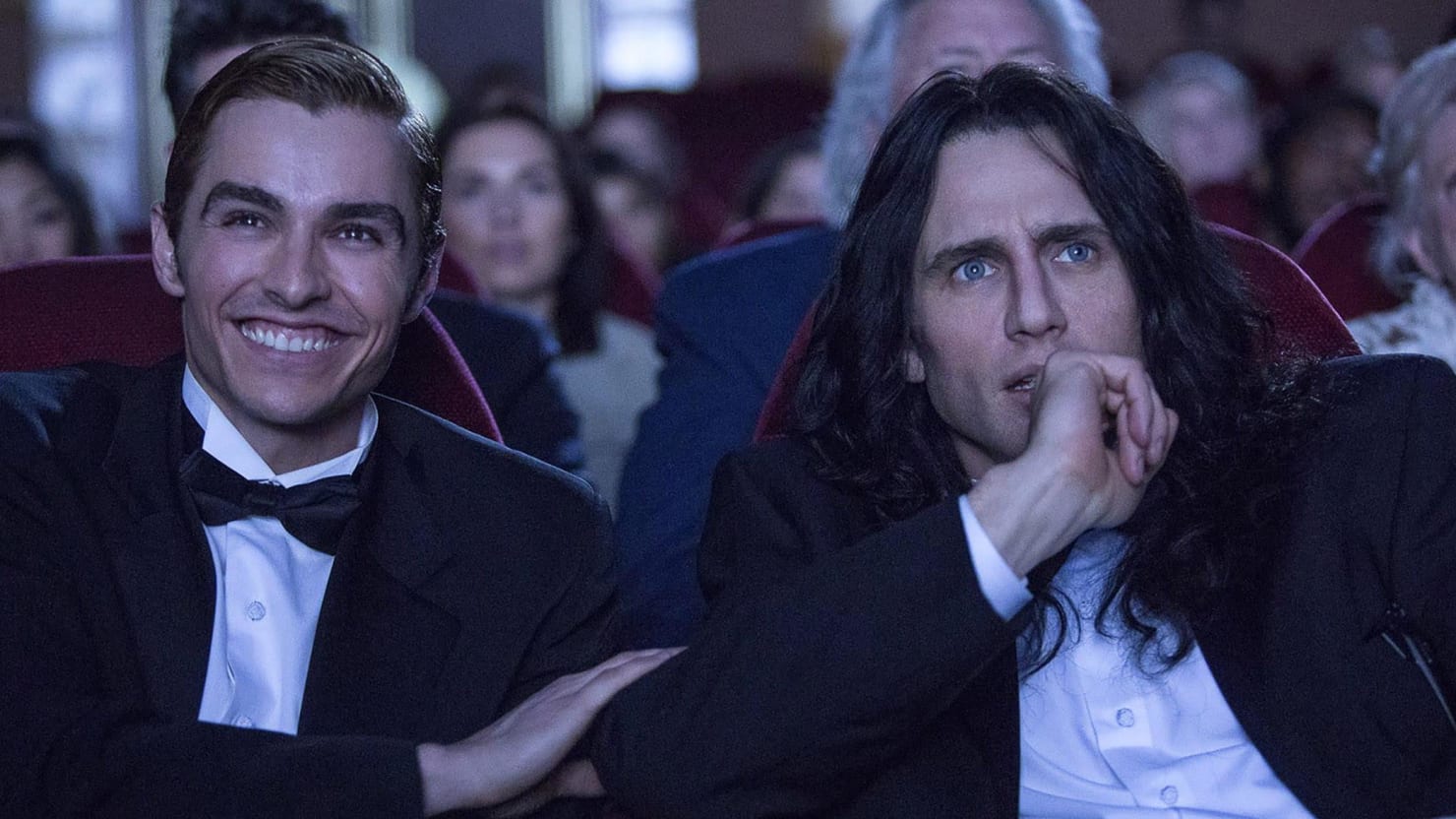
In the film premiere scene, where Wiseau first shows The Room to the public, the awkward footage and embarrassment of the actors is funny. Although, the situation turns bitter when the audience starts laughing out loud. That is the moment when we, the audience, stop laughing. Wiseau realises he failed, and that everyone is laughing at him. He becomes relatable as he represents what we are all scared of: failure, being laughed at, having a career ruined.
If someone is not laughing at him though, it’s James Franco. Franco nailed the expressions and odd accent of Tommy Wiseau, even his horribly bad acting. But outside of the set, his portrayal of Wiseau is unprejudiced, fair and not over-played. We see an empathy from the director of The Disaster Artist for Wiseau, with a subjective point of view from someone who had the chance to succeed in Hollywood.
The Disaster Artist succeeds in showing that The Room is not only a cult movie so bad it makes people laugh, it is also a symbol of Hollywood, where dreams die more often than they come true, and the failure of a man who did not fit in.
Hilarious and heart-breaking, inspirational and depressing, The Disaster Artist succeeds in balancing emotions. James Franco offers an in-depth characterization of Wiseau, which allows the audience to sympathise with him. A surprising addition to the list of one of the top films of 2017.
see the trailer for the original film The Room here –
The Killing Of A Sacred Deer

2017
Director: Yorgos Lanthimos
Starring: Colin Farrell, Nicole Kidman, Barry Keoghan, Raffey Cassidy, Alicia Silverstone, Sunny Suljic, Bill Camp
Words: Manon Peyralade
With the divisive film mother! released around the same time, The Killing Of A Sacred Deer enters the competition of the most twisted, bizarre and intriguing films of the year.
The opening scene sets the tone of the film – a close up of a heart operation. From this outset we understand that the film will make us uncomfortable, and that it will be oddly raw and gruesome.
The cinematography conveys a great sense of uneasiness throughout: the wide-angle used creates an odd sense of space, greatness, almost infinity (the film’s poster conveys that aspect, with a never ending hospital room). The angle makes a normal room look weirdly stretched, making the characters seem farther from each other than they actually are. The use of this angle added to the shot technique is reminiscent of Kubrick’s work on A Clockwork Orange or The Shining.
The use of colours and props draw your attention: the hospital looks extremely plain, with never ending white walls that seem to lead to nowhere.
Being the workplace of Dr Steven Murphy (Colin Farrell), we can almost see those corridors as an allegory of the situation he can’t get out of: a young man called Martin (Barry Keoghan) is obsessed with him, but what adds to the creepiness here is that Dr Murphy accidently caused the death of Martin’s father.
A major aspect of what makes The Killing of Sacred Deer awkward to the point it’s almost unbearable, is the dialogue: intentionally unnatural, we’re made to feel unable to fully understand what is happening, and the impossibility of sorting out the situation Steven is in. For instance, some conversations involve the parents talking about their daughter’s first period at a party, Martin’s fascination for body hair, or Martin’s monologue about the way he eats spaghetti.
One of the themes the film deals with is death, incest and sexuality: Steven telling a story to his son on how he masturbated his own father while he was passed out, Steven’s wife (Nicole Kidman) pretending to be dead to arouse her husband, or even the daughter (Raffey Cassidy) mimicking this behaviour to seduce Martin, which means she knows one way or another what her parents do in the bedroom.
Martin mentions a sort of curse, that is never explicitly mentioned as such, saying that Steven’s family will die, and that bleeding from the eyes will be an omen of their upcoming death. In order to stop the curse, Steven’s wife coldly suggests that they will have to sacrifice one of their children. From that comes one of the oddest scenes in any film in recent years. In an alternative version of Russian roulette, Steven lets fate decides which one of his family members will die in order to save the others. Although before this, the growing illness of the two children who wake up paralysed is extremely creepy. What adds to the oddity is that they move around the floor using their arms, but only later they get a wheelchair. Steven’s behaviour when forcing his son to walk but only throwing him on the floor is painfully uncomfortable to watch.
Psychological horror or horrific drama mixed with surrealism, The Killing of A Sacred Deer, similarly to mother! is hard to fit in one genre. Bizarre, horrific and fascinating, The Killing Of A Sacred Deer is a must watch, and one of the best films of 2017.
Raw

2017
Director: Julia Ducournau
Starring: Garance Marillier, Ella Rumpf, Rabah Nait Oufella
Words: Manon Peyralade
Julia Ducournau set the tone of her art with Junior, a short film depicting the physical metamorphosis of a young teenager. Staying on the same theme, Raw explores the difficulty and confusion of female sexuality for a young girl growing up and discovering life.
Advanced for her age, young student Justine enters Vet school, joining her older sister Alex. After a hazing ritual where she is forced to swallow a raw rabbit kidney, vegetarian Justine starts to experience strange physical symptoms as well as a growing attraction to meat.
The increasing of her urges for meat reach a climax when, after a freak accident, she eats her sister’s finger. Following this, Justine discovers that her sister is a cannibal.
The meaning behind Raw is often misunderstood as being about vegetarianism or animal rights: absolutely not. Here cannibalism could be seen as an allegory of lust, the urge for flesh, both literally and metaphorically.
Through her roommate Adrien, Justine will discover her first taste of meat (a kebab), and eventually her first sexual experience. During this particular scene in the film, we can see that Justine tries to bite him repeatedly, not able to resist his flesh. As the limit between her urges and her morals blur, she eventually bites herself instead.
In another scene where Alex causes a car crash in order to have a taste of the victim, we see that Justine can resist her urges, refusing to submit to them.
A strong script where characterization is clear and established: Justine is vegetarian, like both her parents. When at first it seems strict and controlling, it becomes clear at the end that they are vegetarians for a reason: the mother is revealed to be a cannibal as well. A “trait” that seems to be running on the female side of the family.
Throughout the whole film Justine struggles with pressure, with the way she was raised and her academic results. We can see the character grow in subtle ways throughout the film. For example, the first party of the hazing ritual is a chaotic mix of stranger bodies, loud music and animal behaviour. Justine learns to lose herself, and after training her seduction technique in front the mirror, these parties become a hunting ground, full of potential meat.
Julia Ducournau directed one of the best horror films of the year, one that mixes drama and horror – made by a woman, starring a strong female character. Not only a good horror film but also an important piece of French cinema.
Easily one of the films I loved the most in 2017, Raw is the beginning of a new era for French horror cinema.
Get Out
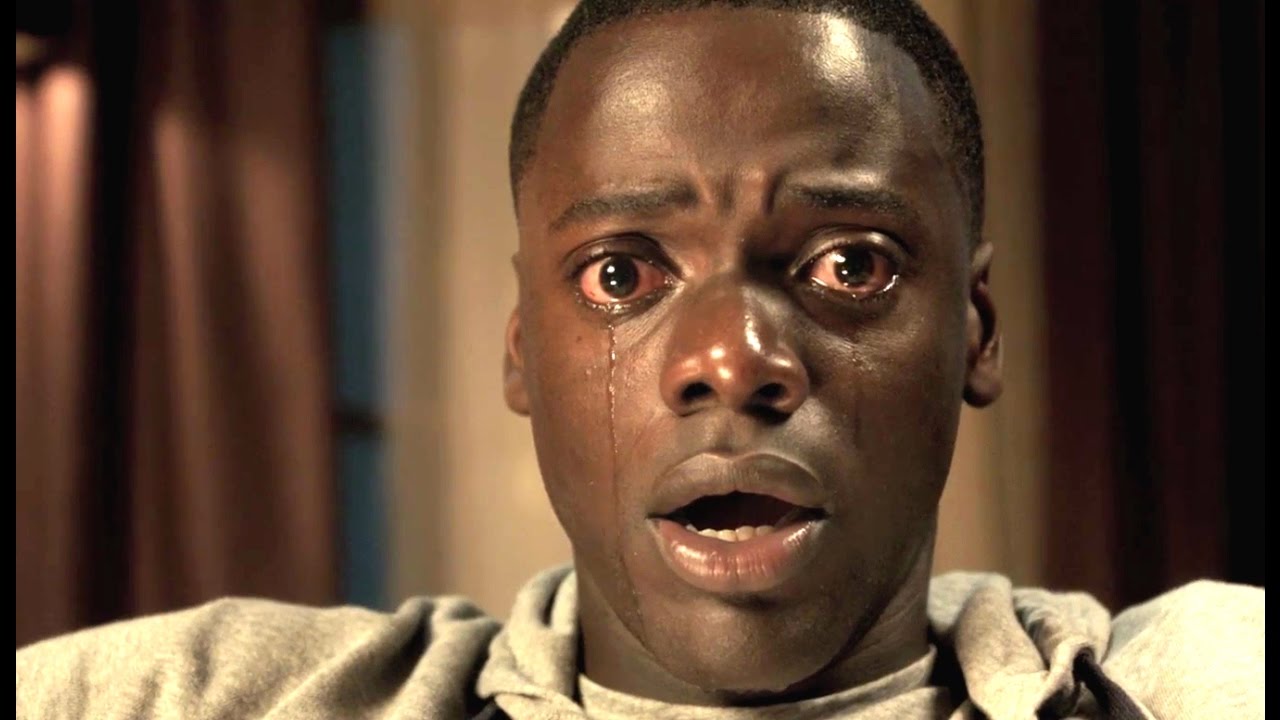
2017
Director: Jordan Peele
Starring: Daniel Kaluuya, Allison Williams, Catherine Keener, Bradley Whitford, Caleb Landry Jones
Words: Josh Senior
Jordan Peele’s debut directorial effort was released to critical acclaim earlier this year, arriving at an odd time for a horror release and pulled together on a shoe-string budget.
Get Out is a breath of fresh air for contemporary horror that offers a daunting and foreboding rise in tension as it slowly creeps towards a bloody third act.
Chris (Daniel Kaluya) takes a trip into the country with his new girlfriend to meet her parents, and discovers along the way that his ethnicity may be the driving force behind the trip. What he uncovers upon arrival is a devastatingly hideous network of people, and that he may not be safe after all as the film goes on to deal with the themes of race, hypnosis, possession and lobotomy.
What Peele does is turn the ‘cabin in the woods’ idea on its head by bringing his character into the home of affluent white people and juxtaposes that with an insane plot and a wicked sense of humour.
Get Out is incredibly sharp in its composition and will surely act as a calling card for both Peele and Kaluya, we await their next project with much anticipation.
 REEL STEEL
You must be logged in to post a comment.