Nausicaä of the Valley of the Wind (1984)
1984
Director: Hayao Miyazaki
Words: Ben Matthews.
Nausicaä of the Valley of the Wind began life as a serialised manga within the pages of Animage, a monthly magazine edited by eventual Studio Ghibli co-founder Toshio Suzuki. It was created by Hayao Miyazaki, who was then seeking work after the underwhelming box-office reception to his first directorial work, Lupin III: The Castle of Cagliostro.
The Nausicaä installments quickly became a selling point for the magazine, Miyazaki’s first exposure to wide critical acclaim. A feature length anime adaptation was quickly commissioned, with an early form of Studio Ghibli coming together for the production; Miyazaki led the team as director, Isao Takahata served as producer, and Joe Hisaishi was drawn in as the film’s composer.
Nausicaä takes place on a unique version of earth, in theory a utopia despite it constantly bordering on the opposite. It is recovering from an apocalyptic reset referred to as the ‘Seven Days of Fire’, the disaster of a nuclear war. Traces of humanity have survived and been scattered far and wide, where a society has begun to be somewhat reformed from various relics of our industrial and information age. Nature appears to thrive but below the surface it rots. Called ‘the sea of decay’, its reach grows and threatens to reset what civilisation the humans have built for themselves.
Nausicaä, a young princess of a small peaceful community, cares for and communicates with the natural world without the contempt held by others in her tribe. When the technologically advanced Tolmekian Kingdom invade and occupy the valley of the wind, clear notions of good and bad become confused, as both sides come under threat from the increasingly dangerous natural world.
The film remains a sort of outlier in Miyazaki’s filmography, for existing distinctly as science-fiction, embracing the manga it’s based on, but also acting as a precursor to the fantasy and narrative conventions with which Studio Ghibli would eventually become renowned for.
In terms of sci-fi influences, the feudal conflict depicted is reminiscent of the one at the centre of Frank Herbert’s seminal sci-fi novel Dune. Narratively too, the idea of a young messianic figure braving and harnessing the harsh environment is remarkably close to the path taken by Paul Atreides. The name given to the Ohm’s (the giant fictional arthropod’s seen in Nausicaä) was even derived from the Japanese translation of sand worm.
French animator René Laloux’s 1973 film Fantastic Planet similarly appears to have inspired the tone of Nausicaä, from its otherworldly creature and world design, through to its use of a frenetic and tense, Jazz-inspired score.
Hisaishi’s work couldn’t feel further from the grandiose music he would create for Miyazaki and Ghibli down the line. His score here alternates between the moments of peace and quiet as Nausicaä navigates an underground cave or glides through clouds, through to the pulsating synth beats soundtracking one of the quick-cut and ferocious action scenes.
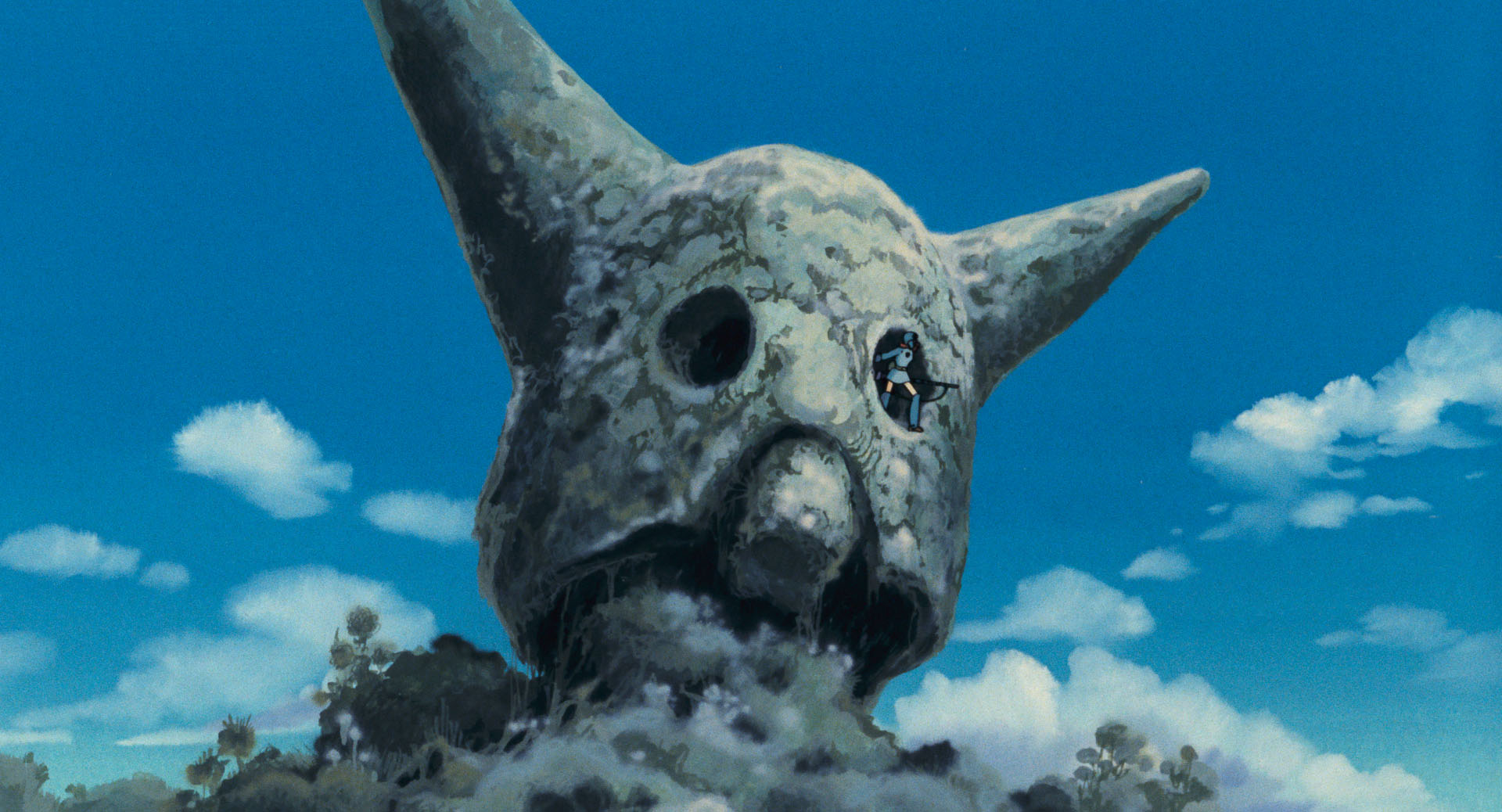
A sequence shows an encounter between Nausicaä and an aggravated Ohm, who serves as the sea of decay’s guardian. For the most part it plays out like a typical chase scene with the scale and speed of something from Star Wars or Raiders of the Lost Ark, but there are also early signs of Miyazaki’s aversion to violence and its impact.
Its climax doesn’t see Nausicaä heroically destroy the creature or rescue her mentor like some kind of superhero, instead it ends on a much more nuanced and somber beat. Miyazaki poses the question, “who made such a mess of this world?” throughout the film, in a surprisingly nihilistic way which doesn’t particularly point fingers at any particular aspect of humanity. Instead, he pins it on an inherent flaw of humanity, in which we are doomed to repeat mistakes of the past. In a world only just recovering from a man-made wipeout, they come dangerously close to undoing every effort they’ve made since.
This kind of environmental message has been explored in different ways in all of Miyazaki’s films since Nausicaä, but none feel as hopeless or damning towards humanity as this. The film’s heart is Nausicaä herself, in typical Miyazaki fashion, a young character at odds with the adults who have built the world around her. She’s probably most comparable to Ashitaka in Princess Mononoke, but traces of her character can be seen in nearly every Miyazaki protagonist since.
A large part of why Nausicaä and Miyazaki’s wider filmography hold up so well 40 years later, is because he always explores unavoidable aspects of adolescence, and issues that will never be locked to one particular generation and their circumstances. It’s notable in all his work but particularly strongly here, with its pointed and mature exploration of a topic only growing increasingly pressing with time.
Receiving a positive initial reception in Japan, the film has only garnered further acclaim in the forty years since release. Outside of its clear influence on Ghibli’s ensuing work, Nausicaä’s DNA can be seen in Western science-fiction (notably recent entries in Star Wars and Denis Villeneuve’s two-part take on Dune) as well as further anime coming later down the line.
It remains a unique touchstone in Miayazaki’s career, and a fascinating first feature for the developing Ghibli team. Its production followed an ethos that would become integral to the success and legacy of their later work, “to offer a sense of liberation to present day young people, who in a suffocating and overprotective and managed society, find their path to self-reliant independence blocked.”
–
 REEL STEEL