2016 BAFTA and Oscars in review

We’ve rounded-up our look at films from the past year that have made the shortlist to pick up awards this season – click on the film title to see our review.
Oscar Winner:
Best Picture
Original Screenplay
BAFTA Film Award Winner:
Original Screenplay
Oscar Winner:
Best Actor – Leonardo DiCaprio
Best Director
Cinematography
BAFTA Film Award Winner:
Best Film
Best Director
Cinematography
Best Actor – Leonardo DiCaprio
Oscar Winner:
Best Actress – Brie Larson
BAFTA Film Award Winner:
Leading Actress – Brie Larson
Oscar Winner:
Adapted Screenplay
BAFTA Film Award Winner:
Adapted Screenplay
Oscar Winner:
Best Music/Original Score
BAFTA Film Award Winner:
Best Music/Original Score
Oscar Winner:
Best Supporting Actress – Alicia Vikander
Oscar nominations included:
Cinematography
Best Music/Original Score
Best Supporting Actress – Rooney Mara
Best Actress – Cate Blanchett
Oscar nominations included:
Visual Effects
Best Music/Original Score
BAFTA Film Award Winner:
Special Visual Effects
Rising Star Award – John Boyega
Oscar Winner:
Best Supporting Actor – Mark Rylance
BAFTA Film Award Winner:
Best Supporting Actor – Mark Rylance
Oscar nominations included:
Best Supporting Actress – Kate Winslet
Best Actor – Michael Fassbender
BAFTA Film Award Winner:
Best Supporting Actress – Kate Winslet
Oscar nominations included:
Cinematography
Best Music/Original Score
Oscar nominations included:
Best Picture
Visual Effects
Best Actor – Matt Damon
Oscar nominated
Best Actress – Jennifer Lawrence
Oscar Nominated
Best Supporting Actor – Sylvester Stallone
BAFTA nominated
Outstanding British Film
BAFTA nominated
Film not in the English language
you can see the full list of Oscar winners here –
and all the BAFTA Film Award winners here –
http://www.bafta.org/film/awards/film-awards-winners-in-2016
our own selection of the best films of the past year can be seen in our Best Films of 2015 review
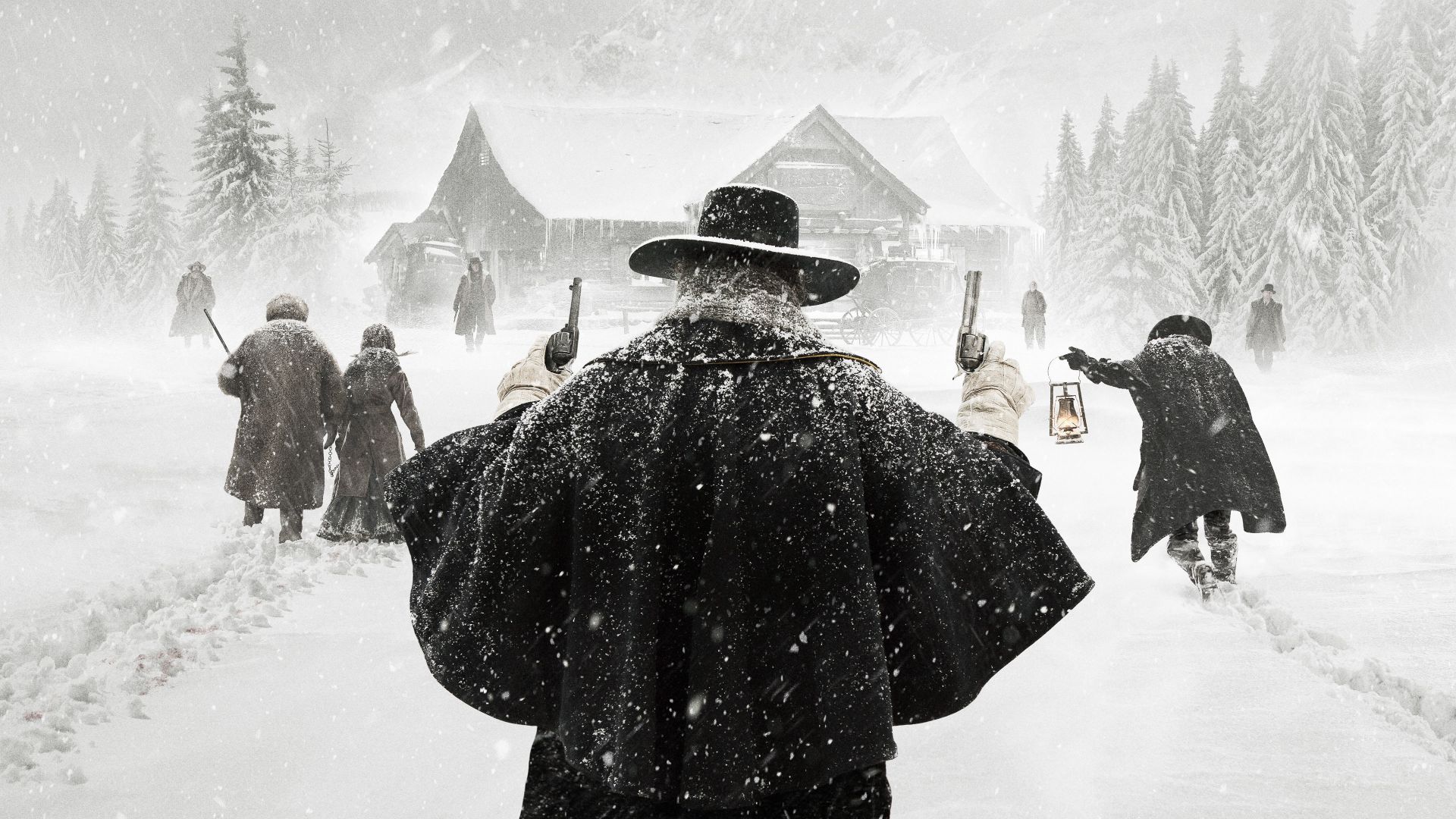
The Hateful Eight
2015/ USA
Director: Quention Tarantino
Starring: Samuel L. Jackson, Kurt Russell, Jennifer Jason Leigh, Walton Goggins, Tim Roth, Bruce Dern, Michael Madsen, Demian Bichir, Channing Tatum
Words: J. Senior
The Hateful Eight, which if you ignore the fact that Quentin Tarantino has actually directed nine separate movies (I assume he counts Kill Bill as one…), is the “eighth” outing from America’s most notorious of cult directors. The man that machine gunned Adolft Hitler’s face off, the man that attempted to make an action comedy about the subject of slavery, the man that publicly protests against police brutality and yet creates films that depict mass gun violence and death. Yes, he’s back, but all controversy aside, this is probably his best film in years.
Praise be to Tarantino for being a director who prefers to write his own scripts and be creatively autonomous from the majority of the cinema industry. Credit where credit is due, the man sticks to his guns when it comes to his cinematic output, and there are not many directors out there today who could only release a film in 70mm prints or to select independent cinemas and abolish any notion of their film playing in multiplexes worldwide.
For all of his independence, he is often at times an overrated director when you consider some of the other great contemporary directors working today. People go mad for Pulp Fiction but I never really got why moving the scenes around so that the narrative was non-linear was so impressive, it’s just a story about unlikeable characters in the wrong order. Jackie Brown is a sub-par adaptation of an Elmore Leonard novel. Kill Bill is quite simply the work of other artists compiled into two movies and the less said about Death Proof the better. I did quite enjoy the alternative history of Inglorious Basterds but I hated Django Unchained. My relationship with Tarantino’s output is at best mixed, so I was happy to hear prior to release his newest film harks back to my favourite of his films Reservoir Dogs. With it it’s claustrophobic setting and impressive ensemble cast, The Hateful Eight does what so many of Tarantino’s films fail to do, it exemplifies his range of skills and doesn’t feel like a pastiche or a rip-off of another film, it feels new and fresh, like a pile of Wyoming snow.
The story revolves around a group of criminals and outlaws, holed up in a Wyoming shack as they shelter from an oncoming blizzard. John Ruth (Russell) is taking the notorious outlaw Daisy Domergue (Jason Leigh) to hang in the nearby town of Red Rock. All he has to do is survive the next three days in the company of a gang of murderers, crooks and liars. Not every man is who he says he is, and each has their own motive for being in the shack. As well as Ruth there’s Major Marquis Warren (Jackson) an ex-communicated Union cavalry man, Red Rock’s New Sheriff Chris Mannix (Goggins), Mexican cook Bob (Bechir), British hangman Oswaldo Mobray (Roth), Retired Confederate General Sandy Smithers (Dern) and the mysterious cattle herder Joe Gage (Madsen). Ruth sets out his stall to investigate each of the men one by one to deduce whether any of them will challenge him for the bounty of Domergue or attempt to set her free. As the hours tick by tempers fray and old relationships come to the fore.
From the outside looking in this film does seem a little bit like Reservoir Dogs with revolvers but it’s far from it. It’s more akin to the basement scene in Inglorious Basterds or the dinner at Calvin Candie’s ranch in Django Unchained. However, this film is pretty much half tension and build up and half full blooded action. The build up is tantalising and makes you wait for over an hour for the eventual bloody pay off you expect when watching a Tarantino movie. Where people praise the director for his action sequences and violence. His skill of writing and pacing are laid open here. It’s in the quieter moments that the film really hooks you in a rewards you for the investment of your time. Set out in Chapters in an almost Shakespearean fashion. The title of each chapter alludes to an event within the upcoming sequence to guide you steadily through the narrative.
It was part way through (and I’ll not say exactly where) when Tarantino’s voice kicks in over the action, in the form of an anonymous narrator, that I was really hooked, the film steps back a few scenes and the director slyly alerts your attention to an action “you may have missed”, which then instantly aligns you with certain characters and alienates you from others. The secrets are divulged to the audience and you wait in anticipation for the fall out of this scene. It’s a clever stroke, and one which I found ramped the enjoyment up several notches.
The cast here are brilliant also; Russell, Jackson, Roth and Madsen return again for the director and each plays his part in devilishly good fun. But it’s the two newcomers here that really stand out from the crowd. Walton Goggins (who played transvestite call girl Venus Van Dam in Sons of Anarchy) as Chris Mannix who really steals the show. Mannix is a former outlaw bandit turned law man and is on his way to Red Rock to assume the position of Sheriff. He is at times quaint and timid and is at odds in the company of such violent men as the ones he finds himself with, but is also attempting to assert his new authority at the same time. It’s a performance of career heightening standards, and I can only hope he gets to helm the next Tarantino project himself, he carries this film at times when the acting of some of the older cast members leaves little to be desired. Jennifer Jason Leigh as Daisy Domergue is also fantastic. In somewhat of a breakout role for her, her character has to cope with being punched, elbowed, stabbed, shot and vomited on throughout the course of the movie, it really is a tour-de-force on her part. She spends the majority of the run time chained to the wrist of Kurt Russell and their chemistry is at times electric.
There’s precious little else to say about this film that hasn’t been said already at this point. I did enjoy it as a whole and I didn’t feel like I’d been robbed of three hours of my life as I have done before when watching one of his films. Whilst it’s his best film since Inglorious Basterds it’s still just a Tarantino film at the end of the day. Gratuitously violent, shamefully borderline with its racist language and a rather predictable affair. If you like his films you’ll love it as always, but if you appreciate other forms of cinema there is enough here to keep you entertained. That isn’t seeing someone’s been head blown to pieces for 1000th time though, there’s more in there if you take a closer look.
Joy

2015/ USA
Director: David O. Russell
Starring: Jennifer Lawrence, Robert De Niro, Bradley Cooper
Words: J. Wood
The partnership of David O. Russell and Jennifer Lawrence continues to bear fruit but of the three films they, alongside Robert De Niro and Bradley Cooper, have made together, this one is the most inconsequential. Why this is the case is less certain, because put simply this film had me gripped throughout, had me engaged in the characters and their situations yet at the same time the jigsaw of the film did not feel at any point like it truly came together, and tonally the film really is all over the place.
The situation of Joy at the start of the film makes for some great comedic situations that, if I am being wholly honest were not fully utilized by Russell, a director usually very good at bringing wry comedy to the forefront of his works. There is a weird David Lynchian verve underpinning the whole third act, as Joy’s aimless mother (Virginia Madsen) watches a ridiculously trashy Dallas like TV soap almost constantly, into which the film takes bizarre flights of fantasy. This David Lynch connection is only strengthened by the participation of Isabella Rossellini and Diane Ladd. The film does a good job of constructing a situation that could so easily fall into totally inappropriate farce, as Joy finds herself sharing a house with her near bedridden mother, grandmother and two children, as well as having her father and her ex-husband sharing the basement. This first act is when the film worked best as a whole unit for me, as Joy’s desperate situation becomes apparent and is handled with surprising maturity by Russell.
As the second act is reached and the film becomes less about a woman fighting against all odds to stay afloat despite having the weight of her entire family’s survival on her shoulders, and more about the ‘nominal’ subject Joy Mangano and her invention of the ‘Miracle Mop’. The film purposely tries to leave the more comical and fantastical elements of its opening act behind to become a much more straightforward drama, which is not a wholly terrible decision to have made yet for some strange reason it is not followed through totally, with the comedic elements not wholly disposed of and in most cases, most notably Virginia Madsen becoming besotted with a Haitian plumber, they stick out like a sore thumb.
As a visual exercise the work of Tim Burton appears to be quite a huge inspiration, as many shots are framed in a very Burton-esque way, looking up at close up shots of the actors framed against a silhouette of light are very Tim Burton. In fact, not only this fantastic work by cinematographer Linus Sandgren but also the recurrent snow motif, strangely detached narration by Diane Ladd and the film’s infrequent flights of fantasy or extended flashback sequences have more than a touch of Tim Burton’s work about them, albeit in a more grounded narrative.
Anchoring the entire film and to a great extent preventing the whole narrative from crashing down around the central character is a performance by Jennifer Lawrence that although nothing out of the ordinary for this extraordinary actress is still a perfect anchor for all the weirdness and absurdity surrounding her throughout the film. Whilst indeed the film proves to be a more than adequate arena for her to prove just how good she is at showing resilience on screen, especially towards the end as she confronts a Texan businessman in the movie’s one scene of real tension, a scene owned by Lawrence in an out of character moment, the real strength to her performance here is the opportunity given to her to be wounded and broken by her life, or indeed the fabulous moment where Joy is star struck as she takes to the QVC airwaves.
The QVC scenes are the film’s most consistently great; written as a pastiche of sorts on the old studio lot based Hollywood, Bradley Cooper is the best of a strong supporting cast in a surprisingly small role as the channel boss, in awe of the place, treating it as his own studio, constantly regaling his audience with tales of David O. Selznick and Jack Warner, he really makes the audience believe that he believes he is their equivalent when really he is just a jumped up delusional, albeit one who it is fairly easy to warm to thanks to Cooper’s charm. The rest of the supporting cast do good if less showy work, and it is a pleasure to see De Niro’s continued collaboration with Russell as he is the only one who can get something resembling the De Niro of old to the screen and, given that ‘Dirty Grandpa’ is out soon, that is a real blessing.
The narrative of Joy is a rocky road but it is a real success that Russell makes a convincingly feel good ending from the opening act. Joy is not a bad film; it is just not a film I can quite pin down. The whole thing just feels slightly jumbled, as if all the components are there just not necessarily in the right order, hence taking some of the effect of the film away. Worth seeing as a piece of well thought and acted film making, but a lesser film in the David O. Russell canon.
Creed

2015/ USA
Director: Ryan Coogler
Starring: Michael B. Jordan, Sylvester Stallone, Tessa Thompson
Words: J. Wood
Every genre has a series of clichéd story points that a film follows, and the boxing movie is no different, in fact boxing movies if anything have the most clichés of them all. Think back to any boxing movie you have ever watched, no matter the quality, and you will recall having seen;
- A hero with some strife or inner turmoil driving him/ her.
- A testy relationship between the brash hero and the tentative, sage mentor.
- A burgeoning relationship brought into difficulties by his career.
- A cliché ridden caricature of an opponent.
- An against all odds, underdog finale.
Creed has all of these elements, in exactly the order and proportions one would expect them, yet it is a film that not only understands its genre but also understands the great legacy it is building upon.
For me Creed is the proper sequel to Rocky IV, a film I understand to be terribly of its time yet still a good Rocky movie, the last one to flirt with plausibility. To build upon the legacy of Apollo Creed, a legacy the film is not in any hurry to let you forget, feels like the right and proper thing to do. Leave Rocky’s outings in 5 and 6 forgotten and turn your attention to what feels like the natural lifecycle of the series. The key reason that this film works so well is the very reason that it could have been an unmitigated disaster in its handling of Rocky Balboa. Written for the first time by someone other than Stallone this Rocky is a mournful, strangely pathetic character whose achievements have amounted to nothing more than grief and regret. Coogler and Covington wisely utilize Rocky sparingly, only giving him a couple of brief scenes apart from the titular hero, making clear that although this is still Rocky’s story he is no longer its driving force. It is with great surprise and I must admit grudging pleasure that I can announce that Sylvester Stallone, a man who has been playing a very poor version of himself for as long as I can remember blew me away in this film, developing a good rapport with his younger co-stars, getting a few laughs and hitting every single one of the not insignificant dramatic notes the film asked of him.
A good deal of the praise for this ought to go to the screenplay, which is clearly written by two people who both know and love the Rocky films dearly and do such an iconic character proud. Much like J.J. Abrams and Lawrence Kasdan did recently with Star Wars: The Force Awakens, Coogler and Covington use a familiar framework to fans of the franchise in order to ease back into the world, and there is just the right amount of little nods to the past without it feeling forced, and the result is an effortlessly enjoyable piece of cinema. I have come to the conclusion having seen more than my fair share of boxing movies that almost any director can shoot boxing well, yet here Ryan Coogler and cinematographer Maryse Alberti are the first pair since Scorsese and Michael Chapman to shoot it brilliantly, with the fights having a well and truly unexpected cinematic air to them. On the basis of this and Fruitvale Station Coogler is a great prospect as a director, who has made two very good films and has all the tools to make a great one.
The same can be said for his regular collaborator Michael B. Jordan, who here eases into the mantle of Adonis, convincing both as a fighter and as an actor. While the likes of Mark Wahlberg and more recently Jake Gyllenhaal never convinced me as boxers, he did, and he certainly had the dramatic chops to deal with the weightier side of the material. There are a couple of missteps however in an otherwise very well made film, one being the casting of Tony Bellew. Casting a real boxer adds an air of authenticity but can feel a bit like stunt casting, albeit stunt casting that was not particularly publicized. Unfortunately, Bellew proves to be a less than great actor, and his scenes are the worst written part of the film, feeling as though they were cut and pasted in from an early Guy Ritchie film.
There is a little too much of an over-reliance in showing how things have changed via slightly excessive use of technology showing old fights, press conferences etc., although they provide a good juxtaposition with the Philadelphia setting that is all too reminiscent of Stallone’s first Rocky outing forty years ago. Despite this I was thoroughly impressed by Creed, which for me has earnt the title every boxing film yearns for; ‘The Best Boxing Film Since Raging Bull’.
Best of 2015

A great year for cinema, this is our selection of the best films released in the UK in the year that was 2015
Sicario
Slow West
45 Years
Song Of The Sea
Housebound
It Follows
The Look Of Silence
The Walk
Whiplash
you can view our free-to-read online publication giving you reviews of each via the following link
issuu.com/reelsteelzine/docs/2015_final
other noteworthy films of 2015:
The Martian
Mad Max: Fury Road
Star Wars: The Force Awakens
The Danish Girl

2015/ UK, Germany, USA
Director: Tom Hooper
Starring: Eddie Redmayne, Alicia Vikander, Amber Heard
Words: R. Topham
A much anticipated biopic about the life of Lili Elbe, an early twentieth century transgender woman and one of the first to attempt gender reassignment surgery, The Danish Girl details a poignant journey through the social construction of gender norms, the relativity of identity, instability, love, commitment and acceptance.
The story of Lili’s transition begins whimsically. Portrait artist Gerda Wegener (Alicia Vikander) asks her husband, landscape painter Einar (Eddie Redmayne), to model as a ballet dancer for her latest piece, complete with stockings, shoes and frilly dress. Something, and someone, awakens in him – Lili. She begins her life as Gerda’s muse, growing stronger with every stroke of the brush and liberated by the popularity of Gerda’s work. This is more than life imitating art; this is art stimulating a life, and that life flourishing in ways never before considered.
It is, at times, incredibly uncomfortable viewing. This is credited to Vikander as the concerned and confused wife, and of course Redmayne, who once again proves himself a brave and masterful performer, and a fine example of British talent. The pair bring an electricity and vigour to the characters that surpasses the average paradigm of a young married couple – a wisdom and intimacy seldom portrayed on screen successfully.
The visual elements of The Danish Girl are beautiful and delicate because they had to be in order to compliment the story, script and acting. The protagonists, as artists, lead relatively charmed lives in the Danish capital, and immerse themselves in art galas, fancy clothing and an endless supply of cigarettes. It is noticeable that Lili radiates happiness much more than Einar does. She has been relieved of a life of imprisonment in a body that is not hers, and Redmayne does an outstanding job of exemplifying the nervousness of this new found freedom through coy smiles and blushing at the flattery Lili receives. Lili’s life is portrayed as full of external elegance as well as internal beauty, whereas Einar’s psychological complexity overwhelms his ability to leave the gray area.
Not only was the film appropriately released at a time when transgender rights are finally at the forefront of social and political conversation, but it also delves into morality, self, and the impact of the two in committed relationships. Einar and Gerda had a long and joyous marriage, and though Gerda is happy to use Einar as Lili for the purpose of her paintings, she struggles to accept Lili as permanent, as a person. But, likewise, Einar and Lili are not perfect either. The former is selfish, the latter is materialistic. Director Tom Hooper has gracefully crafted a dramatic and emotional story about people experiencing very real dilemmas to commendable effect.
If Eddie Redmayne doesn’t scoop up all the awards, I’ll be inconsolable for weeks.
Star Wars: The Force Awakens

2015 – USA
Director: J.J Abrams
Starring: Daisy Ridley, John Boyega, Adam Driver, Oscar Isaac, Harrison Ford, Carrie Fisher, Peter Mayhew, Andy Serkis, Mark Hammill
Words: J. Senior
If you are a human being living on Planet Earth, and unless you have been living in a cave with no internet connection for the past three years, it will be almost impossible for you not-to-know that there is a new Star Wars film currently out in cinemas. The financial might of Disney studios having purchased the rights to film’s greatest ever franchise three years ago has lead us to this point, the point of no return. The Force, has awakened.
Now it’s almost impossible not to get washed up in a tidal wave of euphoria when it comes to Star Wars, for most young people of all ages the six previous films are cherished pieces of cinema that can be returned to over and over again. And before we get into a debate about The Originals vs. The Prequels or any of that nonsense, it’s important to note just how excited the whole world is (with the exception of that undeniable twat Piers Morgan) about the return of the galaxy far far away. For my own personal reasons Star Wars, and in particular George Lucas’ original three movies circa 1977 onwards will always hold a special place in my heart. They were the first real movies I got excited about, and they shaped my childhood to a certain extent. I saw the re-releases in the cinema with my parents, one of my earliest cinema going memories in fact and I remember long winter afternoons constantly re-watching them with my younger brother. To this day I still get Star Wars branded Christmas gifts, and more often than not the films are a reference point between myself, my Father and Brother from which many fond memories and jokes originate. To paraphrase Ron Burgundy, these films are kind of a big deal for me.
So to review this film I need to take a step back from any personal investment in the franchise as a whole. I like many others would simply enjoy this film because Chewbacca is in it or because someone turns a light-saber on, those are just basic things which garner so much adoration, there are more but I shall refrain from listing them. What we as a society need to do is analyse why this film, the seventh addition to the Star Wars franchise is good, because it is, but not because I loved the other films when I was seven. This is the first film in the series I have seen for the first time as an adult, so I will attempt to produce an adult appraisal, so I’ll mention Jar Jar Binks here, just the once, and leave it that. The end product when you strip away the merchandise and the endless tie-ins is a film, so let’s just look at it as that, and that alone.
With most film reviews it is always pertinent to talk about the plot to begin with and as such, there may be a few spoilers in here that you may want to miss. Although we will not discuss the big reveals in detail so as to avoid crushing anyone’s souls.
What J.J Abrams and co. have done with this film is identify what makes Star Wars, Star Wars. Gone is the constant use of green screen and questionable acting. In comes a return to practical effects and a new young cast assembled from a wealth of burgeoning acting talents. Messers Ridley, Boyega, Driver and Isaac, really steal the show and introduce themselves as the franchise’s new driving force.
Abrams appears to have simply followed the ‘if it ain’t broke approach’, he knows what fans of Star Wars want to see and he provides it. What we have here is something that simply feels quite familiar, and different at the same time. There’s a droid with a hidden secret that is being pursued by an evil army, a loner on a desert world with no real family, a chance encounter with a certain intergalactic smuggler, a Sith lord in a black mask with a sinister voice and so much more that brings us back into the world of Star Wars with a friendly and noticeable homage to films passed. Yes there may be a big ball of death with an Achilles heel to defeat but there are also new stories and new directions that The Force Awakens leads us off along to.
Boyega’s Finn is a Storm Trooper with a conscience that decides almost imminently after his first battle that he cannot support The First Order (renamed from The Galactic Empire) in their motives and sets out on a path to escape their clutches. He does this by way of setting ace X-Wing pilot Poe Dameron free from the clutches of the crossguard-sabre wielding Kylo Ren. In doing so he crosses paths with Rey, a loner and a drifter who’s only friend is a small droid called BB-8. It is this chance encounter that sets the film in motion. And by simply attempting to escape The First Order Rey and Finn are dragged right into the centre of the conflict and are welcomed into The Resistance who are lead by a certain Princess. The battle ensues, and it’s a joy to behold.
I’ll not go into anymore detail than that, as I feel I’ve given enough away without spilling the beans too much. But The Force Awakens really is a genuinely excellent film, for the same reason I enjoyed Spectre so much this year for the fact it paid tribute to previous installments whilst still being refreshing and compelling.
J.J Abrams has a strong career in television behind him, which is a telling fact, because this film really did feel like the TV pilots to end all TV pilots, by setting up the main characters and their oppositions. The trailers for the film promised the reveal of big secrets, and some are divulged but so many more are left unresolved, leaving you wanting more. The first film of an all new trilogy was never meant to give you all the answers you required in one fell swoop. But the tease of bigger events to come also lends the film its main strength. Certain characters like Andy Serkis’ Supreme Leader Snoke are shown on screen but are given no back story. Unlike Luke Skywalker in A New Hope we know very little about Rey (she’s the real hero here by the way), we are given only the briefest of insights into her past, is she Han and Leia’s daughter? It would appear not… is she a Skywalker descendant? Who knows? It creates the anticipation for Episode VIII that Star Wars needs to survive over the next 18 months.
In that time we do have Rogue One to keep us mildly entertained (I for one think it will be excellent), but with Brick and Looper director Rian Johnson taking the helm from Abrams I hope that the next installment takes a step away from the familiar and into darker and more pensive ground. Where this film was enjoyable it was also a little safe, but it proved less of tangible risk to all involved by being as such. If the next film does one thing it needs to brave and bold, The Force Awakens has built the platform needed to spring upwards from, it’s a good film not a great film, but with two more films to go it was never the intention that this be the strongest film in the trilogy. It does its job admirably and passes the lightsaber on with a fresh drive and a daring impetus.
Top Star Wars Moments

Words: J. Wood & J. Senior
You may not have heard, but there’s a new Star Wars movie out this week. To commemorate the release of The Force Awakens, we at Reel Steel thought we needed to take a look at the very best moments of the timeless series so, without further ado, I give you my three favourite moments from each of the original trilogy, plus a special bonus moment too. Also in addition to my favourite moments, our editor Josh will weigh in with his picks across the films from the original trilogy.
A New Hope
Binary Sunset
This is the moment that for me first sets Star Wars aside from other science fiction and fantasy as something more elegiac. Thus far in the story we are aware that there is a galactic war, that Darth Vader exists as a malevolent force of evil and that the two droids are on a secret mission from a princess. However this scene puts Luke Skywalker, an orphaned, bored farmhand front and centre of the saga, on a barren, desert world with two suns. Not for the first o last time John Williams’ score works away from the most noted excerpts with a clever, gorgeous melody that truly makes the moment complete.
Escape From The Prison Block
The first time the three major players all come together. Luke and Han’s efforts to free Leia, against all of Han’s better judgement plays out as almost a comedy of errors, as Han and Chewie bundle their way through a hardly thought through semi-plan. Buoyed by Luke’s boundless enthusiasm and Leia’s level headed calm, this shows how great the dynamic that would drive the franchise would be from the very earliest opportunity.
Darth Vader vs. Obi Wan Kenobi
Alec Guinness was a genuinely world class actor cast amongst a group of debutants and little knowns as a source of heft. His sage presence throughout the first hour of this film leads the audience to believe that his character would play a major role in the franchise. However putting him up against the monstrous like Vader gave the franchise the first moment that would truly define it. While this may not be the best lightsabre battle of the franchise it is still enthralling stuff, and the repercussions of its shocking conclusion have implications throughout the franchise.
Editor’s Pick: The Clumsy Storm Trooper
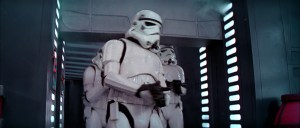
In an array of moments this is often the one I find myself coming back to with fondness in A New Hope. Not technically a classic moment but it’s a moment that does remind us that even Star Wars films are just movies and were largely made with fun intended, no matter how many humanitarian messages people attempt to withdraw from the series. The sight of this Storm Trooper clanging his head on a low hanging door has me in stitches every time. Maybe a letter needs to be filed to The Death Stars health and safety officer?
The Empire Strikes Back
Luke Meets Yoda
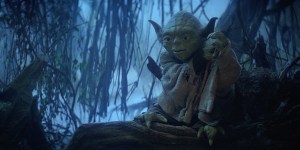
Following Obi Wan’s death in A New Hope, Luke’s fate was left open at the start of Empire, as the only person with Jedi Powers fighting for the forces of good. The beginnings of the Dagobah sequences do not bring the greatest hope of greatness as Luke and R2 come across a strange little being. Empire is a film of great reveals, and as the strange little green being with the mangled syntax is revealed to be the great Jedi warrior, the franchise once again entered a new plane.
Betrayal on Cloud City
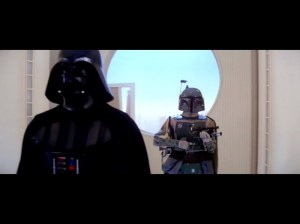
Luke’s visions on Dagobah offer the audiences a hint at the horrors to come, but when Han, Leia and Chewie enter the banquet room on Cloud City, the sight of Vader and Boba Fett hammers home quite how serious their situation is. The subsequent torture and freezing in carbonite of Han cements Empire as the truly dark film of the franchise, using the clever building of Han and Leia’s relationship to emphasise the tragedy. Some would have expected the big reveal to be on here, however I feel lesser celebrated elements of the franchise need highlighting.
The Final Shot
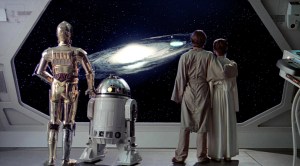
My favourite scene in the entire franchise. Much like the binary sunset, this has much to do with the fantastic score of John Williams, using his wonderful skills to heighten a quieter moment in the franchise. There have been few films within a franchise end on such a down note, the hero has lost his hand, all relations have been turned on their heads and Han is in mortal danger. So to end it simply, with Luke, Leia and the droids watching the Falcon head to Tattooine is a subtle yet effective way to end a wonderful film.
Editor’s Pick: The Debut of Slave 1

Long before we get to see Boba Fett in full action we see his iconic space ship tailing the Millenium Falcon on its way to Bespin. We had to wait until Attack Of The Clones to really see it in action, but for a spaceship that is so impractical (it lands flat on its back like a turtle that’s rolled over) it has possibly the coolest name of any vehicle in all six movies and only adds to the cult of cool that surrounds Boba Fett’s character.
Return Of The Jedi
Sail Boat Battle

Han is rescued yet he, Luke, Leia, the droids Chewie and Lando are still in terrible danger as they are sentenced to being eaten by The Sarlacc, and be digested over a thousand years. Although the ill-advised slave outfit Leia is wearing looks worse each time I watch the film, this is a nice relief after the darkness of The Empire Strikes Back. This sequence captures the Saturday morning matinee atmosphere that Lucas showed with Raiders of the Lost Ark, and pits Return of The Jedi on firm, triumphant ground.
Luke Reveals All to Leia
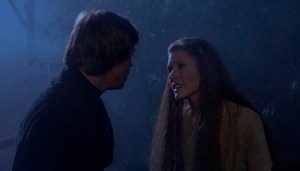
After the reveals first by Vader and then Yoda, the fact that Luke lets Leia into the secret of her true identity adds an extra dimension to the stakes of the final battle. Their connection at the end of The Empire Strikes Back is now firmly explained, whilst the humanity on show between them is the high point of the franchise’s emotional impact.
The Battle of Endor: Space

The final act of Return Of The Jedi is a masterclass in intercutting narratives to create a wider picture. Of these three segments the space battle is the one that always stuck out to me. There is the spectacle of the dogfight, the charisma of Lando holding things together, the cult iconicness of Admiral Akbar and the sheer brilliance of seeing the Star Destroyer crash into the surface of the Death Star. This is triumphant filmmaking portraying the triumphalism of the narrative’s conclusion.
Editor’s Pick: Hover Bikes
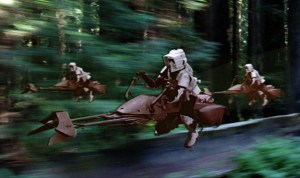
This is possibly my favourite moment in the whole trilogy. It’s the moment when you finally see the brother-sister bond between Luke and Leia in full effect as they wizz between the trees of Endor taking out box helmed Storm Troopers one by one. My particular favourite part is when Luke chops the front off of an oncoming Hover Bike and nobs its pilot straight into a tree stump, and causes it to explode. Luke’s finale in this film is pretty tame so it’s quite nice to see him in full Jedi flow before the film gets a bit sulky and everyone starts wearing black, like a goth teenager.
Bonus:
The Tale of Darth Plagueis The Wise
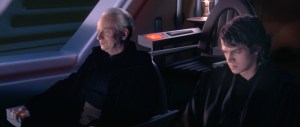
Ironically, for a series very little renowned for it’s screenplay, especially in the absurdly trite prequels, the bonus comes from Revenge Of The Sith, and the fantastically written scene of the story of Darth Plagueis the Wise. Brilliantly acted by Ian McDiarmid as Chancellor Palpatine, he tells Anakin the story of the Sith Lord murdered by his apprentice having mastered the concept of immortality and reincarnation. Played out in a way that so cleverly semi-suggests it, almost barely hiding his own mask while still maintaining cover, the scene sticks out like a sore thumb in Revenge Of The Sith, in that it is so well portrayed.
Editor’s Pick: Pod Racing

Quite late in the day I’ve realised I have a Star Wars vehicle fetish, which is something I never expected. Maybe I would like the Fast & Furious movies after all…
… So we come to Pod Racing, a sequence from the much maligned Phantom Menace, which for the record I think is absolutely fucking great. Darth Maul yo!
But the Pod Racing section is a total classic, we get to see Anakin Skywalker before he turned into Darth Vader being all Home Alone cute and taking on the grown ups at their own game in this deadly-floaty-car-type-race thing.
It spawned a range of merchandise in its own right, including a rather chintzy arcade game that I once spent three hours trying to master on Blackpool Pleasure Beach to no avail.
Also, a fun fact for you Jake Lloyd who played young Anakin on screen was arrested last year for drink driving and crashing his own car. I guess his pilot skills are only effective on Tatooine?
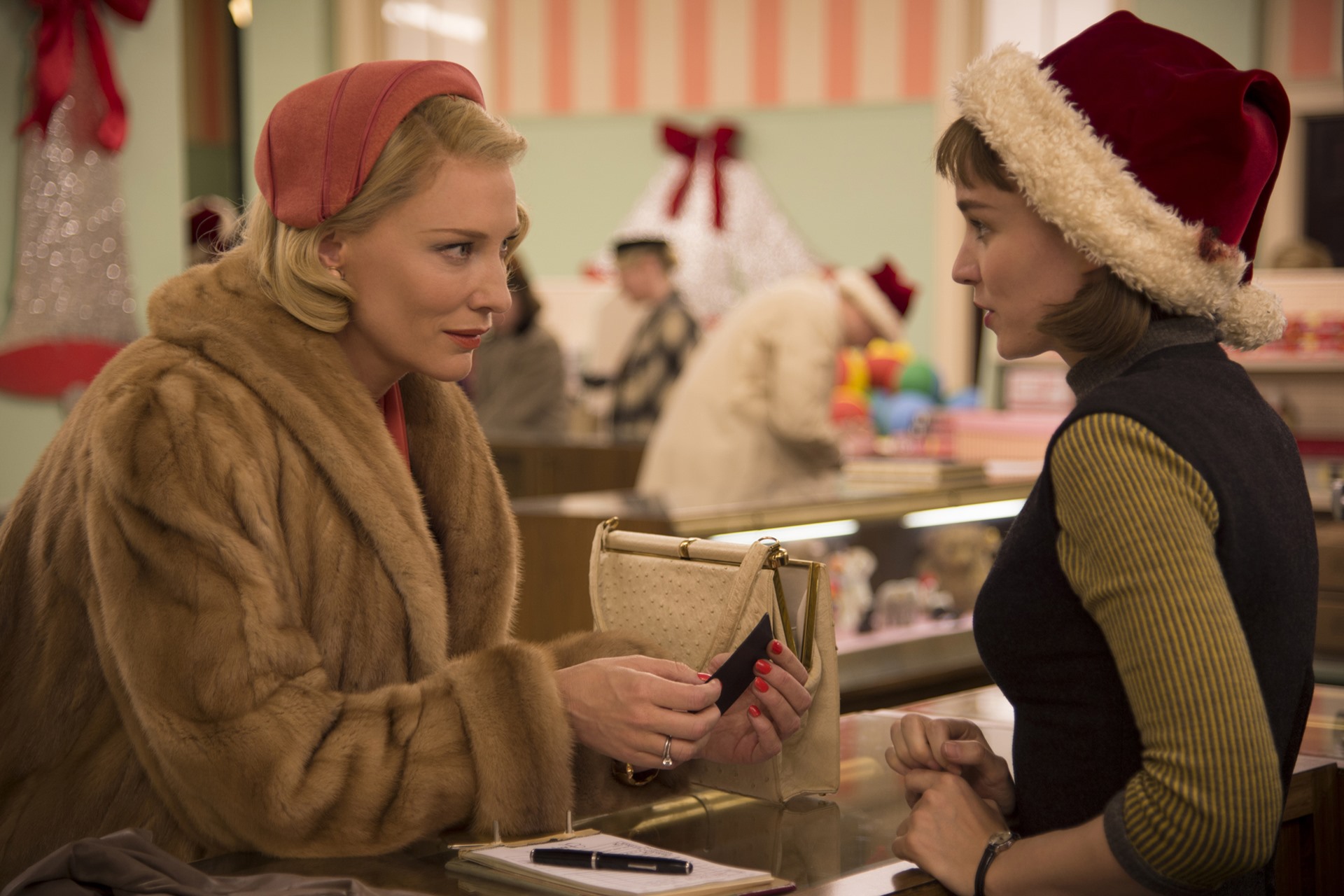
Carol
2015/ USA
Director: Todd Haynes
Starring: Cate Blanchett, Rooney Mara
Words: R. Topham
I saw ‘starring Cate Blanchett’ and was sold immediately. But labelling Carol Aird the ‘role of her career’ seemed somewhat of a grand statement following her unbelievable performance as the lead in Woody Allen’s Blue Jasmine. More than ten years after the initial screenplay was written, Carol has garnered universal praise, and, on this instance, you should believe the hype.
I had high hopes for Carol with regards to its adaptation of Patricia Highsmith’s semi-autobiographical book The Price of Salt, the angle being that it represents homosexuality and, of course, stars Blanchett. She is nothing less than exquisite as the title character, a chain-smoking, fragile and reserved woman who maintains a strong faith in love despite enduring a messy divorce from her husband resulting in the loss of custody of her beloved daughter. The first thing that catches my attention, aside from the realistic recreation of 1950s glamour which is bound to win awards, is the strange and distracting pout Rooney Mara’s character Therese sports. And not just when she meets Carol for the first time and they are both flagrantly smitten straight away. The pout is perpetual. This, and the inclusion of the phrase “Don’t be daft” (in the upper-class of 1950’s Manhattan? C’mon) are my only complaints.
Aesthetically, it’s a very elegant film; the Super 16mm film marries the cinematography with the makeup and costumes beautifully, and the composition of the camerawork is expertly executed. Likewise, the soundtrack is a pleasant succession of smooth jazz featuring the likes of Billie Holiday. It’s purposely an incredibly subtle film to exemplify the lovers inability to be overt with the nature of their attraction and relationship with one another; no lavish displays of affection or excessively saccharine declaration of uncontrollable lust. The script is in itself quite weak, but the simplicity of it enables the rigour of Blanchett and Mara’s performances to take centre stage and really shine through.
Director Todd Haynes and screenwriter Phyllis Nagy have adapted Highsmith’s original story to create a complex journey through sexuality and emotions. Therese’s initial besottedness with Carol is replaced by desire which is replaced by lust which is replaced by genuine adoration. To paraphrase Haynes himself, the paradigm of their relationship in terms of who’s the object and who’s the subject shifts as quickly as Carol’s marriage deteriorates. It’s a story that transcends the typical love-at-first-sight charade by incorporating real life dramas – the qualms aroused by the age difference between Therese and Carol, for instance – to successfully speak to a modern audience.
Maniac
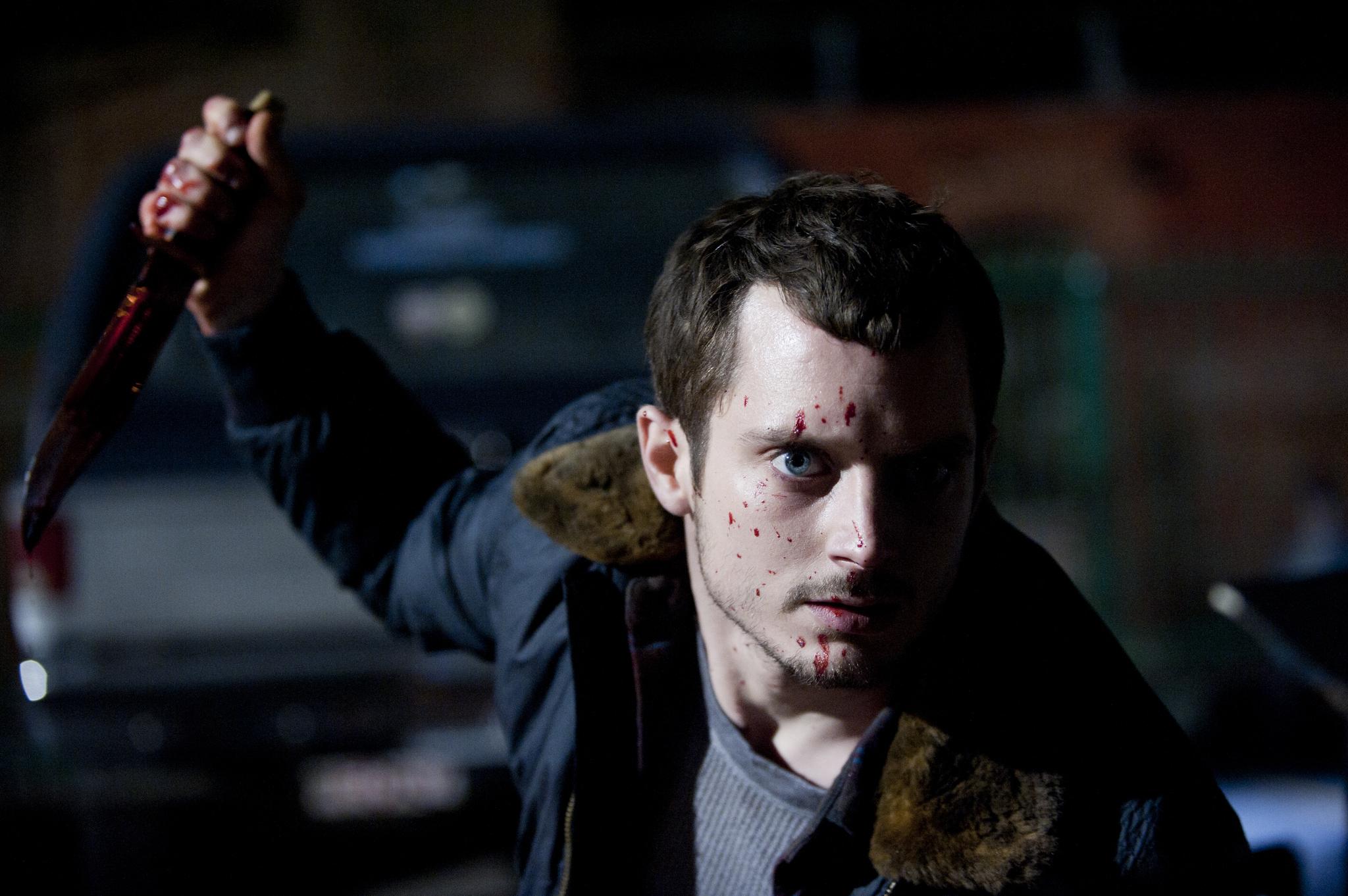
2012/ France, USA
Director: Franck Khalfoun
Starring: Elijah Wood, Nora Arnezeder, America Olivo
Words: O. Innocent
Let’s get this out of the way first; Franck Khalfoun’s Maniac (2012) isn’t as good as William Lustig’s 1980 original. It isn’t that the remake’s a bad film, it just doesn’t exude that same seedy, grime-ridden sickness that made the original such a notorious (it remained banned in the UK until only a few years ago) underground exploitation classic. But then again Khalfoun’s version isn’t going for grime, it’s going for a stylish, high gloss kind of sickness. Taking the same basic concept as the original Maniac – psychologically disturbed man with mother issues goes out at night to stalk and kill beautiful young women in order to cut their scalps off to adorn his mannequin collection – the remake then does something quite unexpected as it proceeds to fuse said concept with stylised, neon-drenched visuals and a pounding ‘80s style soundtrack more at home in Nicolas Winding Refn’s Drive (2011) than a horror film. Rather than clashing horrendously, this amalgamation of beauty and brutality works surprisingly well, going a long way to distance Maniac from its dank and gritty torture porn contemporaries as it showcases a visually stunning, almost arthouse homage to ‘80s slashers.
Perhaps the most striking aspect of Maniac’s embracing of experimentation is its use of first person POV. While it’s true that the killer’s POV shots are something of a prerequisite turned cliché when it comes to slasher films, Maniac does something genuinely new and exciting with the trope. In Maniac the whole film is almost exclusively seen from the killer’s point of view, creating a disturbing viewing experience as it explores the old adage that POV implicates us in the on-screen murders. However, by taking us even further into the killer’s world and his warped mind, we consequently get to know the character intimately which allows us to feel empathy for this ultimately pitiable character. Elijah Wood, far removed from his career defining role as The Lord of the Rings’ Frodo, here gives a chilling yet compelling performance as the killer who, despite the heinous acts he commits, you just can’t help feeling sorry for.
The film also benefits from a strong screenplay co-written by French filmmaker Alexandre Aja who has been responsible for some of the most exciting genre output of recent years with the likes of Switchblade Romance (2003) and The Hills Have Eyes (2006) remake pushing the genre into new territories of the extreme. Aja’s screenplay for Maniac also goes to extremes, but it also nicely balances the gore quotient with the psychological development of Wood’s character. Talking of gore, the remake certainly doesn’t skimp on the blood and guts with The Walking Dead’s effects masters, KNB providing practical effects that are so well done they are absolutely sickening. Rounded off by Rob’s amazing, menacing synthesiser score, Maniac, while not the immediate exploitation classic its predecessor was, is still a fascinating, visually striking and viscerally exhilarating slice of modern horror cinema.
 REEL STEEL
You must be logged in to post a comment.