Wuthering Heights (2026)
2026
Director: Emerald Fennell
Cast: Margot Robbie, Jacob Elordi, Hong Chau, Shazad Latif, Alison Oliver, Ewan Mitchell, Amy Morgan, Charlotte Mellington, Owen Cooper, Vy Nguyen, Paul Rhys
Words – Carly Stevenson.
Emerald Fennell’s highly contentious reimagining of Emily Brontë’s novel sparked heated online debate long before its theatrical release, and the discourse has only intensified in the wake of a successful opening weekend. However, despite performing well at the box office, “Wuthering Heights” has received a torrent of hostile reviews from critics and cinema-goers alike. While some of Fennell’s choices are certainly questionable (most notably, the whitewashing of Heathcliff), there is much to admire in this idiosyncratic fever dream of a film.
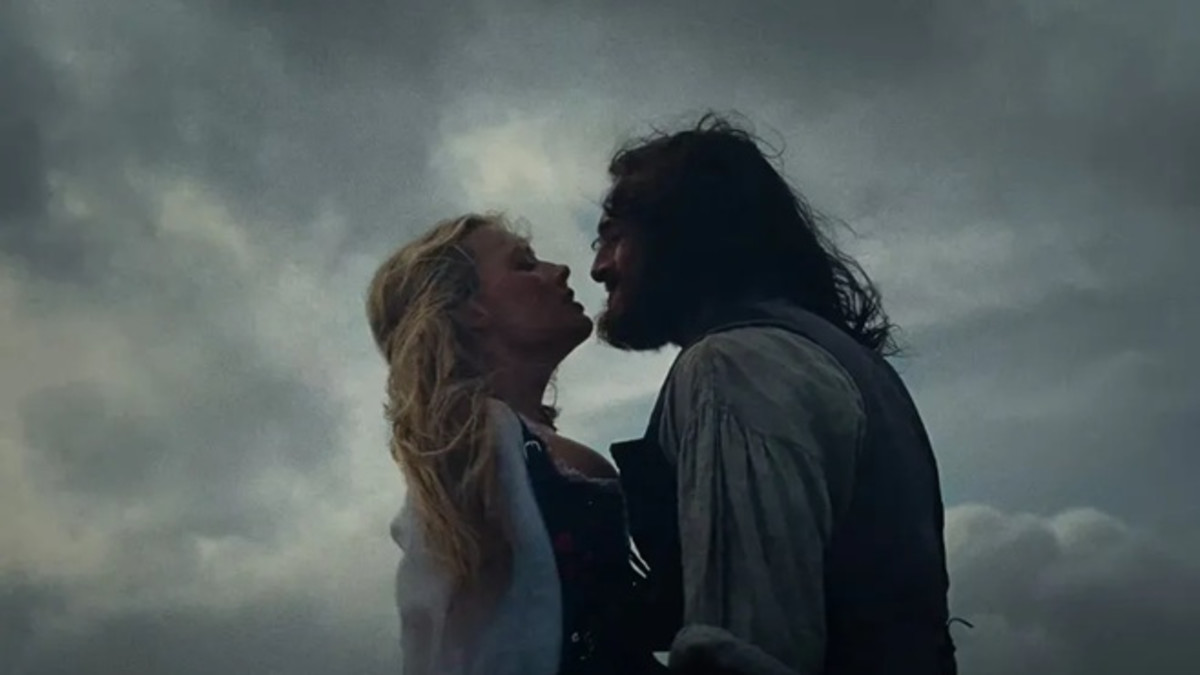
Linus Sandgren’s cinematography captures the gothic setting with painterly prowess – especially in the shots of the titular house flanked by jagged rocks – and the anachronistic costumes look like a haute couture collection inspired by Tim Burton. Andy Gent’s stop motion title sequence featuring intertwined tendrils of hair (a nod to Cathy’s locket in the novel) is a particularly nice touch. With its striking visuals and Charli xcx’s haunting, atmospheric soundtrack, you would be forgiven for thinking “Wuthering Heights” is closer to a music video than a feature film. Style over substance? Probably. But it’s hardly the only adaptation guilty of this. Robert Eggers’s Nosferatu (2024) – a remake of an adaptation of Dracula – springs to mind. Whether you love or loathe “Wuthering Heights”, I think it’s fair to say that Fennell is being held to a different standard compared with her male counterparts.
The most common criticism of Fennell’s adaptation is that she completely ignores the issues of race and class, which are as fundamental to the plot as they are to Heathcliff’s character development. Yet, perhaps we should be relieved that she decided to ‘stay in her lane’. Someone as privileged as Fennell can have little to say about the impact of poverty and discrimination on a person’s psyche. While casting a white actor (Elordi) to portray a racially ambiguous character is indefensible, I think it’s important to note that Heathcliff’s behaviour in the novel reinforces racist stereotypes held by many readers at the time. As in Shakespeare’s Othello, characters insinuate that Heathcliff acts the way that he does because of his race. If Fennell had cast a person of colour as Heathcliff in this highly eroticised adaptation, the optics might have been uncomfortable. Consider the implications of presenting a modern audience with a ‘wild’, ‘uncivilised’, violent, libidinous, obsessive, jealous, vengeful outsider who seduces a married white woman. A different director could navigate this issue with tact and nuance, but it’s beyond Fennell’s purview.
In interviews, Fennell has said that she wanted to distill the feeling she had when she read the novel as a teenager. Viewing the film through this lens allows us to appraise it for what it is: a personal, emotional response to the story that leans heavily on wish-fulfilment. Rather than trying to encompass every theme in the novel, Fennell hones in on one particular aspect – the masochistic nature of the central character’s relationships – and runs with it. The bold choice to emphasise the latent eroticism of the novel at the expense of other themes has proved divisive, but at least Fennell has tried to do something different to previous adaptations.
In Fennell’s own words, “Wuthering Heights” (stylised in quotation marks) is a sister or cousin to the original text, not a twin (paraphrased from an interview with Fennell on the Ask Penguin podcast). As such, it takes significant liberties with the source material, but this is also true of Francis Ford Coppola’s Bram Stoker’s Dracula (1992) and Guillermo del Toro’s Frankenstein (2025). Both Coppola and del Toro bring romance to the forefront in their adaptations, but somehow it’s ‘astonishingly bad’ when Fennell does the same (The Independent).
For all its provocation, “Wuthering Heights” is less transgressive than the 1847 novel it is based on. This is partly because the main characters have been defanged, presumably with the intention of eliciting our sympathy. But if you take the cruelty out of a story like Wuthering Heights, what are we left with? This film gives us the answer.
–
–
 REEL STEEL